الأربعاء، 7 أبريل 2021

The 150 Year History of Muni’s ‘Newest’ Route: The 15

The 150 Year History of Muni’s ‘Newest’ Route: The 15
By Jeremy Menzies

With the return of Muni’s 15 route earlier this year as the 15 Bayview Hunters Point Express, here’s a quick look back at a line that traces part of its lineage back over 150 years.
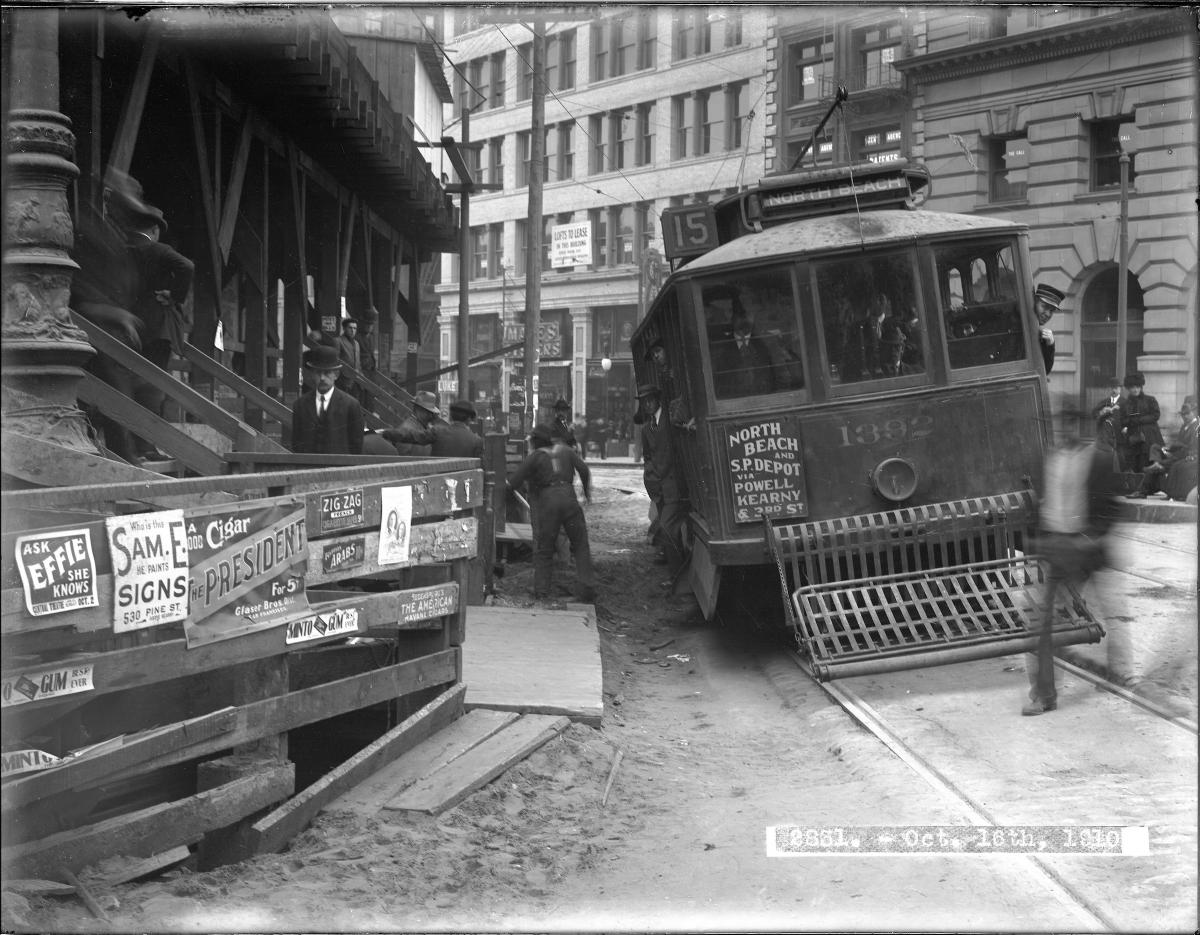
A 15 3rd & Kearny streetcar picks its way through a crowded downtown scene in this 1910 photo.

A 15 3rd & Kearny streetcar picks its way through a crowded downtown scene in this 1910 photo.

In the mid-1800s people began travelling San Francisco’s 3rd Street corridor by stagecoach and horse-drawn streetcars. At the turn of the 20th century, horse car service gave way to electric streetcars, with three lines eventually sharing the work of serving 3rd Street from north to south. Operated by the United Railroads Company, the combined service of the 15 Kearny & North Beach, 16 3rd & Kearny, and 29 3rd & Sansome lines ran from North Beach all the way to the county line in Visitacion Valley.
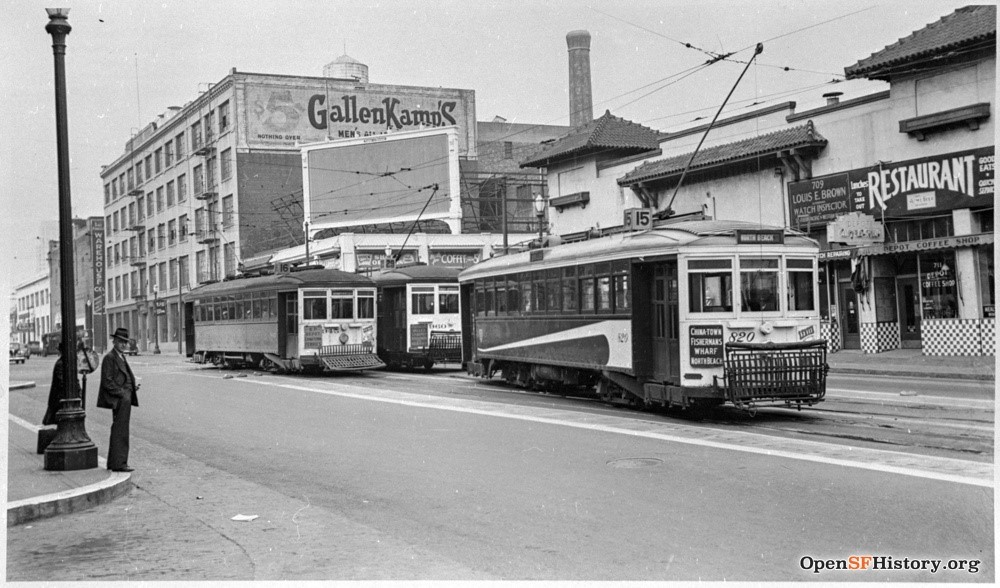
A photo from OpenSFHistory.org showing the 15, 16, and 29 Streetcars outside the Southern Pacific Railroad Depot in 1940, shortly before streetcar service would be replaced with buses.

A photo from OpenSFHistory.org showing the 15, 16, and 29 Streetcars outside the Southern Pacific Railroad Depot in 1940, shortly before streetcar service would be replaced with buses.

In the 1940s, streetcar service was replaced by buses that combined multiple lines into one route.  Like their streetcar predecessors, the buses stopped at key locations along 3rd Street, including the factories in Dogpatch, Southern Pacific Railroad Depot (now 4th & King Caltrain), downtown commercial district, Market Street transit lines and the docks in the North Beach area. 
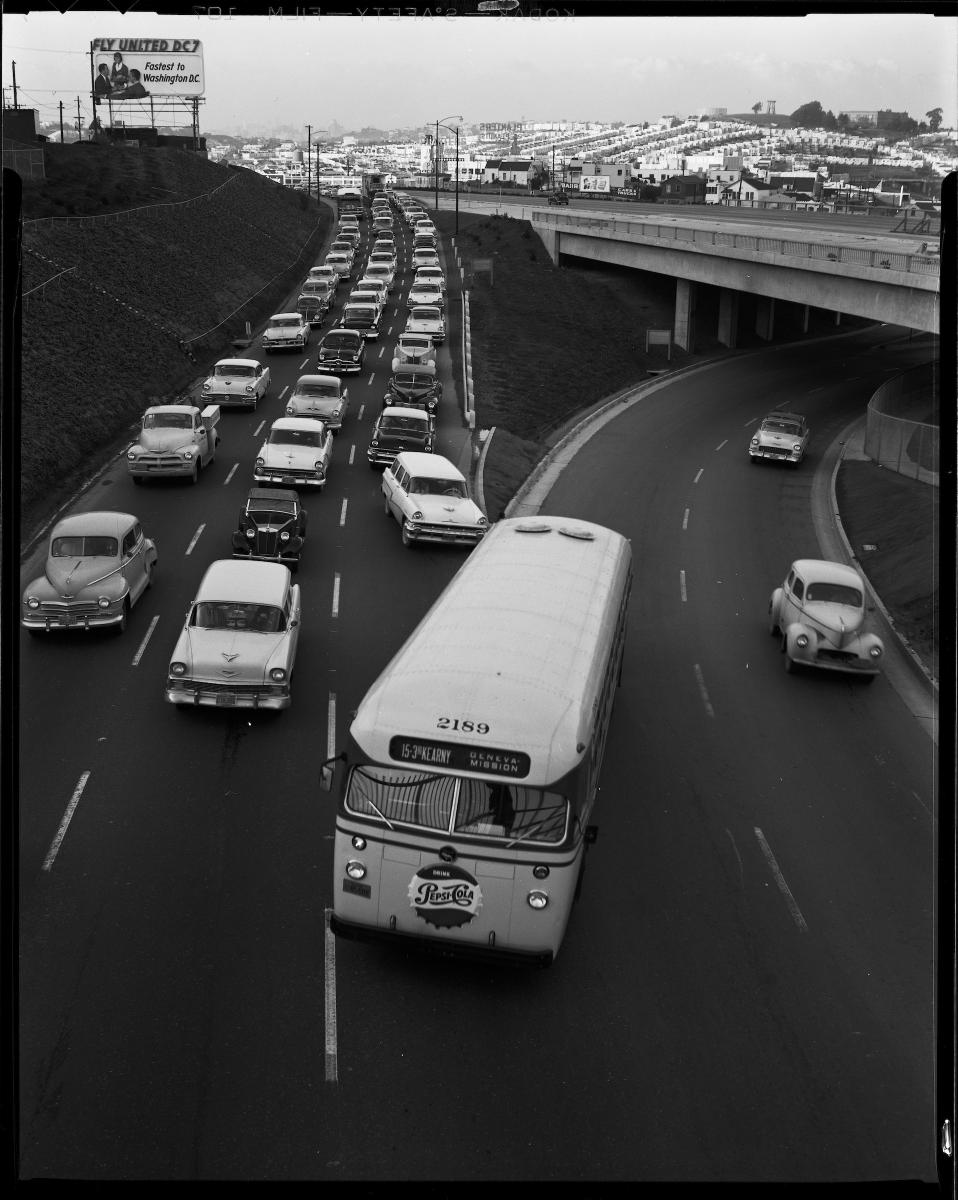
A Muni 15 3rd & Kearny bus makes a lane change on San Bruno & Harkness avenues in this 1957 photo.

A Muni 15 3rd & Kearny bus makes a lane change on San Bruno & Harkness avenues in this 1957 photo.

As the years passed and the city changed, the 15 changed with it, serving different terminals depending on where passengers need to go.  Eventually this expansion led it to become one of Muni’s longest routes, running 11 miles from North Beach all the way to City College. The 15 Third was discontinued in 2007,  after over 60 years of service, when it was replaced by the T Third rail line on Third Street and by a rerouting of the 9x and 9AX routes north of Market Street.
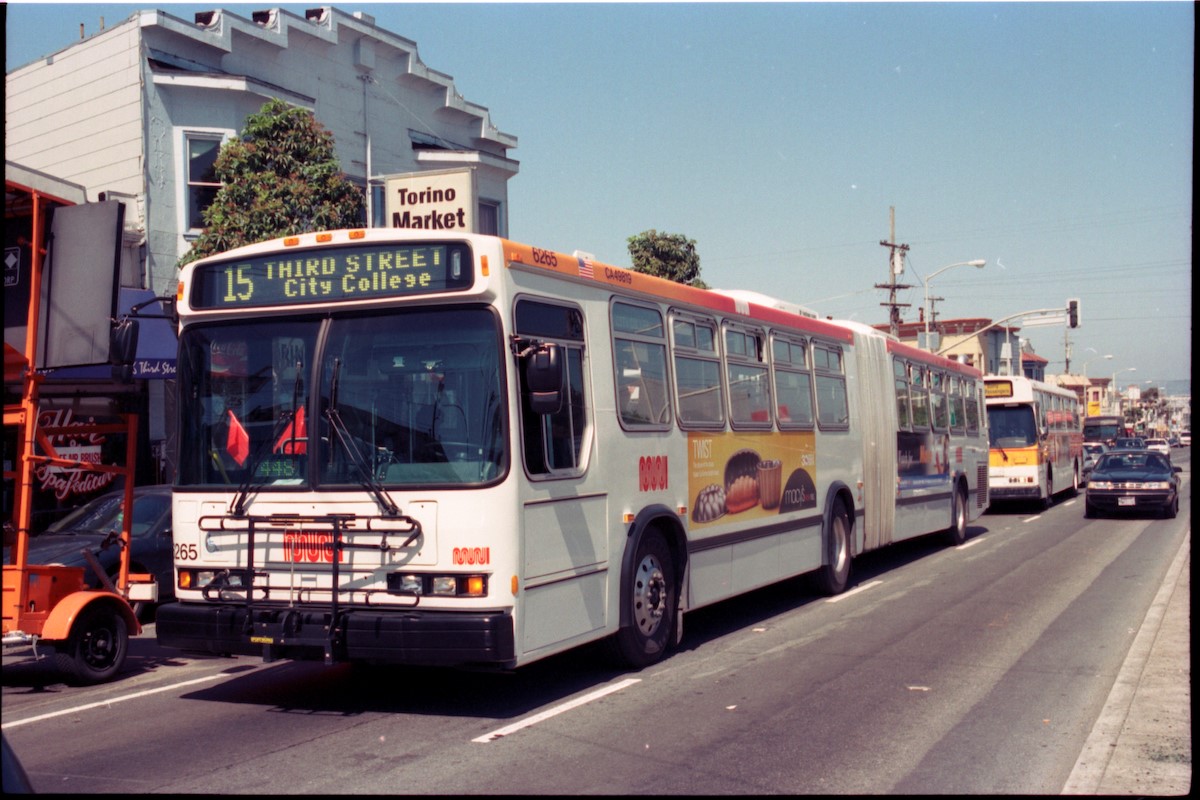
A 15 Third Street coach passes Torino Market at 3rd and Palou on its way out to City College in 2002.

A 15 Third Street coach passes Torino Market at 3rd and Palou on its way out to City College in 2002.

Rapid growth in Mission Bay in recent years has resulted in changing needs for people who travel to and through this corridor. So San Francisco residents began advocating for additional service, particularly through the Southeast Muni Expansion Project in 2018.  Based on public input, that project prioritized a more direct trip to downtown from the Bayview. Responding to these concerns, we established the “new” 15 Bayview Hunters Point Express in January 2021.
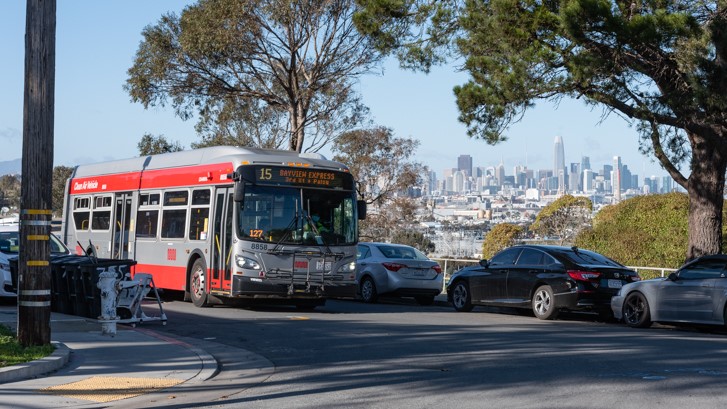
A 15 Bayview Hunters Point Express coach passes a city vista along Jerrold Ave in the Hunter’s Point neighborhood on January 25, 2021.

A 15 Bayview Hunters Point Express coach passes a city vista along Jerrold Ave in the Hunter’s Point neighborhood on January 25, 2021.

Starting out in Hunter’s Point and traveling to the transit hub at 3rd and Palou, the “new” 15 takes riders to locations within the neighborhood and then makes limited express stops to downtown and regional transit connections. The 15 Bayview Hunters Point Express route provides some of the same north-south connections as the original stagecoach and horse car lines back in the mid-1800s.  Just like its predecessors, it builds on a core 3rd Street service and offers a transportation option that seeks to meet the needs of today’s residents. 


Published April 08, 2021 at 03:18AM
https://ift.tt/3t1GUMa

الاثنين، 5 أبريل 2021

Muni Subway Gets Green Light and Wi-Fi!

Muni Subway Gets Green Light and Wi-Fi!
By Mariana Maguire

The recent wave of major subway repairs is finally wrapping up and customers can expect smoother, more reliable rides when Muni Metro reopens. New wayfinding signs and art projects are in place at Castro and West Portal stations, and – drumroll, please – Wi-Fi availability, thanks to routers being installed in stations and cellular antennas being installed in the tunnels. Safety certification for the subway repairs was approved on March 11, paving the way to reopen the subway and phase in more rail service in May. Soon, you’ll be able to let your loved ones know you’re on your way even when you’re underground.

Our staff used this rare extended subway shutdown as an opportunity to accelerate other upgrades and necessary maintenance work, by packaging them with subway repairs to maximize results. During normal service, subway maintenance crews can only work within the few hours a day when trains are not running.

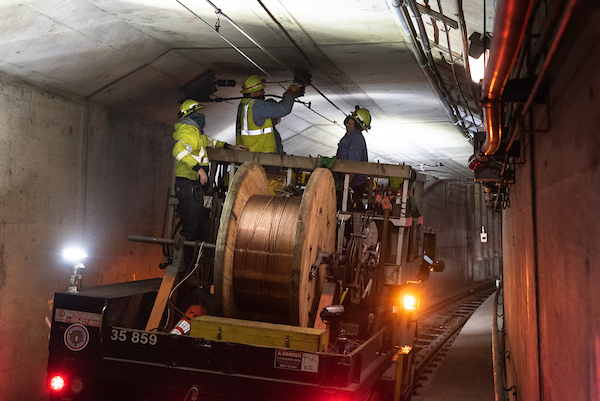
Photo of crew installing overhead wire in the subway tunnel

SFMTA crew installing new overhead wire in the subway tunnel

The work we completed during the pandemic provides significant customer improvements, including a quicker ride, the convenience of Wi-Fi and fewer breakdowns in the tunnel. This work represents an important downpayment on a larger set of deferred capital needs including replacement of the train control system, track replacement between Castro and Embarcadero and upgrades to the subway and station support systems, such as station electrical panels and fan systems. We’ve also been able to train additional crew members in tunnel operations and maintenance.

One of the last and key steps in finishing repairs and reopening the subway is safety testing and certification. The SFMTA is testing the track, signal system and overhead wires to ensure they are functioning properly and meet safety standards. We’re also tested our train control system to ensure it is in proper working order. The train control system is a crucial part of subway safety and operation, overseeing all of our trains in the tunnel and directing them to the right places.

Other important repairs and improvements included:

Track grinding: Just as it sounds, our track maintenance crews grind the track to smooth it out. Like a freshly repaved roadway, track grinding provides a smoother, quieter ride with less wear and tear to vehicles. This work had been in the queue for a while but was deferred because it requires service to be shut down and takes many hours. We were able to take advantage of the extended shut down to finally undertake this vital improvement.

Tunnel lighting: Our subway maintenance staff replaced the lights inside the tunnels between Castro and Van Ness stations and are completing installation of new tunnel lighting between Embarcadero and Montgomery stations. These lights are vital for train operators to see potential hazards. They are also necessary for visibility in emergencies. The previous lights were 50 years old and dim, creating safety concerns. While customers might not notice these new tunnel lights, this important safety upgrade will nevertheless make their trips safer.

Signs: We are also installing new wayfinding and directional signs at Castro and Church stations--part of a larger effort to improve wayfinding throughout the Muni Metro system. This includes upgrading the wayfinding signs inside stations that point customers to stairwells, elevators and escalators, and indicate where they lead. New station identification signs will also let you know where you are when your train pulls into one of these stations. All these new signs will be brighter and more visible with LED technology.

With this new signage, we are moving away from the confusing and outdated use of “inbound” and “outbound” wording in the subway. Instead, we will use a combination of route end points and cardinal directions (north, south, east, west), that are easier for customers to navigate and consistent with rail systems and stations in most major cities worldwide. As an example, that means if you are taking the N Judah at Powell Station and your destination is in the Sunset, you will look for signs for trains going to “Ocean Beach/Westbound” because Ocean Beach is the final destination west on the route.

Public art: When entering or exiting Muni Metro at Castro or West Portal, you will also see brand new, beautiful artwork on our accessible bus platforms at street level.

With the reopening of the subway, we will continue to gradually phase back Muni Metro rail by extending the T Third Metro to West Portal and bringing back the N Judah Metro rail between Ocean Beach and 4th and King. We expect these service changes to take place in May and we will share additional details as they become available.


Published April 05, 2021 at 10:26PM
https://ift.tt/3sNtt2p

الثلاثاء، 30 مارس 2021

Muni’s Equity Toolkit Helps Essential Employees Get to Work

Muni’s Equity Toolkit Helps Essential Employees Get to Work
By Mariana Maguire

The latest data from SFMTA’s new Equity Toolkit shows that Muni service changes are helping people in neighborhoods identified by our Muni Service Equity Strategy access more jobs and support the city’s recovery.  

In winter 2020, we launched the SFMTA Equity Toolkit to understand how service decisions are affecting neighborhoods where there is likely a high prevalence of essential workers who rely predominantly on Muni to get to their essential jobs. Our goal is to make better service decisions based on the trends and impacts we see in the Equity Toolkit.  

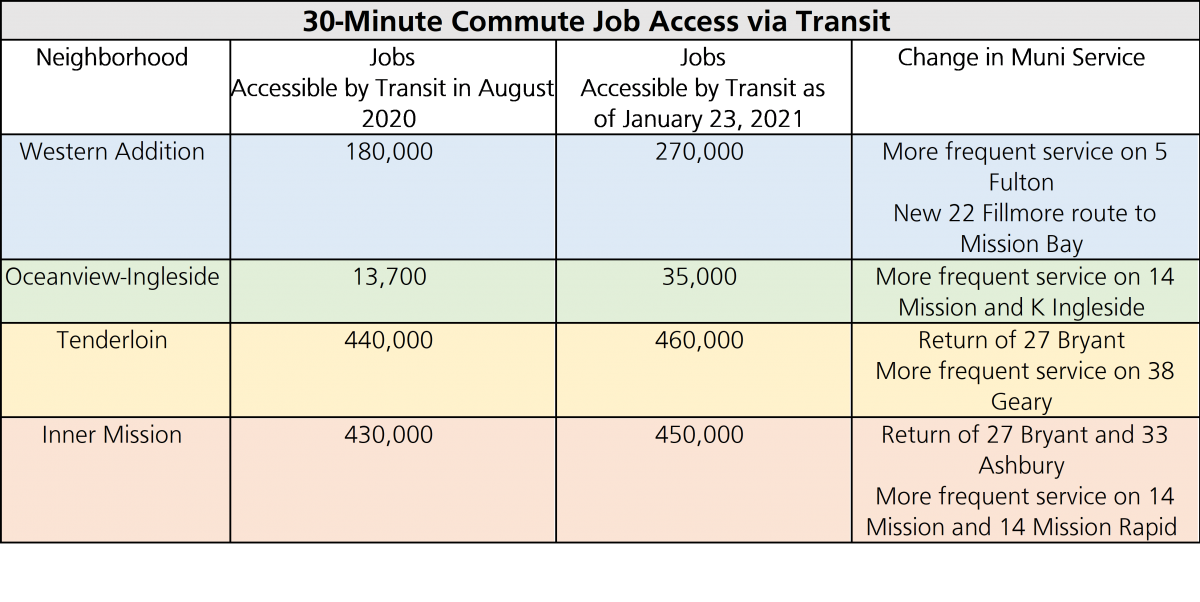
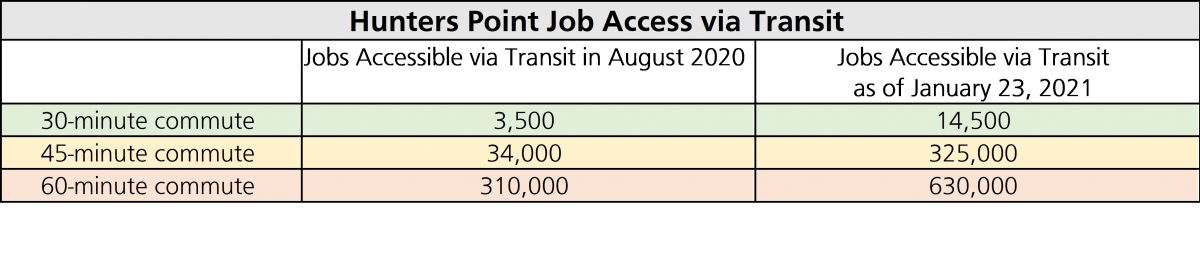
Recently, the greatest increases in access to jobs via Muni have been in Hunters Point and Western Addition. The Hunters Point neighborhood saw the largest gains from the addition of the 15 Bayview-Hunters Point Express, as demonstrated in the table below. Thanks to the return of key Muni lines and increased frequencies on connector routes, Inner Mission, Tenderloin, Oceanview-Ingleside and Treasure Island have also seen increased access to jobs via Muni.  

Table title: "30-Minute Commute Job Access via Transit" First row, left to right: column 1 is "Neighborhood", column 2 is "Jobs Accessible by Transit in August 2020", column 3 is "Jobs Accessible by Transit as of January 23, 2021", column 4 is "Change in Muni Service" Second row, left to right: column 1 is "Western Addition", column 2 is "180,000", column 3 is "270,000", column 4 is "More frequent service on 5 Fulton, New 22 Fillmore route to Mission Bay" Third row, left to right: column 1 is "Oceanview-Ingleside", column 2 is "13,700", column 3 is "35,000", column 4 is "More frequent service on 14 Mission and K Ingleside" Fourth row, left to right: column 1 is "Tenderloin", column 2 is "440,000", column 3 is "460,000", column 4 is "Return of 27 Bryant, More frequent service on 38 Geary" Fifth row, left to right: column 1 is "Inner Mission" column 2 is "430,000", column 3 is "450,000", column 4 is "Return of 27 Bryant and 33 Ashbury, More frequent service on 14 Mission and 14 Mission Rapid"

Table title: Hunters Point Job Access via Transit First row, left to right: column 1 is blank, column 2 is "Jobs Accessible via Transit in August 2020", column 3 is "Jobs Accessible via Transit as of January 23, 2021" Second row, left to right: column 1 is "30-minute commute", column 2 is "3,500", column 3 is "14,50o" Third row, left to right: column 1 is "45-minute commute", column 2 is "34,000", column 3 is "325,000" Fourth row, left to right: column 1 is "60-minute commute", column 2 is "310,000", column 3 is "630,000"

Lessons Learned 

The Equity Toolkit also shows some decreases in job access via transit in other neighborhoods identified by the Muni Service Equity Strategy. This reflects the Toolkit’s methodology and/or the impacts of service changes and helps us to understand where we need to make improvements in our data collection, transit service or both. 

Bayview job access increased for commutes of 45 and 60-minutes, but decreased 11% for 30-minute commutes. How can that be? The answer is that the T Third bus substitution was replaced with rail service in December 2020, which makes different and fewer stops than the bus within a 30-minute time period. Overall, Bayview residents are still able to access more jobs now than in August 2020 – roughly 644,500 now compared to 624,000 then, a 3% increase. 

In addition, we rely on fixed points of reference, such as the Bayview Opera House, to gather data and Bayview is a large neighborhood. We learned that using one community landmark for this area is not enough, so we will be adding additional landmarks in future analyses to more accurately capture service change impacts. 

In Visitacion Valley we see decreases in job access via transit across the board. Like in the Bayview, we determined that the issue is both methodology and service. When we redistributed buses from the 8 Bayshore to 8AX to respond to changes in ridership, the community landmark (John King Senior Community) we were using to track the data only showed us the decrease from the 8 Bayshore, not the increase from the 8AX. 

By comparison, more affluent areas show very low to no increases in job access via transit. This reflects our decision to prioritize resources on Muni service for essential workers and essential travel, especially for communities with the fewest options during this unprecedented pandemic. More affluent neighborhoods have more transportation alternatives readily available and more people who are able to work from home. 

These findings give us insights we didn’t have before and help us think about service in new ways. As we learn from the Equity Toolkit we will continue to refine it and make it more detailed by adding more reference points for our data analysis.  

As San Francisco gradually reopens and we continue to add back Muni service, we will also continue to evaluate the impacts through our Equity Toolkit and work to use these insights to inform service adjustments that support our city’s economic recovery. 

Read more about changes to our network on the SFMTA’s Transportation Recovery Plan webpage


Published March 30, 2021 at 07:33PM
https://ift.tt/2PkupwH

الاثنين، 29 مارس 2021

SFMTA’s Cable Car Signal Tower Gets a Refresh

SFMTA’s Cable Car Signal Tower Gets a Refresh
By Jeremy Menzies

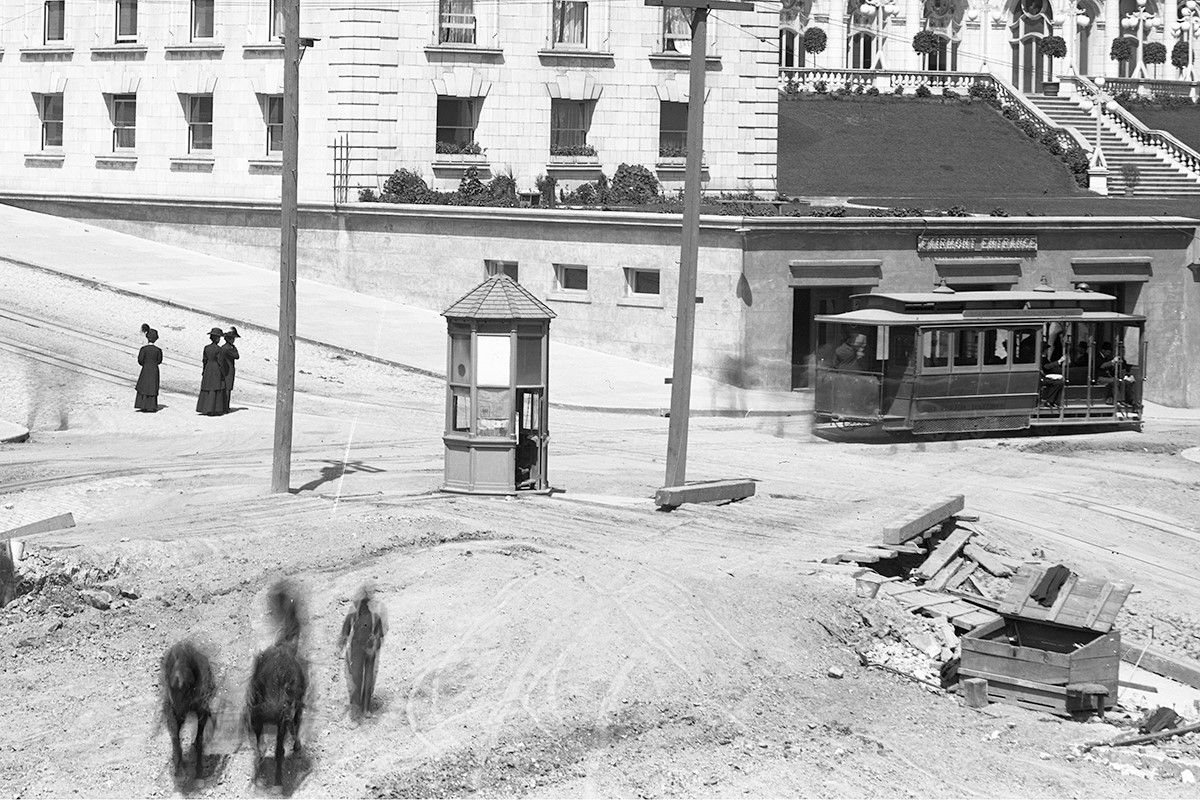
At the corner of California and Powell Streets stands a diminutive but important building that has been in use for well over 100 years. This octagonal signal tower controls the crossing of the Powell and California Street cable car lines, and recently underwent a full restoration thanks to the skilled craftspeople at the Cable Car Division.

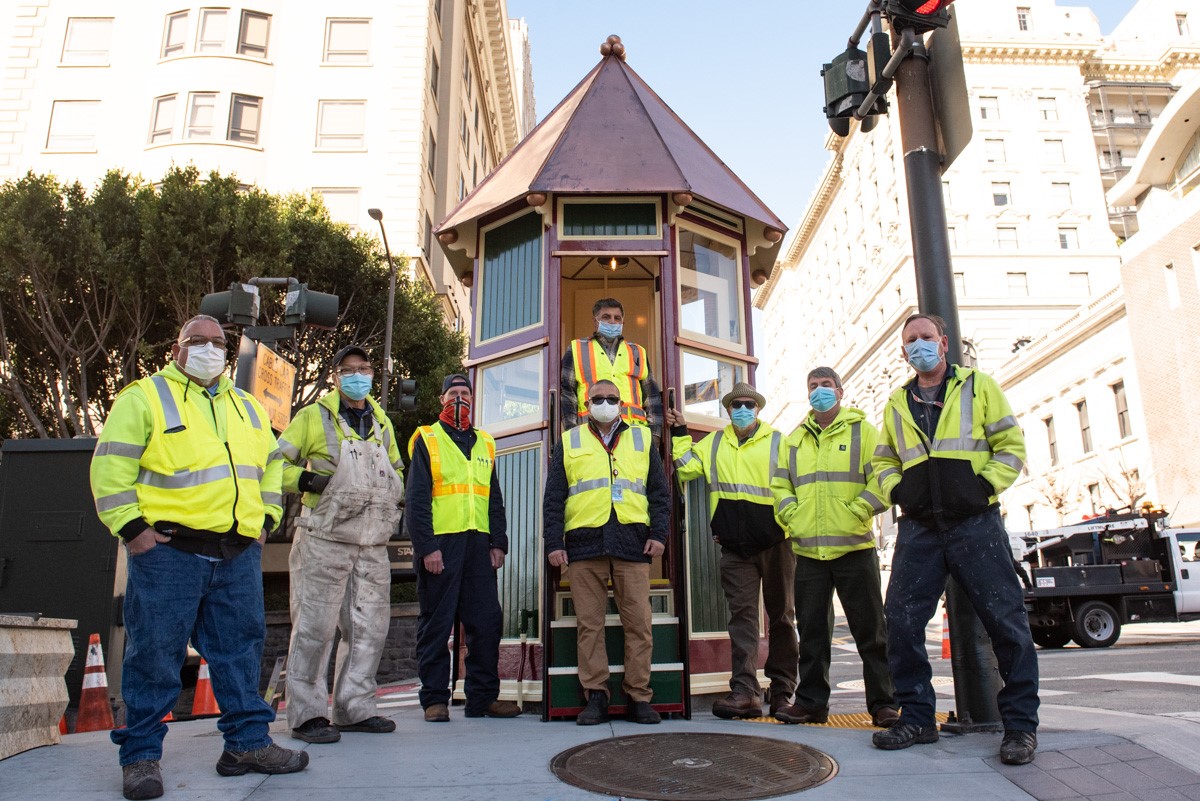
A group photo of Muni craftspeople and shop management who worked to restore the signal tower in 2020-2021.

A group photo of Muni craftspeople and shop management who worked to restore the signal tower in 2020-2021.

The tower’s history dates to 1888 when the original was built by the Ferries and Cliff House Railroad, which operated cable cars on Powell Street at the time. That tower was destroyed in the 1906 earthquake and fires that ravaged Nob Hill. In March 1907, it was rebuilt by then-owner United Railroads of San Francisco (URR) and went back into operation.

Photo showing signal tower in 1908 with the Fairmont Hotel and passengers waiting for a cable car in the background. Photo courtesy OpenSFHistory.org.

Photo showing signal tower in 1908 with the Fairmont Hotel and passengers waiting for a cable car in the background. Photo courtesy OpenSFHistory.org.

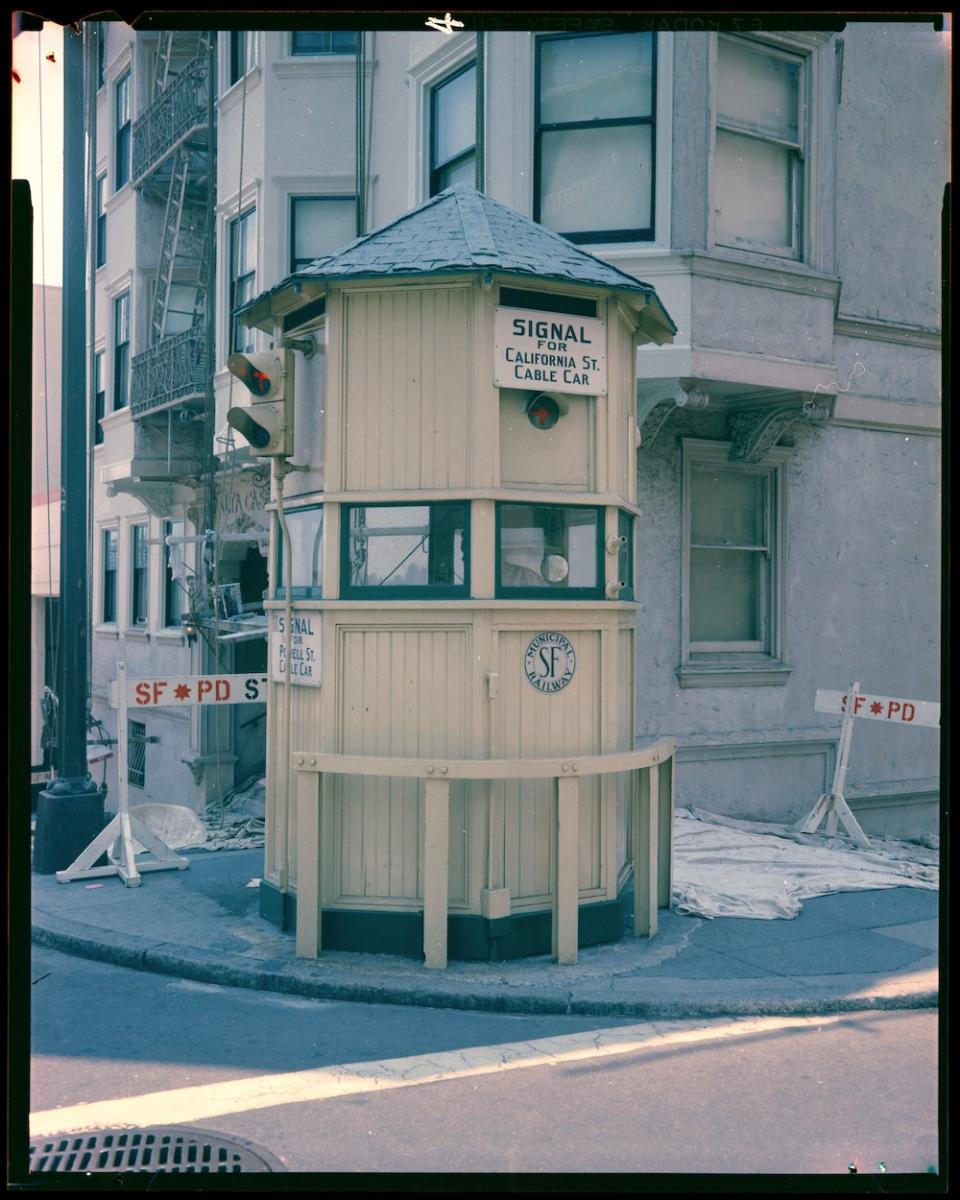
In 1935, a runaway automobile on California Street struck the tower, causing severe damage and tragically killing the signal operator inside. The tower was subsequently rebuilt, and a heavy metal barrier was installed on its west side.

This 1966 photo shows the west-facing side of the tower, painted in green and cream, shortly before paint and repairs were done on the building.

This 1966 photo shows the west-facing side of the tower, painted in green and cream, shortly before paint and repairs were done on the building.

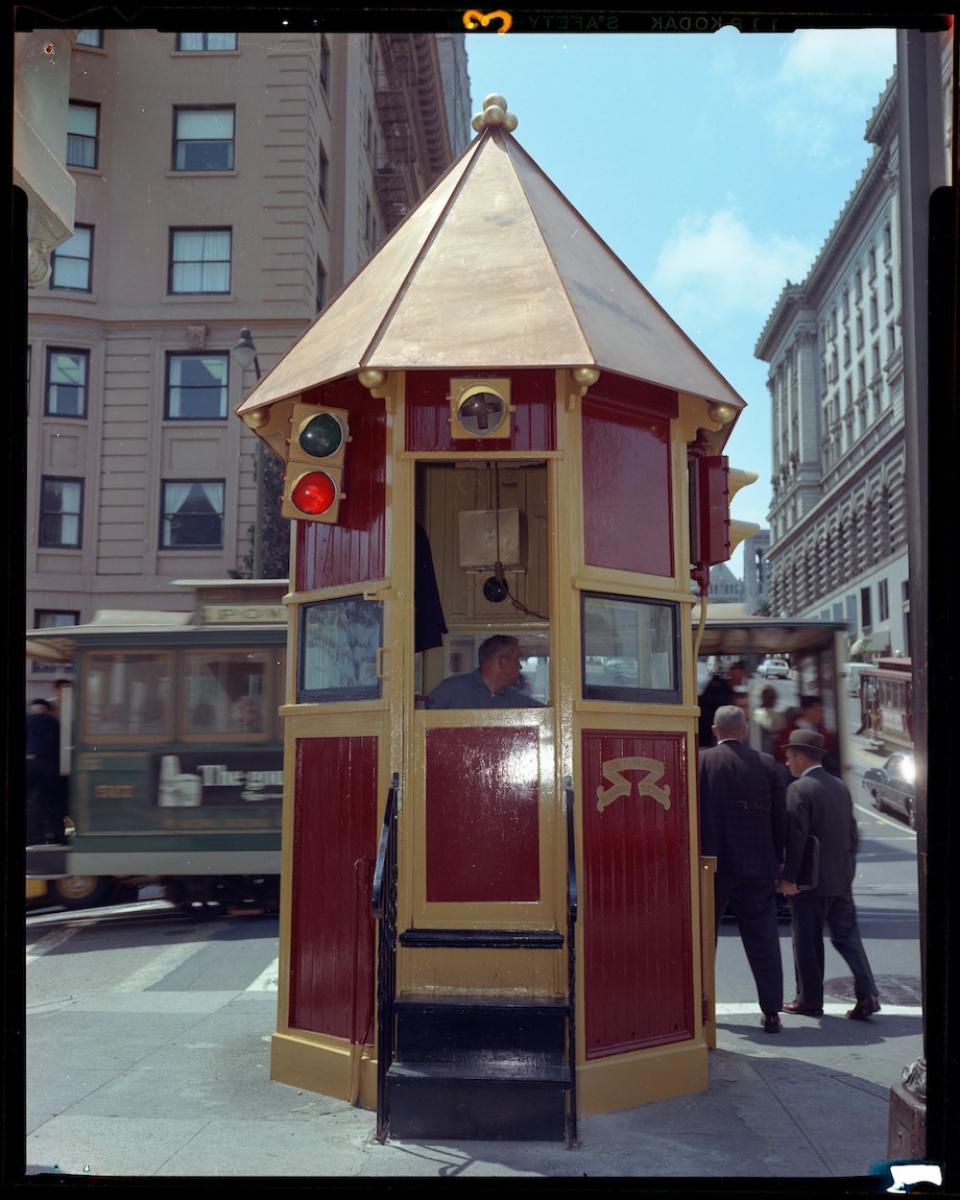
The next major change came in 1967 when the tower was renovated and a new copper roof was installed. The structure was also repainted to reflect the maroon and tan color scheme of the California Street cable cars. Until 1982, the tower retained its manually-operated kerosene lantern signals originally installed in 1907.

A 1967 photo showing the newly repainted and copper-roofed signal tower.

A 1967 photo showing the newly repainted and copper-roofed signal tower.

The suspension of cable car service during the Covid-19 pandemic proved an opportune time to give the little signal tower some much needed T-L-C.  During 2020 and early 2021, SFMTA carpenters, painters, metal workers and mechanics undertook a complete overhaul of the building. A new floor, roof, ceiling, door, windows, steps, heating, lighting and electrical system were all built and installed.

As with our world-renowned cable cars, no detail was overlooked during the tower rebuild. Muni carpenters repaired woodwork throughout, custom-building both the octagonal ceiling and split Dutch door. Paint crews highlighted each element of the tower with colors that enhance the structure’s overall visual appeal. Our expert mechanics installed new electrical systems. Even the grab handles and handrails for the steps were custom built from materials that are also used on Powell Street cable cars by skilled metalworkers at the SFMTA’s Special Machine Shop. A final step in this rebuild will be the installation of new signals before the tower goes back into operation later this year.

Check out the gallery below showing photos of the tower through the years and the recent restoration.


Published March 29, 2021 at 11:10PM
https://ift.tt/3m39I4d

الجمعة، 26 مارس 2021

Better Connections from Bayview and Hunters Point to Downtown

Better Connections from Bayview and Hunters Point to Downtown
By Enrique Aguilar

To better connect southeast San Franciscans with downtown, the SFMTA debuted the 15 Bayview Hunters-Point Express in late January, coinciding with the return of T Third train service. Within weeks, average daily boardings reached 1,000 customers on this new service.

Photo of 15 Bayview Hunters Point Express bus

The 15 Bayview Hunters Point Express 

We added this route based on community feedback from the Southeast Muni Expansion Project in 2018, which prioritized a more direct trip to downtown from the Bayview. With the sudden rise of the COVID-19 pandemic and its disproportionate impacts on communities in the Bayview and Hunters Point, fast-tracking the project became critical to our transit planning. Adding service capacity and a direct connection between these neighborhoods and downtown is a crucial step in supporting the City’s economic recovery and increasing job access for essential workers using transit.

Using data from the SFMTA Equity Toolkit, staff determined that the addition of the 15 Bayview Hunters Point Express in the January 23 service changes resulted in the largest increase in job access for 45- and 60-minute commutes of any San Francisco neighborhood.

The SFMTA convened the Bayview Hunters-Point Express Working Group, comprised of community leaders who helped shaped the conversation on route options. Then, at a time when pandemic precautions precluded in-person community outreach, we invited all area residents to vote for their preferred route through both an online and text-based survey.

After months of planning and continuous support from the Bayview Hunters-Point Express Working Group, we were able to implement a route that offers service closer to residents’ homes and make trips shorter for community members.

“We appreciate the community process and approach SFMTA took to reinstate the 15 Bayview Hunters Point Express,” said Lyslynn Lacoste, Executive Director at Bayview Hunters Point Mobilization for Adolescent Growth in our Communities (BMAGIC) and working group member. “Particularly identifying and prioritizing those that are most isolated in the Bayview community and ensuring that they have efficient access to the public transportation line extending to downtown. I look forward to personally utilizing [it] myself as I travel from the downtown area to my office in the Bayview.”

While in-person outreach remains limited due to COVID-19 physical distancing guidelines, SFMTA staff continue to engage community residents and leaders in order to evaluate the service and gather feedback. Discussions with the working group on the initial impact of the service began earlier this week. In mid-March, project staff also distributed handouts to customers of the 15 Bayview Hunters Point Express waiting at bus stops and onboard when riding between downtown and the Bayview. Posters were also placed in businesses along Third Street in the Bayview.

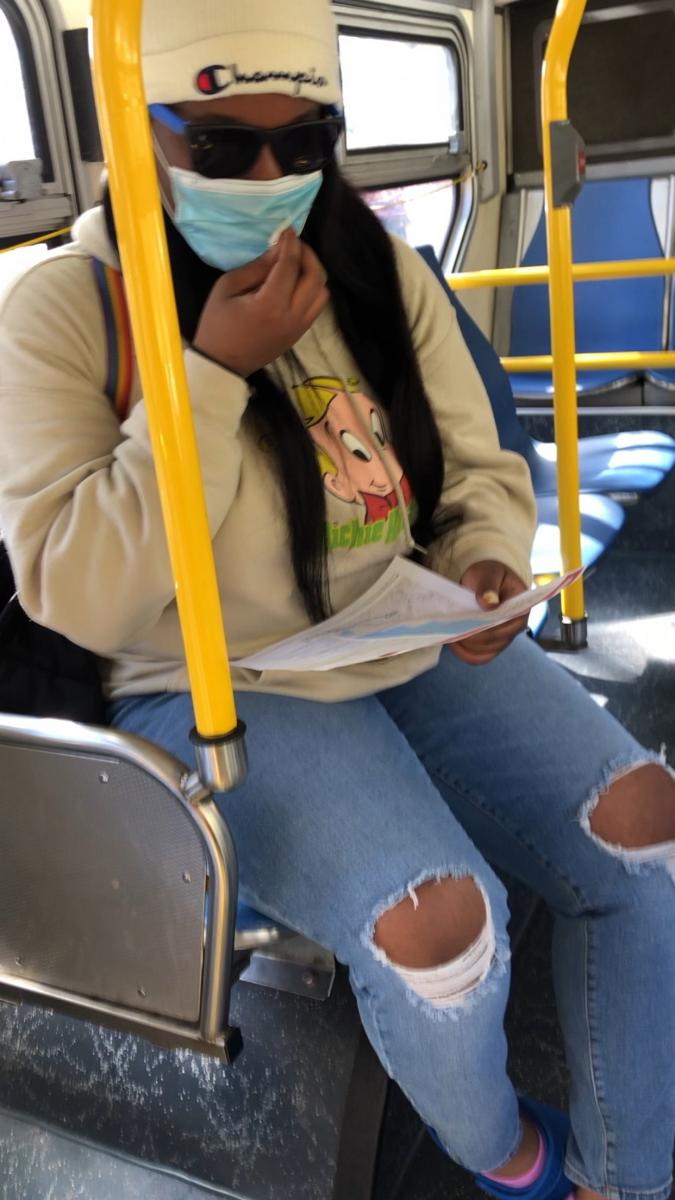
Muni customer reading handout provided by SFMTA staff

Muni customer reading handout provided by SFMTA staff

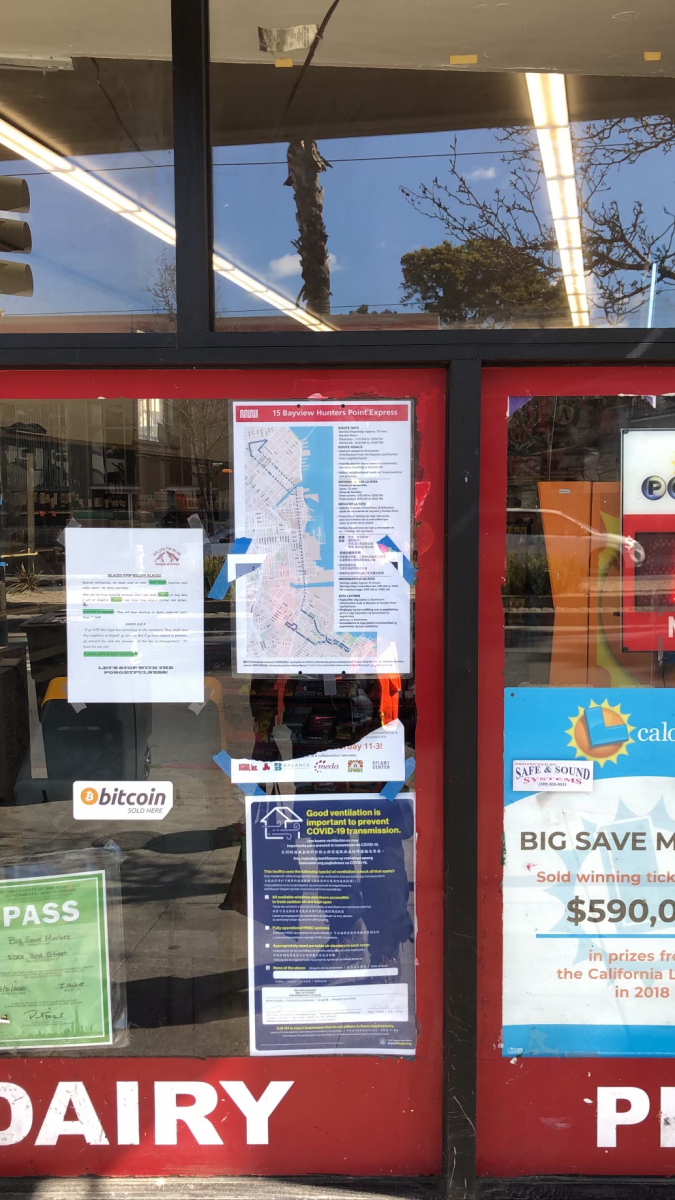
15 Bayview Hunters Point Express signs were posted at businesses along Third Street

15 Bayview Hunters Point Express signs were posted at businesses along Third Street

Community members are encouraged to provide comments on the 15 Bayview Hunters-Point Express by completing the online Muni feedback form.


Published March 26, 2021 at 04:27PM
https://ift.tt/3svsJig

الخميس، 25 مارس 2021

Hate is a Virus

Hate is a Virus
By

As a city we stand united against racism. While violence resulting from racism has been more visible in recent years, many of our colleagues and community members have been surviving the violence resulting from racism for generations. This is especially true for many Black, Indigenous, Latinx, Asian, and Pacific Islander communities that have often grappled with the effects of racism in silence or without widespread acknowledgement and support.

Hate against Asian American Pacific Islander communities has risen at an alarming rate during the COVID-19 pandemic.

Anti-Asian violence has been fueled by rhetoric baselessly blaming people of Asian descent for the outbreak and spread of COVID-19.  We condemn all forms of racism and xenophobia and stand in support of any marginalized groups who are being targeted.

Let’s continue coming together to stop racism in all its forms, including Asian discrimination. We can all do our part to stop bias, hate, and violence by educating ourselves and taking action. 

One action to take today is enrolling in Hollaback’s online training, Anti-Asian/American and xenophobic harassment.  The organization has partnered with Asian Americans Advancing Justice to launch a free bystander intervention training to meet this moment.  

As this year has shown, San Franciscans excel at connecting with each other in order to create the change we want to see in our city and the world. And we can do it again.


Published March 25, 2021 at 11:25PM
https://ift.tt/3sAHCzG

الثلاثاء، 23 مارس 2021

SFMTA Supports San Francisco Small Businesses Through Construction and COVID-19

SFMTA Supports San Francisco Small Businesses Through Construction and COVID-19
By Sophia Scherr

Local small businesses are what give San Francisco its eclectic and unique charm. Running a small business in San Francisco isn’t an easy feat either, especially over the past year. Therefore, it’s imperative that SFMTA’s projects not only provide resources to businesses that are impacted by construction but are also responsive to COVID-19 concerns as well.

Through our partnership with the Office of Economic and Workforce Development (OEWD), we have been able to provide an additional layer of support to businesses along project corridors including the Geary Rapid Project, Van Ness Improvement Project and L Taraval Improvement Project.  The SFMTA project teams have made it a standard practice to include dedicated support as part of every major capital project. OEWD staff undertake door-to-door outreach and provide information and assistance with grant applications and other city resources that are available to impacted business owners. This partnership with OEWD is just one of many tools in SFMTA’s toolbox to ensure that our small businesses can thrive.

Projects like the Geary Rapid Project span diverse neighborhoods, each with differing needs. Project staff therefore customized outreach and engagement with small business owners and merchant groups for each of the unique business corridors along the corridor: Union Square, the Tenderloin, Japantown and the Fillmore.

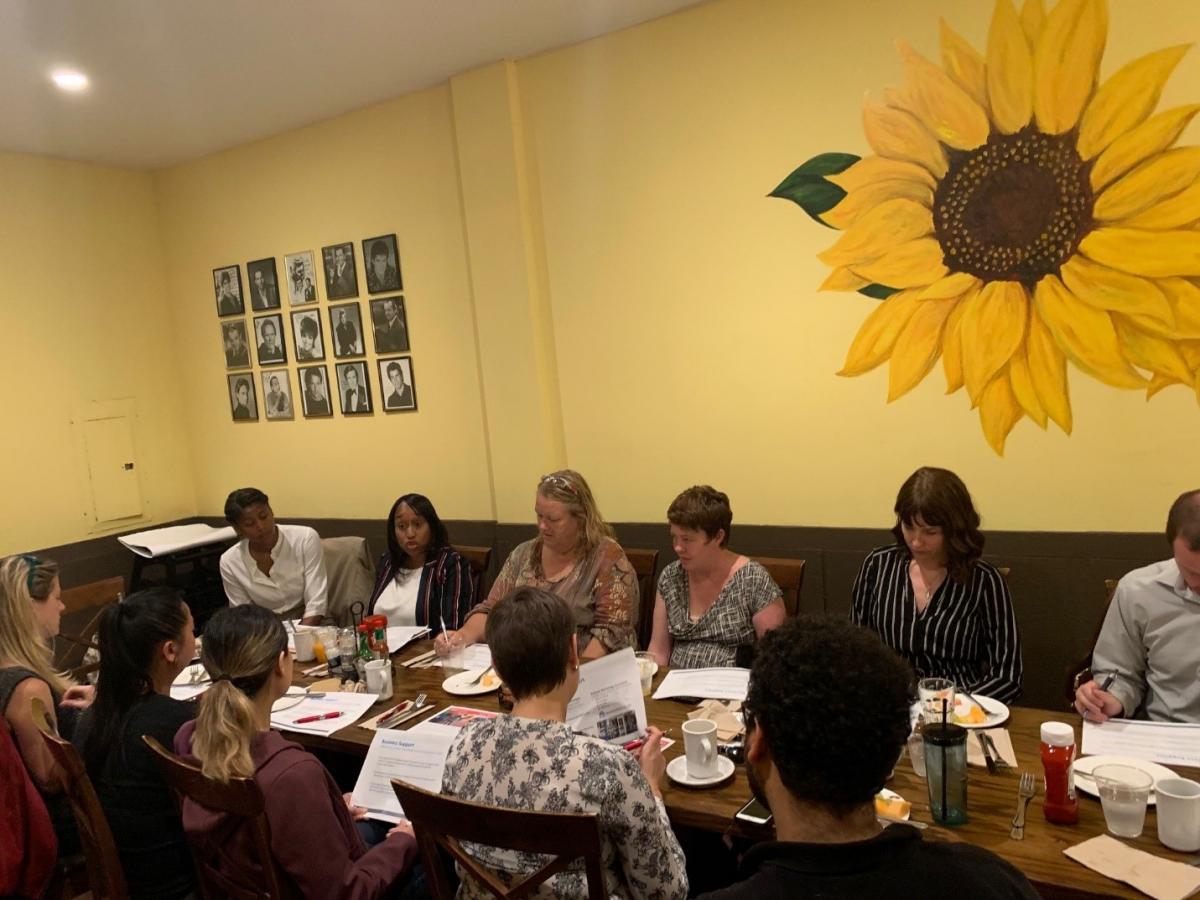
photo of Geary Rapid Project and OEWD staff meeting prior to COVID-19 with Fillmore Merchants to discuss upcoming construction

Geary Rapid Project and OEWD staff meet prior to COVID-19 with Fillmore Merchants to discuss upcoming construction

Prior to construction starting in a neighborhood, SFMTA and OEWD staff held frequent meetings with merchant groups and business owners to describe the anticipated impacts of construction and determine which support-resources best fit their needs. Once construction began, each merchant corridor was provided business wayfinding signage in line with their branding, as well as to fit the look and feel of the neighborhood. This wayfinding signage helps to raise the visibility of businesses, so that patrons can still find and access their favorite stores throughout construction.

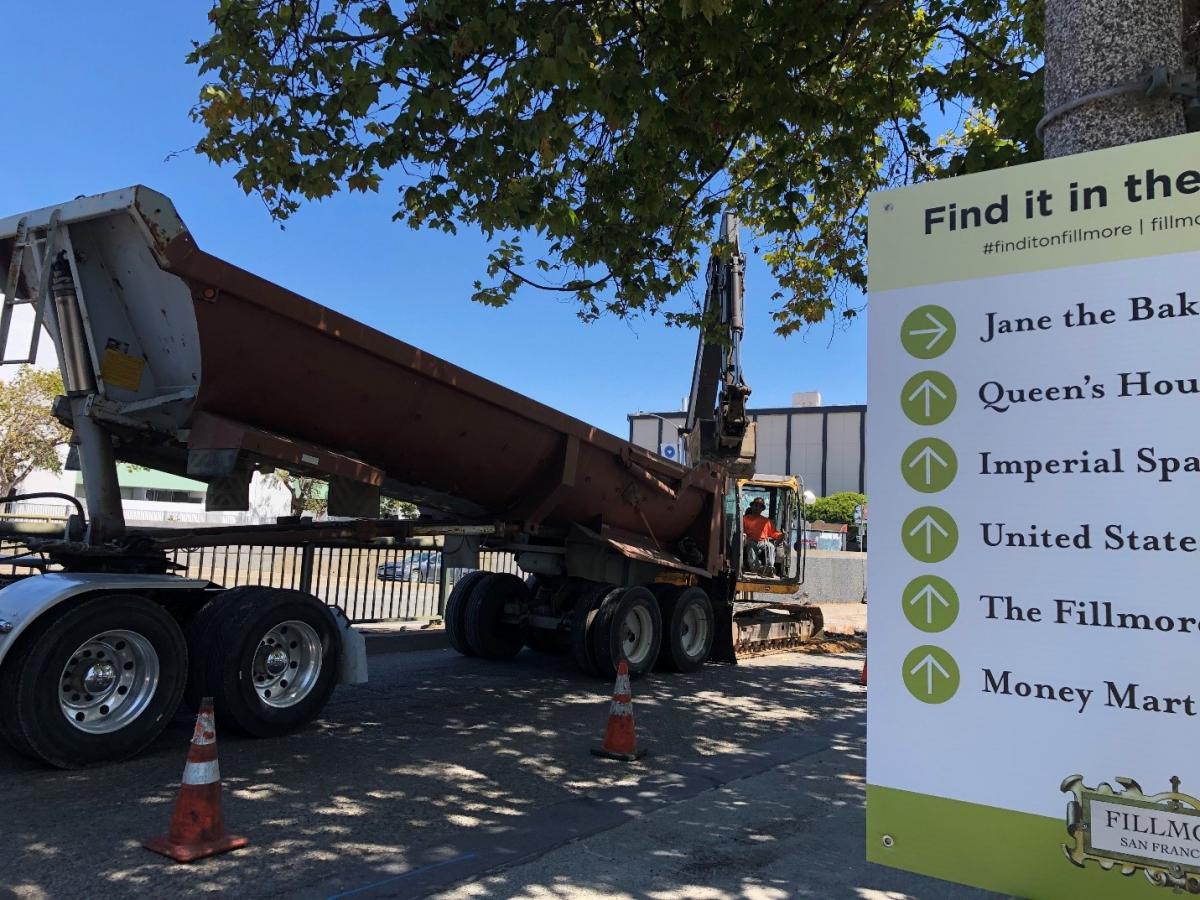
Photo of wayfinding signage next to Construction Crews working in the Fillmore

Wayfinding signage next to Construction Crews working in the Fillmore

COVID-19 and shelter-in-place orders only compounded pressure on small businesses already feeling the effects of construction. In response, SFMTA staff and merchant groups worked together to develop new ideas on how to keep customers coming during this challenging time. Small businesses, local events, and COVID-19 resources were featured within the project’s weekly construction forecast, which is sent to over 3,000 subscribers.

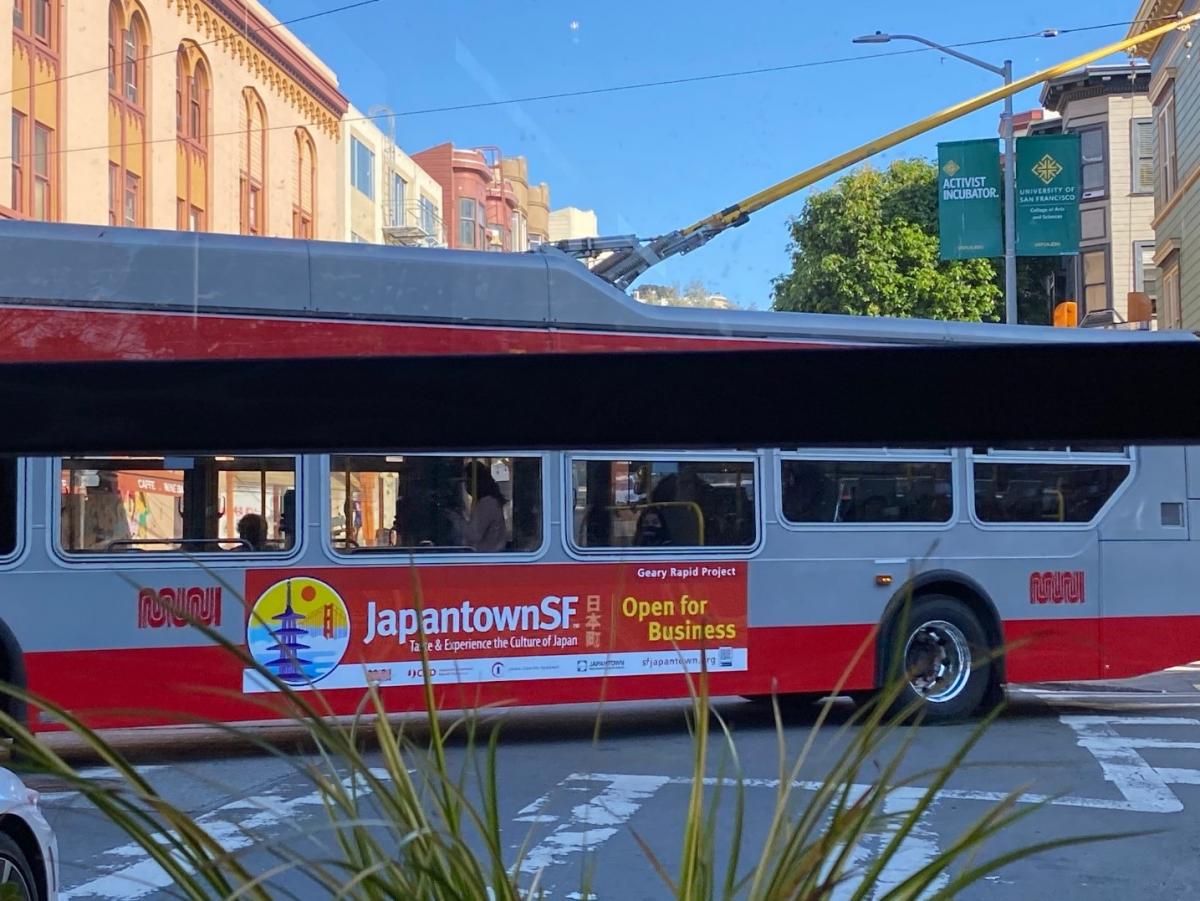
Each group also collaborated with staff to determine what type of marketing support would best suit them, and when was the best timing given the changing nature of shelter-in-place restrictions. The results were a mix of traditional and new approaches of promoting local merchants. For example, the Japantown Merchants Group chose an advertising campaign to promote visiting Japantown, featured inside and outside of buses throughout the Muni network. The Tenderloin Community Benefit District took a social media approach and promoted visiting restaurants and stores via targeted Facebook ads.

No matter the chosen method, providing targeted support is a proactive way for the SFMTA to help small business during these trying times, so they are able to remain open as our city begins the re-opening process.     

Photo of bus with ad produced for Japantown as part of the Geary Rapid Project Business Support Program

Bus ad produced for Japantown as part of the Geary Rapid Project Business Support Program

Of course, we recognize that in the past not every SFMTA project has been smooth sailing when it comes to construction. However, we have built upon our experience as a lesson for projects currently underway, and for those being planned. We have learned that consistent, personalized outreach and having project staff dedicated to addressing issues directly and quickly are essential to building and fostering meaningful relationships that maximize opportunities, and minimize the impact of construction.


Published March 23, 2021 at 05:30PM
https://ift.tt/2QtB1ZP

الاثنين، 22 مارس 2021

Creating a Better Market Street: Car-free Enforcement to Resume

Creating a Better Market Street: Car-free Enforcement to Resume
By Mariana Maguire

It’s been over a year since Market Street went “car-free” on January 29, 2020, but shortly afterwards, the COVID-19 pandemic shut down our city and changed how people move through San Francisco. As the city begins to reopen and vehicle traffic is increasing, we are by stepping up compliance and enforcement efforts to keep Market Street car-free starting March 29, with the help of SFMTA’s Parking Control Officers (PCOs) and the San Francisco Police Department (SFPD).

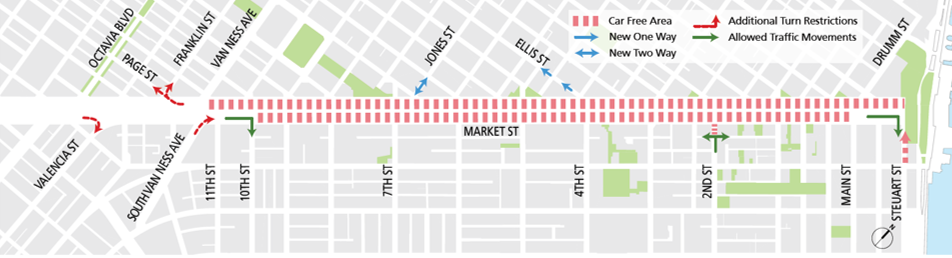
Under the year-old car-free rules established as a part of Better Market Street, no private vehicles are allowed to travel along Market Street eastbound from 10th to Main streets or westbound from Steuart Street to Van Ness Avenue. Traffic is still allowed to cross Market Street, but there are no turns allowed onto the street in the car-free area. These restrictions apply to all private vehicles, including Uber, Lyft, Postmates, DoorDash, and other services whose drivers use personal vehicles without a commercial license plate.

Map of Market Street showing car-free zone from Van Ness Avenue to Main Street eastbountd and from Van Ness Avenue to Steuart Street westbound. New one-way restrictions on Ellis from Market to ____, new two way traffic on Jones from Market to _____, and additional turn restrictions from Market to Valencia street, from Market to Page and Franklin Streets, from South Van Ness onto Market Street and northbound from Steuart to Market. New traffic movements will occur from 2nd Street northbound onto ___ and ____ and on Market Street to Steuart Street.

 Map: Car-free area on Market Street, implemented January 2020.

Enforcement of compliance will increase starting March 29 and will continue for about a month to help remind drivers of the restrictions. PCOs and police officers will monitor the street at various locations. PCOs will wave on vehicles attempting to turn onto Market Street within the restricted area. During the first week of the campaign the SFPD will issue warnings to drivers as we ramp up education efforts. Thereafter, they will issue citations to vehicles in violation of the car-free restrictions.

These efforts are in direct response to violations and concerns we’re heard from people that private vehicles are still driving in the car-free area. We also understand and appreciate concerns around police enforcement and we’re working hand in hand with SFPD to address those concerns.

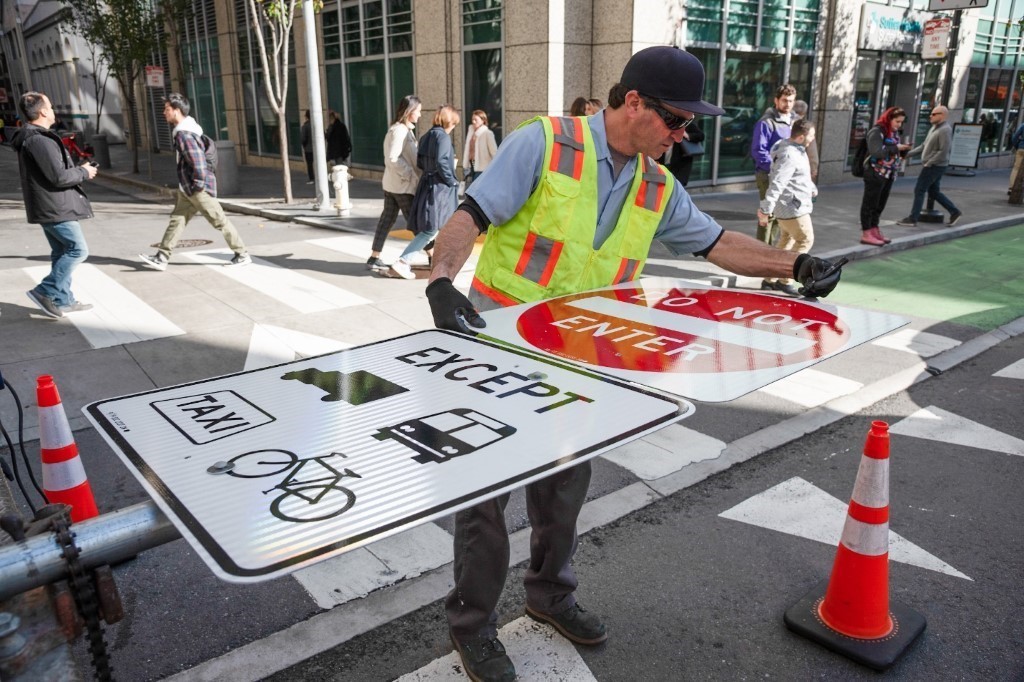
Photo of worker getting ready to put up a pole with new signs indicating that Market Street is restricted to non-private vehicles only.

Photo: Crew member installing new signage on Market Street in January 2020

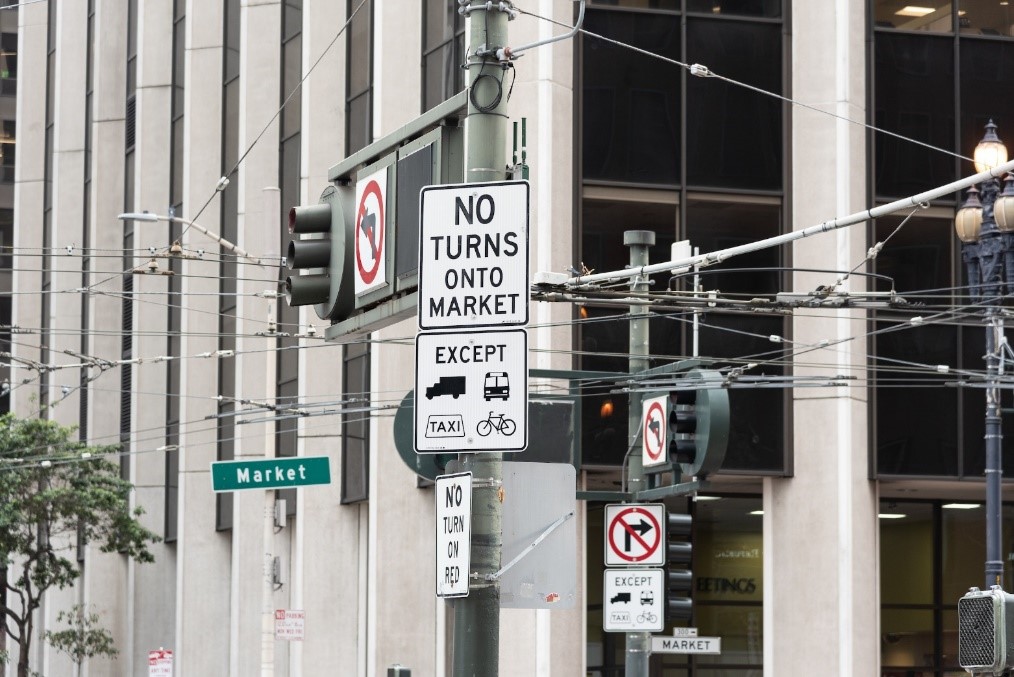
Photo of signs on Market Street indicating restrictions to private vehicles.

Photo: Car-free Market Street signs limiting private vehicles from driving on Market Street east of Van Ness Avenue.

Vehicles that are still allowed to use Market Street:

  • Muni and other transit service vehicles
  • Taxis
  • Paratransit
  • Licensed commercial vehicles
  • Emergency service vehicles
  • Bicycles
  • Scooters

Don’t get ticketed! If you’re not one of the vehicles above, don’t drive on Market Street east of Van Ness Avenue. Pay close attention to signage like those shown in the photos. If you’re using a navigation app it will route you around the car-free area.

Please help us spread the word to family, friends, neighbors and coworkers. Plan your trips accordingly. Consider alternate modes of travel if you’re going downtown. If you need to use your personal vehicle to reach destinations along Market Street, take alternate streets – they’re open!

Keep checking the COVID-19 Muni Core Service Plan website for the latest Muni service as we continue to expand and restore additional Muni rail routes which will improve transit service along Market Street.


Published March 23, 2021 at 12:38AM
https://ift.tt/3f75iIe

الخميس، 18 مارس 2021

Get On Board for Your Driver

Get On Board for Your Driver
By Lori Phelan

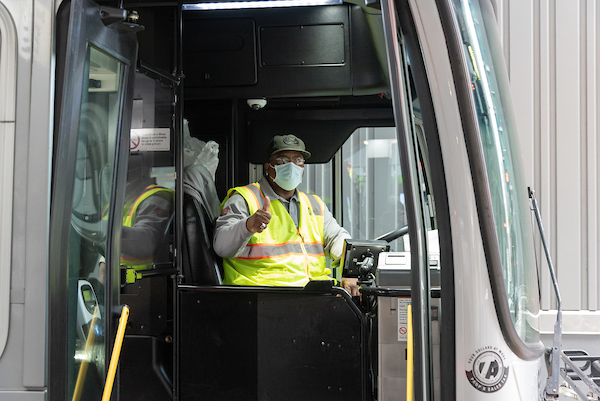
Photo of Muni bus operator wearing mask

Today is Transit Worker Appreciation Day, a national day of recognition to thank and celebrate the public service of transit vehicle operators and support staff who keep our cities moving. Operating any vehicle in a city like San Francisco is not easy, yet our operators strive to provide a comfortable ride while navigating large-capacity buses with precision through city streets and traffic. We recently celebrated hundreds of Muni Operators with years –even decades-- of “safe driver” experience, having had no avoidable collisions. We also celebrate the hundreds of mechanics, car cleaners, and other critical personnel who keep vehicles safe and operational.

Muni’s transit operators and support teams have been on the job in San Francisco throughout the COVID-19 pandemic, providing essential service at a time of unprecedented challenge and uncertainty. In addition to keeping our Muni Core Service Plan rolling during shelter-in-place, many of our Cable Car and rail operators have served as ambassadors while rail service was suspended, distributing masks, assisting customers while waiting for Muni and keeping the public informed about how to get to where they want to go.

In addition to our 2,500 Muni operators, there are nearly 3,000 taxi and 100 paratransit drivers in San Francisco, all of whom have had to manage the unique constraints the pandemic has imposed. This workforce has proven more than equal to the challenge of the past year.

Badge station: I'm on board for my operator

If you’d like to get on board with supporting an operator or other worker who made your day just a little bit brighter this past year, please consider participating in Transit Worker Appreciation Day and saying thank you by:

  • Posting thank you messages, photos or videos to social media with the hashtag #TWAD (Transit Worker Appreciation Day) or #ILoveMyMuniDriver.
  • Submitting an official commendation online through Muni Feedback -- provide details about your experience so that we can identify the employee and ensure that they receive kudos.
  • Giving a thumbs-up on MuniMobile app's RateMyRide.

And remember, a simple smile or thank you works any day – for which there are 365 opportunities each year.


Published March 18, 2021 at 03:10PM
https://ift.tt/3vDWOOE

الأربعاء، 17 مارس 2021

4th Street Bridge Transit Lanes Ease T-Third Bottleneck

4th Street Bridge Transit Lanes Ease T-Third Bottleneck
By Erin McMillan

In January, along with other proposed and planned key locations across the city, the SFMTA Board of Directors approved temporary emergency transit lanes for the 4th Street Bridge.  These temporary lanes address a key bottleneck that delays the T Third line on 4th Street northbound and southbound between Berry and Channel Streets.

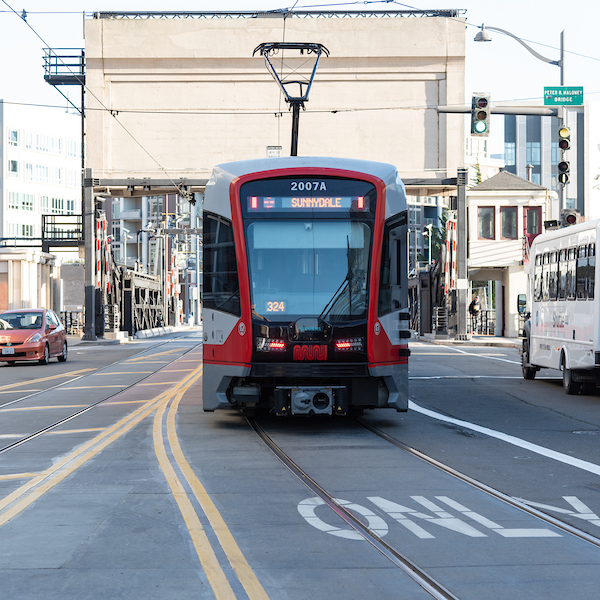
Photo of a Sunnydale-bound T Third approaching the 4th Street Bridge

A Sunnydale-bound T Third train approaches the 4th Street Bridge

As a response to community feedback, the project team developed a two-phase implementation of the temporary transit lanes to allow for an evaluation of their effectiveness before fully restricting northbound bridge traffic.

The initial evaluation of the first phase has been completed, and data shows that partial implementation was effective in allowing Muni trains to travel across the bridge with little delay.

Currently, northbound left turns are restricted from 4th Street onto Berry Street. The previous left turn pocket at that location was converted to a temporary transit lane, while northbound through-traffic continues to be allowed on the bridge. As the city emerges from the public health order to less restrictive tiers, we will perform an additional evaluation of the existing Phase 1 implementation. If that analysis determines that northbound private vehicle traffic on the bridge has begun to cause delays to the T Third, the single northbound lane will be restricted temporarily to transit only between Berry and Channel Streets as a second phase of the project.

A summary of this phased approach is provided below.

Phase 1: Complete. Evaluation of this phase began after the T Third resumed service in late January:

  • A southbound temporary emergency transit lane was installed in one of the two southbound lanes on the 4th Street Bridge
  • Northbound left turns are now temporarily prohibited from 4th Street onto Berry Street
  • The left turn pocket in the northbound direction from 4th onto Berry Street was converted to a temporary transit lane

Phase 2: If a change in emergency order tiers shows that traffic is causing transit delay on the 4th Street Bridge:

  • A northbound temporary transit-only lane will be installed in the sole northbound lane on the 4th Street Bridge
  • Northbound traffic will not be permitted on the 4th Street Bridge, with these additional temporary restrictions:
    • Heading north on 4th Street at Channel, no through traffic onto the 4th Street Bridge (right or left turn required)
    • Heading east on Channel, no left turn onto the 4th Street Bridge
    • Heading west on Channel, no right turn onto the 4th Street Bridge
  • Southbound general traffic will continue to be permitted

Evaluation of the phased approach

Our Phase 1 evaluation included site visits and several weeks of monitoring traffic on and around the 4th Street Bridge. Our chief metric was whether general traffic blocked trains on the shared northbound lane across the 4th Street Bridge.  If northbound traffic blocked trains more than 5% of the time, our plan was to implement Phase 2. Periods of evaluation included morning, mid-day, and afternoon/evening peak.

We also monitored train travel times using location data from T Third train tracking devices to identify when trains experienced the longest travel times on the 4th Street Bridge. Because this data showed few instances when trains were blocked by northbound traffic, we paused implementation of the second phase.

Initial Phase 1 Evaluation Results

Our data demonstrated that Phase 1 was successful in decreasing transit delays and protecting trains from traffic congestion. With the temporary emergency transit lanes in place:

  • On average, overall transit delay decreased by 63% at the of 4th and Berry streets.
  • T Third trains are now 2.5 times more likely to travel through the 4th and Berry street intersection without having to stop for a red light. 
  • When trains do encounter a red light, the average wait time for a green signal is 70% shorter
  • With Phase 1 in place, T Third trains were delayed by traffic congestion less than 1% of the time

Next steps

Our ongoing evaluation of the project will include a community survey in mid-March as well as continued technical evaluation of the effectiveness of these temporary transit lanes.  A renewed technical evaluation will take place with the changing of tiers in the city’s emergency public heath order.

For additional information on this project, and to sign up for updates, check out the 4th Street Bridge Temporary Emergency Transit Lanes webpage.


Published March 17, 2021 at 10:18PM
https://ift.tt/3vzBjP1