الأحد، 31 مايو 2020
Show HN: Videos for Kids Science Experiments Without Long Preparations https://ift.tt/3gFZFiC
Show HN: Interactive Speech Anatomy Visualization and Universal Phonetic Script https://ift.tt/3ckq1Dl
Show HN: Citizen Police Data Project – Police allegation data made accessible https://ift.tt/3eAZovp
Show HN: Fast Raster to Vector Converter https://ift.tt/2BloO1V
Show HN: ImageCart – Low cost unlimited public and private Docker repositories https://ift.tt/3gEU4cm
Show HN: k3sup ('ketchup') – bootstrap Kubernetes with k3s over SSH https://ift.tt/3gFoWcJ
Show HN: Automatic cleanup in C using with-statements https://ift.tt/2XLugCF
Show HN: Print a WiFi Login Card https://ift.tt/3dqv9aA
Show HN: Unity MMORPG Boilerplate – Multiplayer in Unity Made Easy https://ift.tt/3gGr8R2
Show HN: Practise algorithms whenever you open a new Tab in Chrome (AlgoTab) https://ift.tt/3eBB0dg
Show HN: Colors and Fonts Extractor – a simple Firefox extension https://ift.tt/2Mhds16
Show HN: OmSave – Safari Extension for OmniFocus on macOS https://ift.tt/2Bbmnia
Show HN: Go Micro – A distributed systems development framework https://ift.tt/2Bj2LsE
Show HN: I made a simple tool to preview Google/local fonts on live websites https://ift.tt/2TYm0hI
Show HN: Taski – Make better decisions every time https://ift.tt/2BlVvfL
Show HN: Findyour.blog – Get your blog rated and reviewed by authors/readers https://ift.tt/3gHUmPQ
السبت، 30 مايو 2020
Show HN: Solo mode for Google Docs – extension to hide comments and cursors https://ift.tt/2BjmBnB
Show HN: Open GIF Search https://ift.tt/2XM2LJ3
Show HN: Shooting pose analysis and basketball shot detection https://ift.tt/2MkmxpH
Show HN: I made a simple PDF text editor https://ift.tt/2McZNrE
Show HN: A community for sharing healthy lifestyle goals https://ift.tt/2AmmXcz
Show HN: Write a bot that plays SpaceX's ISS docking simulation https://ift.tt/2TRI79e
Show HN: I used Java to build a side project https://ift.tt/36I7xLZ
Show HN: NPM module that makes easy to convert JSON to CSV https://ift.tt/2ZRD38F
Show HN: Tinder, but for Movies https://ift.tt/3dhUKSZ
Show HN: I build djit.su during the coronavirus lockdowns – a new code editor https://ift.tt/3cfLZHK
Show HN: `fzf` * `Git` done right https://ift.tt/2ZMUjMu
Show HN: Visualizing Maps in R^3 https://ift.tt/2BhWPQG
Show HN: Caldera - Phoenix LiveView for Node + React https://ift.tt/2yNAR77
Show HN: CState – open-source Hugo powered status page https://ift.tt/2McH7Zp
Show HN: SSH tunneling course for devs, sys admins, and infosec professionals https://ift.tt/3gEcbis
Show HN: Top 10 Newest HackerNews Stories (Phoenix/LiveView) https://ift.tt/3ciyEy4
Show HN: Calculate how long your website/API can be down https://ift.tt/2MdRpIC
Show HN: Python library to edit and render HTML without a template language https://ift.tt/36KjK2A
Show HN: More than 100 name generators without any signup https://ift.tt/2ZSH6Sq
Show HN: List of all (427) startups that got funded last month https://ift.tt/3cf2SCo
Show HN: Education43 – community-driven free educational resources https://ift.tt/2XMTocj
Show HN: Transactional Outbox for Go https://ift.tt/3ci2WkT
Show HN: Implementation of Simple File-System Based on Inode from Scratch https://ift.tt/3cjOvwq
الجمعة، 29 مايو 2020
Show HN: Deploying Pytorch models on iOS via Core ML – my “pandemic project” https://ift.tt/3chNyEQ
Show HN: Awesomeblog.club – self-hostable directory for small blogs and links https://ift.tt/3eAdKMO
Show HN: Instantly Turn Google Docs into reStructuredText https://ift.tt/3dfJfeH
Show HN: An API to store balances and transactions https://ift.tt/36F56d5
Show HN: My HTML course for complete beginners https://ift.tt/3gABaDr
Show HN: TrashEmail – Telegram-based disposable mail service https://ift.tt/2yOjZxe
Show HN: A point-and-click visual decoder for flag semaphore https://ift.tt/2ZNPItm
Show HN: I wrote a toy functional programming language https://ift.tt/3ew9AoU
Show HN: Remote mastermind groups for first time founders https://ift.tt/2zyXsoB
Show HN: MongoDB analytics to track changes in your site's performance https://ift.tt/36EnEKi
Show HN: Unweb – adblock for distractions (including HN) https://ift.tt/2B7RUBC
Show HN: I built a free forms service for static websites https://ift.tt/3cb0495
الخميس، 28 مايو 2020
Show HN: Master in AI – Get an Unaccredited Master in AI https://ift.tt/2B5fe2S
Show HN: Generate a Go REST API from PostgreSQL with filtering, pagination, auth https://ift.tt/3es1m18
Show HN: Redux with a UseState Hook https://ift.tt/3chdX5D
Show HN: Ratemydorm.com https://ift.tt/3gsfcm5
Show HN: A Discussion Site for Religious Groups Based on Hacker News https://ift.tt/36CjxOQ
Show HN: Breaking a meaningless world record: computing Γ(1/4) to 500b digits https://ift.tt/2M7NqgB
Show HN: Astra – Virtual Sub Accounts for your existing bank accounts https://ift.tt/2yDCHY6
Show HN: RoughNotation – create and animate hand-drawn annotations on a web page https://ift.tt/36Cgc2t
Show HN: Almanac – GitHub for Docs https://ift.tt/3ewPXgn
Show HN: A11yJSON, a standard to describe the accessibility of the real world https://ift.tt/3c60a1L
Show HN: HTML Goddess – A static site generator to code like it's 1999 https://ift.tt/3ew8R7p
Show HN: User authentication at the edge using Auth0 and Cloudflare Workers https://ift.tt/3dd6fL9
Show HN: Livresq – An Authoring Tool for Education https://ift.tt/2yG17Ap
Show HN: I built a cron job scheduler https://ift.tt/2ZJPnb6
Show HN: A website for making patches for the OP-1 and OP-Z synths https://ift.tt/36AgdUC
Show HN: Python on iOS Native Apps https://ift.tt/2THpp4j
Show HN: React – Toastify Your Console.log()'s https://ift.tt/3caz2Pd
Show HN: Karate Club – A Python library for machine learning on graphs https://ift.tt/3eEt8rx
Show HN: Neatly – A simple way for teams to find their important shared files https://ift.tt/3gurnPh
Show HN: wasm-mt – A multithreading library for Rust and WebAssembly https://ift.tt/2M8muxb
Show HN: I wrote a remote story estimation tool https://ift.tt/3eq9cbx
Show HN: Non-custodial Bitcoin exchange w integrated wallet opening public beta https://ift.tt/36GjOQT
Show HN: Production-grade configuration system for Node.js https://ift.tt/3eoqG8c
Show HN: Docker Push Readme” – a Docker CLI plugin to update container repo docs https://ift.tt/2M83E9D
الأربعاء، 27 مايو 2020
Show HN: I built a $499, landlord-friendly, self-install solar and battery kit https://ift.tt/36z8VR0
Show HN: Simple-blogger – blog generated from GitHub project READMEs https://ift.tt/2AkaDJJ
Show HN: Host live public audio conversations https://ift.tt/2X80EAf
Show HN: Serve your own cloud API abstractions in Kubernetes https://ift.tt/2X7j18l
Show HN: Primrose – HTML5 canvas text editor for WebGL textures https://ift.tt/2zD2rEr
Show HN: To Listen to Any Page Prefix the URL with Playthis.link https://ift.tt/3gnNPcR
Show HN: Straight2Spam – Send your email right to someones spam folder https://ift.tt/2ZHMkjN
Show HN: Twingate – A modern solution for remote access https://ift.tt/3gtyxTT
Show HN: Python Testing Crawler – spider your Flask or Django website in tests https://ift.tt/2Ah8M8t
Show HN: Devslist – Browse hundreds of remote developer jobs in one place https://ift.tt/3epGOGs
Show HN: Obsidian – Powerful knowledge base that works on local Markdown files https://ift.tt/2LZZbWm
Show HN: Bobolink – a small tool to help search your bookmarks https://ift.tt/2zDflSV
Show HN: Guide to Freelancing in Sweden https://ift.tt/3d698xy
Show HN: GraphQL2REST – Automatically generate a REST API from your GraphQL API https://ift.tt/3esj5FU
Show HN: RSA encryption explained with demo in Google Colab https://ift.tt/2ZGNsnH
Show HN: Decentralized Food Delivery or Grocery Delivery Platform https://ift.tt/2ZI26v6
Show HN: Multiplayer greyhound racing game to play over Zoom https://ift.tt/3c1VBFO
Show HN: We created over 200 PHP packages https://ift.tt/3ellv99
Show HN: Keywordgenerator.io – A tool to generate thousands of longtail keywords https://ift.tt/2M1jtih
Show HN: dbhi/qus · qemu-user-static and Docker/Podman, non-invasive MWEs https://ift.tt/2M2Z3Fy
الثلاثاء، 26 مايو 2020
Show HN: Simulate 2^100 live automata cells in milliseconds, in your browser https://ift.tt/2XqZv5G
Show HN: Understanding Shape Detection Using Hough Transform with Python https://ift.tt/2THUi8H
A Data-Driven Transportation Recovery
By Bradley Dunn
Responding to the Covid-19 public health crisis has radically changed our transportation system. No one wants a disaster to put lives at risk and disrupt everyday life. Data is guiding the SFMTA, not just during our reaction to the crisis, but how we will thoughtfully recover.

Transit’s Recovery
When shelter-in-place began and the SFMTA was forced to reduce Muni service, we identified how to focus our service reductions using data. Our Muni Core Service Plan prioritized our available resources based on locations of medical facilities, Muni’s Equity Strategy and data from shifting customer travel patterns observed during the first weeks of the COVID-19 shelter-in-place order. Our service plan kept all of San Francisco within one mile of an active Muni stop. As additional resources have become available, guided by the same data as well as additional information from our operators, riders, and city leaders, we have increased frequency and returned some additional routes to service.
As more people return to working in retail and manufacturing, there will be an increased demand for transit, even as physical distancing still limits Muni’s capacity. If we cannot get the thousands of employees who rely on Muni to work, San Francisco cannot recover economically.
Preventing crowding and everyone wearing masks is key to our recovery. Generally, as the activities allowed by the public health order expand, we are keeping the core service routes and increasing capacity and frequency. The increased frequency helps limit crowding and promote physical distancing.
As congestion increases with more movement, we also need to use data to help us identify solutions that keep our buses from being stuck in traffic. With fewer cars on the road, San Francisco’s shelter-in-place simulates the street conditions across the city that are normally seen only on routes with transit lanes. On average, peak Muni travel times have been reduced by about 15% across the Core Service network during the shelter-in-place period. These time savings will inform how we can use transit priority improvements, like transit-only lanes, as we expand Muni service in a way that better serves our customers and supports economic recovery.
When our buses are stuck in traffic, it decreases the frequency that buses pick people up at stops. With less frequent pickups, more people gather at stops making it harder to move all the people that need to board our buses while maintaining physical distancing. When buses complete their trips faster, they can return to service more quickly to reduce crowding and support distancing. Deploying transit-only lanes could also enable Muni to reduce customer’s travel times and help reduce agency costs in the face of lost revenue and budget cuts.

Data-driving dedicated space for biking
With Muni being reserved for essential trips only, walking and bicycling have become more important than ever during this pandemic. Streets that are calm and welcoming support newer bike riders, helping to reduce demand for Muni trips. We are using public feedback and pre-existing data to implement our Slow Streets traffic calming program and support walking and biking opportunities.
SFMTA staff gathered suggestions from conversations with members of the Board of Supervisors and community groups about locations for Slow Streets. They analyzed these inputs along with the 1,800 responses to our on-line, multilingual survey to identify the most frequently identified corridors. Streets were then screened for topography, surrounding land use, conflicts with Muni service, primary public safety routes and commercial loading zones.
When fully implemented, there may be over 34 miles of Slow Streets in San Francisco. We will analyze the effectiveness of the program by tracking the mode share of people driving, walking or biking on the street changes before and after implementation. Staff are also tracking side streets to see if there is substantial diversion of traffic.
As we move forward towards recovery, we expect bicycling to continue to serve trips that would otherwise be made on Muni or create traffic congestion in a private automobile. Our bicycle trip counters in some locations like the Panhandle path have shown massive increases. To be responsive and help provide more space for safer more comfortable riding, we are planning to add a protected bike lane on Fell Street. We will continue improving San Francisco streets through the data-informed approach to Vision Zero , build-out previously approved protected bike lanes and expand bike-share to provide access in more neighborhoods.
These are truly challenging times and the needs of San Franciscans are changing. We do not know everything that the future will bring but efficiently moving people around our city will always be a top priority. To do that, we must utilize data to adapt our transportation system to this crisis as well as use transportation as a tool to spur our city’s recovery.
Published May 27, 2020 at 12:47AM
https://ift.tt/2yyQRtx
Show HN: JQL – A JSON Query Language CLI Tool Built with Rust https://ift.tt/2XwcMu3
Show HN: Spatially Embedded Video Chat https://ift.tt/3d5BV5j
Show HN: I built a service to uncover hidden Facebook advertising interests https://ift.tt/2B4PvI1
Show HN: Asserted.io – Test in Prod. Continuous Uptime Testing with Mocha https://ift.tt/2zqcdtM
Show HN: Website that finds least amount of clicks between two Wikipedia pages https://ift.tt/3emxWBE
Show HN: Savory – Bookmark manager for people with 1000s of bookmarks https://ift.tt/3ekIEs9
Show HN: Trianglify.io – Colorful patterns generated via Delaunay triangulations https://ift.tt/2ZPSD51
Show HN: Teletext TrueType Font https://ift.tt/3exxFfl
Show HN: Bear – The most minimal blogging platform ever https://ift.tt/2TF4UoR
Show HN: Kiba Pro v2 (Commercial Ruby Extensions to Kiba ETL) https://ift.tt/36tjzZw
Show HN: Stopcorona.info, Covid-19 tracker visualizing data from 20 sources https://ift.tt/2XC1AMy
Show HN: How Safe Are My Roads? – UK Road Safety Data https://ift.tt/2ZDCtLC
Show HN: Gather feedback on your documents on Slack https://ift.tt/2B3nL6B
Show HN: Send cloudinit output to cloudwatch logs https://ift.tt/2XBTpjk
Show HN: Create and Monetize Your Blog with QuickPublisher https://ift.tt/3gmOgnC
Show HN: A Code Generator in Eclipse https://ift.tt/3ek3kAv
Show HN: Pitch Deck Hunt – 100 real pitch decks from the best startups https://ift.tt/2XqUHgO
Show HN: From Data Model to HTML UI https://ift.tt/3d4azwf
Show HN: Exploring organisms development (and more) with cellular automata https://ift.tt/3edwstc
الاثنين، 25 مايو 2020
Show HN: A Simple COBOL Game, TicTacTOBOL https://ift.tt/2XwPZhp
Show HN: "News” a minimal Dockerized single-page news aggregator https://ift.tt/2XuNyMl
Show HN: Save notes from your desktop/mobile browser to Raspberry Pi https://ift.tt/3gmtZP7
Show HN: Fractal garden – realtime 3D fractal explorer in the browser https://ift.tt/3echnbk
Show HN: Tabletop Treasure Generator built with Sveltejs and 98.css https://ift.tt/2B0Jk7Q
Show HN: HAProxy back end controller/scaler, supports AWS ASG and Consul https://ift.tt/2ZBHR28
Show HN: Protect Your Wealth with Kubera https://ift.tt/2ZBwPcY
Show HN: Growing fractal trees in HTML canvas https://ift.tt/3eiYtzH
Show HN: PgTyped – Typesafe SQL in TypeScript and Postgres https://ift.tt/2LZkqrg
Show HN: I made Spotlight for Chrome (Cmd+M) https://ift.tt/2ZyM6eB
Show HN: I built a minimal Twitter web app with few rules https://ift.tt/2TEbdc6
Show HN: InvaderZ is now available to play on itch.io https://ift.tt/36AMP0w
Show HN: Airspace – async communication for remote teams https://ift.tt/2TCEWCq
Show HN: 2030 CCv3 IRL – web animation of speculative AR https://ift.tt/2zw9Rth
Show HN: A Firefox add-on to disable notifications when a tab is muted https://ift.tt/2TE01fA
Show HN: A testing framework for Cloudflare Firewall rules https://ift.tt/3gjE7bp
Show HN: Dsnet, a simple command to manage a centralised WireGuard VPN https://ift.tt/2XqZfnx
Show HN: A snake game written in Common Lisp built on top of trivial-gamekit https://ift.tt/3d2y9JM
Show HN: Preemptive Multitasking on an AVR Microcontroller https://ift.tt/3e8TLo6
Show HN: Triqla – Documents for Evolving Plans https://ift.tt/2LYchna
الأحد، 24 مايو 2020
Show HN: Dumbproxy – modern and simple HTTP(S) proxy https://ift.tt/2Xu3VZw
Show HN: Use Your Inbox As A Google Reader Replacement https://ift.tt/2yvzp9t
Show HN: WebPipe – Pipe from your servers to the browser https://ift.tt/3eh0qg8
Show HN: A Firefox add-on to strip Google search results from 'blacklisted' URLs https://ift.tt/3gmdp1C
Show HN: Pi Stats, a macOS menu bar app to view and manage your Pi-hole status https://ift.tt/2XnZH60
Show HN: A HTTP2 web server with auto SSL certificate, Zero-Configuration https://ift.tt/3gjQ80s
Show HN: Kubetap – kubectl plugin to deploy intercepting proxies to K8s Services https://ift.tt/2TwT5Ba
Show HN: Ventura – improved Fortuna PRNG with strong entropy sources https://ift.tt/3eiqmIi
Show HN: Share Streaming Services With Friends(Even if they don’t own accounts) https://ift.tt/2TvGBcQ
Show HN: Dj-Paddle – Payment-Integration for Your Django-SaaS-Project https://ift.tt/3gkvpJO
Show HN: Bosconian (1981), in 3-D https://ift.tt/36rwzP7
Show HN: Generate hundreds of animated designs with one image https://ift.tt/3efvahn
Show HN: Lockdown.sh Simple shell script for locking down new linux installs https://ift.tt/2Zv6PQA
Show HN: Visualizing flow using Smashing and data from Jira, GitHub and Jenkins https://ift.tt/2ZwVgrX
Show HN: Program and publish a game in 2 hours https://ift.tt/2TxDd1h
Show HN: FizzBuzz purely in Rust's trait system https://ift.tt/2ZuUJa8
Show HN: Web controlled traffic light for Raspberry Pi powered by Elixir/Nerves https://ift.tt/36ptrTS
Show HN: faasd – Lightweight OSS Serverless https://ift.tt/2A0Wa5B
السبت، 23 مايو 2020
Show HN: I made a self-improvement app to help you become better than yesterday https://ift.tt/2ZvJRZF
Show HN: megaAI – a powerful, small, AI-capable 4K camera for Pi https://ift.tt/2XoYUSb
Show HN: Means.tv a leftist streaming service without ads or VCs https://ift.tt/3bZu4oz
Show HN: Strongverbs.ai – Finding good strong verbs with machine learning https://ift.tt/2AWeAF0
Show HN: A WebGL Tribute to Tron(1982), movie that made me fall in love with CGI https://ift.tt/2WVoCi4
Show HN: LibStack – Better search for Node.js packages https://ift.tt/2XppY3F
Show HN: Command-Pal – The hackable command palette, inspired by VSCode https://ift.tt/2Xomdvh
Show HN: Daintree, an open source AWS webconsole https://ift.tt/3cWquwA
Show HN: Master SSH tunneling in an interactive lab https://ift.tt/2XlMNW5
Show HN: A dependently-typed programming language with static memory management https://ift.tt/3giBlmA
Show HN: How to build a complex multithreading framework and your apps https://ift.tt/2WZ4LyK
Show HN: Eth.Build – Web3 prototyping and educational tool https://ift.tt/2WXLSvK
Show HN: Discohash – Fast Hash https://ift.tt/3gghqEO
Show HN: LaTeX.css – Make your website look like a LaTeX document https://ift.tt/2Tx1iVQ
Show HN: Discover high-quality articles,videos and more with human-curated lists https://ift.tt/2WTK4UF
Show HN: Who Pays Technical Writers (Beta) https://ift.tt/3c1bs7n
Show HN: Sync your Firefox tabs with MobileSafari on iOS https://ift.tt/2XrGws1
Show HN: GoTutee, Education Marketplace https://ift.tt/3ee8azq
Show HN: Raspberry Pi WiFi extender/router/ad-blocker to filter all DNS traffic https://ift.tt/3edDcXY
Show HN: Dstask, a Git-powered single EXE taskwarrior alternative https://ift.tt/3e7B6J6
Show HN: ChordIQ – learn notes, chords, scales, perfect pitch https://ift.tt/3bYpy9Q
الجمعة، 22 مايو 2020
Show HN: Life is Short – Game of Life in 203 chars of HTML/JavaScript https://ift.tt/3bX7Ymk
Show HN: One-stop for all happy things on the Internet https://ift.tt/2zr4dIG
Show HN: Fluxmath: Train your mental math skills with this competitive math game https://ift.tt/3eeu9Ga
Show HN: Multi-room audio with Snapcast and Raspberry Pi https://ift.tt/3eeeOFA
Show HN: I'm releasing my 2D Tile Map Editor for free https://ift.tt/2yofskG
Show HN: Quizlime, run your own real-time collaborative quizzes https://ift.tt/2TsnQXB
Show HN: Create a custom macOS app from a group of websites https://ift.tt/3d7SUUJ
Show HN: Deta Base – Add a database to your side projects in 3 lines of code https://ift.tt/2Ztz6a0
Show HN: Set.health – Mapbox for Medical Products https://ift.tt/2WX6KDH
Show HN: Resume Management System https://ift.tt/3ec0aPq
Celebrating the life and legacy of Harvey Milk
By Sophia Scherr
Today we celebrate and remember the life of San Francisco LGBTQ+ advocate and icon, Harvey Milk. One of our city’s most revered politicians, Milk's legacy as the first openly gay San Francisco supervisor and elected official in California helped in breaking down discriminatory barriers and usher LGBTQ+ politicians in government positions. Milk also advocated for equitable transportation, as he rode Muni exclusively since he did not own a car. He was a firm believer that affordable mobility was important in creating a thriving and livable city.
Below is Harvey Milk with Curtis E. Green, General Manager of the Municipal Railway promoting Muni’s “Fast Pass”. Mr. Green was a barrier-breaking figure in his own right, by becoming the first African American appointed to Muni's top position from his beginnings with the Agency as a bus operator. With his 1974 appointment, Green also became the first African American to serve as top executive for a major city transportation agency nationwide.


As we commemorate the 40th Anniversary of Muni Metro, Castro Station and Harvey Milk Plaza, we’re excited to bring improvements to the plaza as part of the Castro Station Accessibility Improvement Project. These much-needed improvements include a new glass elevator in compliance with the Americans with Disabilities Act (ADA) and an additional second elevator will be added to provide continuous access to the station.
We take a moment to recognize and thank trailblazers like Harvey Milk and others - who fought against systematic oppression, discrimination and bigotry. Let’s take inspiration from Milk and others to continue this hard and important work. We can all be changemakers and make San Francisco and the communities we all live in more inclusive.
Published May 22, 2020 at 06:27PM
https://ift.tt/2ZuHeYa
Show HN: Zapatos, a Postgres Library for TypeScript https://ift.tt/2yqrpGB
Show HN: sf - A stupid JavaScript web framework for deno https://ift.tt/2A3TsMl
Show HN: Unpacking HP Firmware Updates- Part 2 in the series is up https://ift.tt/2ATWR0X
Show HN: Plopdown HTML5 Video Annotator Released https://ift.tt/3cWHByf
Show HN: Turn your fancy, expensive computer into a stupid typewriter https://ift.tt/2TuH7I8
Show HN: GraphQL Shopping Cart API https://ift.tt/3cVDenk
Show HN: Dark Mode for HN https://ift.tt/2TvybSS
Show HN: Browserless Alternative with Proxies https://ift.tt/2TwD1z9
Show HN: React Native scrollable bottom sheet native animations gestures 60FPS https://ift.tt/2LMqIdU
Show HN: Krucible – temporary Kubernetes clusters for testing and development https://ift.tt/2TwzEYW
Show HN: Plenary – A privacy focused RSS feed and offline reader app for Android https://ift.tt/2WRpCUw
Show HN: Automatic Markdown Reports from Machine Learning Experiments https://ift.tt/2A3FXN2
Show HN: ChartSS.css - accessible html/css charts with markdown support https://ift.tt/2zZ9aso
الخميس، 21 مايو 2020
Show HN: I Made JavaScript Color Conversion Library for LCH/Lab/XYZ/RGB/Hex/HSL https://ift.tt/2WTlrY9
Show HN: Devplayground – Code Together https://ift.tt/2ZyeJZg
Show HN: Freechains: Peer-to-Peer Content Dissemination https://ift.tt/2LOtkYz
With Memorial Day Around the Corner Muni is Still for Essential Trips
By Erin McMillan
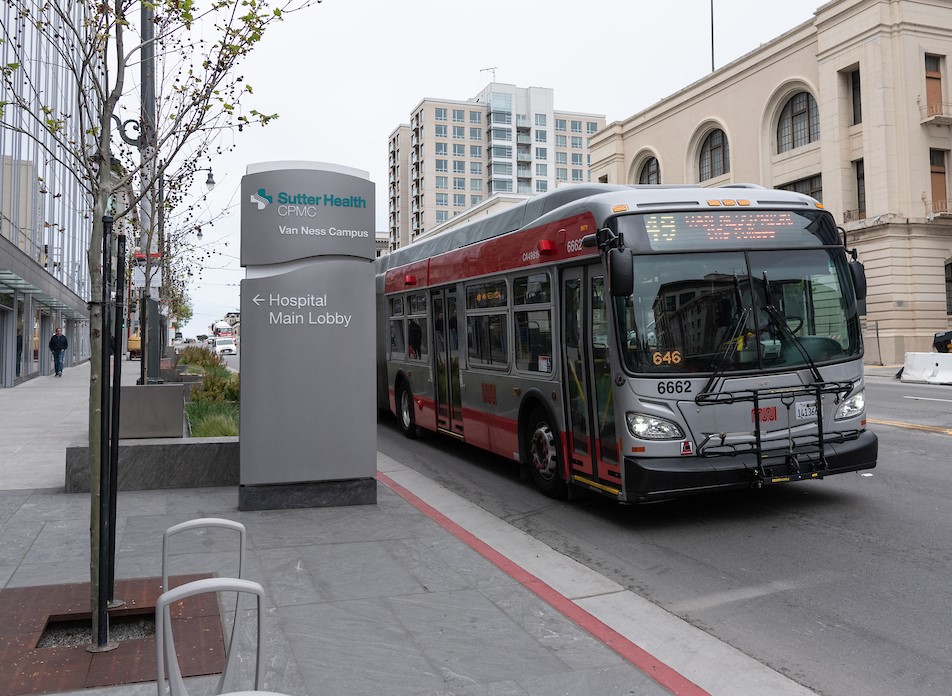
With Memorial Day weekend right around the corner, many of us are eager to get outside and enjoy the sunshine and wide open spaces. But as we enter the biggest holiday weekend since the shelter-in-place order, it’s still important to be acutely aware of how our individual actions can and will affect our communal ability to address the impacts of COVID-19.
While we hopefully will arrive at a new normal soon, the shelter-in-place order is still in effect and it’s still important as ever that we remember to physically distance ourselves while out in our neighborhoods and to only make essential trips.
In early April, we temporarily reduced Muni service to our Core Service network which serves the highest ridership lines and supports essential trips to places like hospitals, healthcare facilities, grocery stores, restaurants and other essential services. Thanks to increasing staffing availability, we were able to increase service over the past few weeks. We did this using ridership data and customer feedback. We are now providing as much as our resources allow, while providing adequate physical distance for customers and operators.
While we start to see slow changes that move us toward the lifting of the shelter-in-place order, it’s important to remember that Muni service is still only supporting essential trips that cannot be made in other ways. We are asking all San Franciscans to help us maintain adequate space on buses for physical distancing by staying at home except for essential trips. When essential trips are necessary, walking, biking, taking taxis or driving instead saves a seat on Muni for those that don’t have other options. These customers are largely hospital workers, social service providers, grocery store workers and other essential workers. Any time you take another mode of transportation for your essential trip, you save a seat for those who rely on Muni.
Muni still serves approximately 100,000 passengers a day – getting nurses, cooks, custodians, and other essential workers to their jobs. We continue to ask for San Franciscans’ help by a) complying with the shelter-in-place directive, b) only making essential trips, and c) using alternatives to Muni for essential trips whenever possible.
To encourage customers to give each other space on and off Muni, you may see ambassadors asking customers to wait for the next bus if there isn’t enough space for adequate physical distancing. Operators have been instructed that they may also skip stops if the bus is already more than half full to maintain appropriate physical distancing onboard. In addition to supporting physical distancing, you may also see ambassadors reminding customers that wearing a face covering is now required on Muni as well.
While it continues to feel odd to discourage San Franciscans from riding Muni if you have an alternate option, we’re starting to see the light at the end of the tunnel that will lead so many of us back to the bus. So, let’s stay on track and save those Muni seats for the folks who need it most right now.
Published May 22, 2020 at 02:36AM
https://ift.tt/2Zq1ude
Show HN: Easy Way to Install Jitsi/Jibri on Debian Buster https://ift.tt/2ALx6j7
Show HN: Download books from a Goodreads shelf using Library Genesis (CLI) https://ift.tt/3bSoELZ
Show HN: DevOps and SRE hiring and training tool https://ift.tt/2Xh71QB
Show HN: Kubetap – Interactively Proxy Kubernetes Services https://ift.tt/2zb5t2R
Show HN: Fil, a new Python memory profiler for data scientists, written in Rust https://ift.tt/2WPJEP6
Show HN: I copied soundclouds playcontrol with a offline local storage PubSub https://ift.tt/2ZqKe7S
Show HN: Blunt – A CSS Layout Framework for Minimalists https://ift.tt/3cTdY0K
Show HN: RSS RESTful API https://ift.tt/3gccfpF
Show HN: Immersivepoints.com, visualise your data in virtual reality https://ift.tt/3e6WpKU
Show HN: Literate Calc Mode https://ift.tt/2LPbDIx
Show HN: A real deno app: Pagic https://ift.tt/2ZqEH18
Show HN: Beautiful correlation plots for the terminal https://ift.tt/2LMYb7Y
Show HN: Bouncing ball game using poseNet and Phaser3 https://ift.tt/3eaFjM7
Show HN: SpaceX Dragon simulator docking autopilot in Clojure https://ift.tt/2LOBRux
Show HN: Ulysses–a writing tool I built to refocus when my mind is too loud https://ift.tt/2zh7hqV
Show HN: Python-based Twitter bot that posts aerial imagery of a random location https://ift.tt/2TpNUTr
Show HN: Personal finance guides to manage all aspects of your financial life https://ift.tt/2LLpLCr
Show HN: Py package to collect normalized news (finance, politics, economics) https://ift.tt/2WOSxIH
الأربعاء، 20 مايو 2020
Show HN: ZmURL – Eventbrite for Zoom https://ift.tt/2WP0UUI
Show HN: Introducing Gryphon, the iOS to Android Translator https://ift.tt/2WOkIYp
Show HN: gunDB project website redesign https://ift.tt/2WPfyex
Show HN: A super clean Jekyll blog theme optimized for speed https://ift.tt/2ANjuEc
Show HN: This tweet updates itself https://ift.tt/2Zu1hpg
Show HN: Broadway, RabbitMQ, and the Rise of Elixir https://ift.tt/2WLv9vM
Show HN: I made a Vim-like editor for building webpages https://ift.tt/3bMECHy
Show HN: Free test to check the company's dark web exposure https://ift.tt/3cKuBf8
Show HN: Our daily learning site, TIL, is five years old https://ift.tt/3g4D3rD
Show HN: A high-level Lisp configurator for the Ergodox keyboard https://ift.tt/3g9h7LV
Show HN: Go Package Implementing Age-Partitioned Bloom Filters (APBF) https://ift.tt/2WLrhLh
Show HN: Automate Your Machine Learning Experiments: try mljar-supervised https://ift.tt/2Xdu5jf
Show HN: The easiest no-code Alexa skill creator ever made https://ift.tt/2Tn3Plo
الثلاثاء، 19 مايو 2020
Show HN: Distributed app to password-protect URLs https://ift.tt/3e6UTsp
Show HN: Porting a Classic 1970s Chess Program to Modern Hardware https://ift.tt/2Tm88gO
Show HN: mono/color: Very small, responsive, dual-themed CSS framewor https://ift.tt/2ToIbNw
Moving San Francisco Forward
By Jeffrey Tumlin

Your city transportation leaders are focused on caring for this city while we fight the coronavirus pandemic. And, we’re also busy strategizing on what comes next. The city needs to be able to move in order to function.
San Francisco must take this moment to rebuild our transportation system purposefully and facilitate a resilient recovery. The SFMTA has been working with city leaders and public health officials to devise how best to do that in our new fiscal and public health reality.
The SFMTA is developing a Transportation Recovery Plan which includes a series of levels that coincide with future allowances of economic activity by state guidance and our local public health officials. For each level, there are associated service and operational strategies. We will expand Muni service intentionally to address past problems, like subway crowding. Our plans actively respond to ridership data and community input and feedback. This is a data-driven plan to help not only us, but the city, succeed in our shared efforts.
For the first couple levels, the Transportation Recovery Plan maintains the current Core Service routes with increased capacity and frequency. We have seen significant travel time savings due to reduced congestion during this public health emergency, which also equates to lower costs, as compared to buses sitting in traffic. We’ll be looking to expand our network of transit lanes to preserve these gains and protect riders from feeling the effects of budget cuts due to the economic impacts of the COVID-19 crisis.
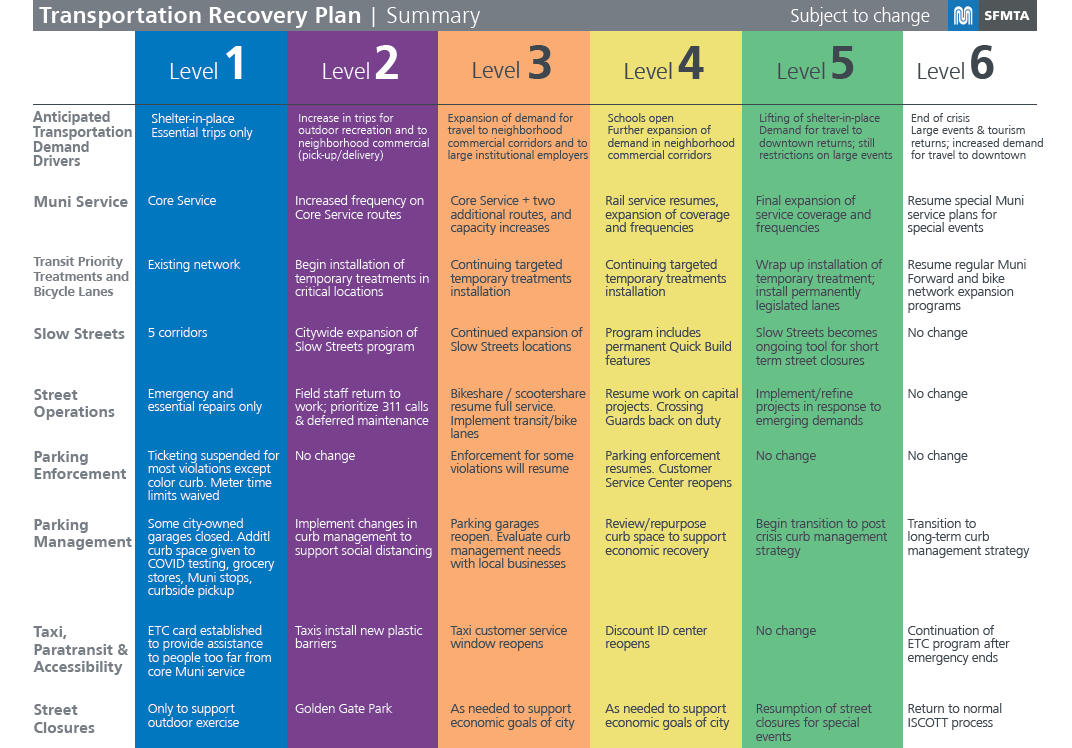
Making the streets safer to accommodate walking and biking as we emerge from Shelter-in-Place is pivotal to limiting a potential surge in traffic congestion. Our Slow Streets program, implemented during the shelter-in-place order, will continue as part of our recovery-- giving people more space to walk and bike for essential trips with appropriate physical distancing. Expanding Slow Streets supports more people walking and biking instead of driving or taking Muni. Additionally, we are investigating low-cost, reversible street treatments known as Quick Build to add bike lanes and safety improvements to certain streets that connect bicyclists to businesses.
One part of the plan I am personally committed to is ensuring that the SFMTA supports local business recovery. We are closely following the work of the Economic Recovery Task Force and are ready to offer solutions – this could mean things like providing street or curb space to requesting businesses where possible. These, among other services delivered by the SFMTA, will roll out in coordination with the broader work of our city partners.
Above all, the health and security of our employees will always be at the forefront of our plan. Safeguarding our employees is both the right thing to do and fundamental to our ability to serve the public. We are proud we have been able to maintain some of the lowest rates of COVID-19 cases among major American transit agencies. This is not by luck or happenstance. From increasing vehicle cleanings to an early and on-going procurement of protective equipment for frontline staff, we have been proactive about employee health, which in turn promotes community health.
While Muni ridership has hit unprecedented lows over the last few months, we’re grateful to those who’ve stayed home to slow the spread of COVID-19 or taken non-Muni trips to allow those who had no other option to get to essential jobs and services. As more businesses re-open and more services become available, it is critical that the SFMTA support the city’s new normal. We also need to bear in mind the limited resources of the agency and unique needs of mitigating risk in an environment with an invisible virus.
San Franciscans have historically adapted to change very well, and the residents of our city have always been on the forefront of not only accepting but advocating for positive and meaningful change. If we are going to bring back our transportation system better than it was before COVID, we are going to have to engage in some discussions about trade-offs. For example, with reduced revenue, do we provide less service or do we provide service more efficiently by strategically dedicating road space to transit?
We are incredibly thankful to all San Franciscans for your resiliency and your contributions to flattening the curve thus far. The SFMTA will continue to be here to support you in ways that will feel familiar, but also in new ways that may feel a little different as we operate in a new era. We would be remiss without thanking Mayor London Breed for her leadership during this time. Members of the Board of Supervisors and other stakeholders have provided valuable partnerships. We are also incredibly grateful for our congressional delegation, which advocated for relief funding that has helped us avoid layoffs and continue service during the pandemic.
With continued support from regional leaders and continued patience from San Franciscans, we will emerge from this stronger and more resilient.
Published May 20, 2020 at 12:22AM
https://ift.tt/2TlESH0
Show HN: Pdf.to – PDF Editor, PDF to Word, PDF Combiner https://ift.tt/2ZnBqzp
Show HN: Gendoc – Beautiful PDF document generation API, and more https://ift.tt/2XbrpTf
Show HN: Muil – Fast and simple email templates development using React https://ift.tt/2TkUB97
Show HN: PullPreview – Deploy previews for any application, on your servers https://ift.tt/2AKzQgT
Launch HN: Satchel (YC S18) – Guides to the Best SaaS Tools https://ift.tt/36cI117
Reimagine Potrero Yard with Us – Spring 2020 Update
By Adrienne Heim

During this difficult time, we must do everything we can to maintain our health and wellness. In response to COVID-19, many of our city services have been temporarily transformed, but despite this pandemic, it’s important that we continue to invest in our infrastructure to keep current and future generations moving throughout San Francisco. Potrero Yard, one of Muni’s oldest bus yards, is indeed an essential project that will continue to move forward.
Improvements proposed through the Potrero Yard Modernization Project offer solutions to ensure we maintain our fleet of buses as efficiently as possible, accommodate our new buses that will be delivered in the next six years, enhance our resilience to climate change and natural disasters, and ensure our staff is able to perform their work in a safe and efficient way.
Potrero Yard Today
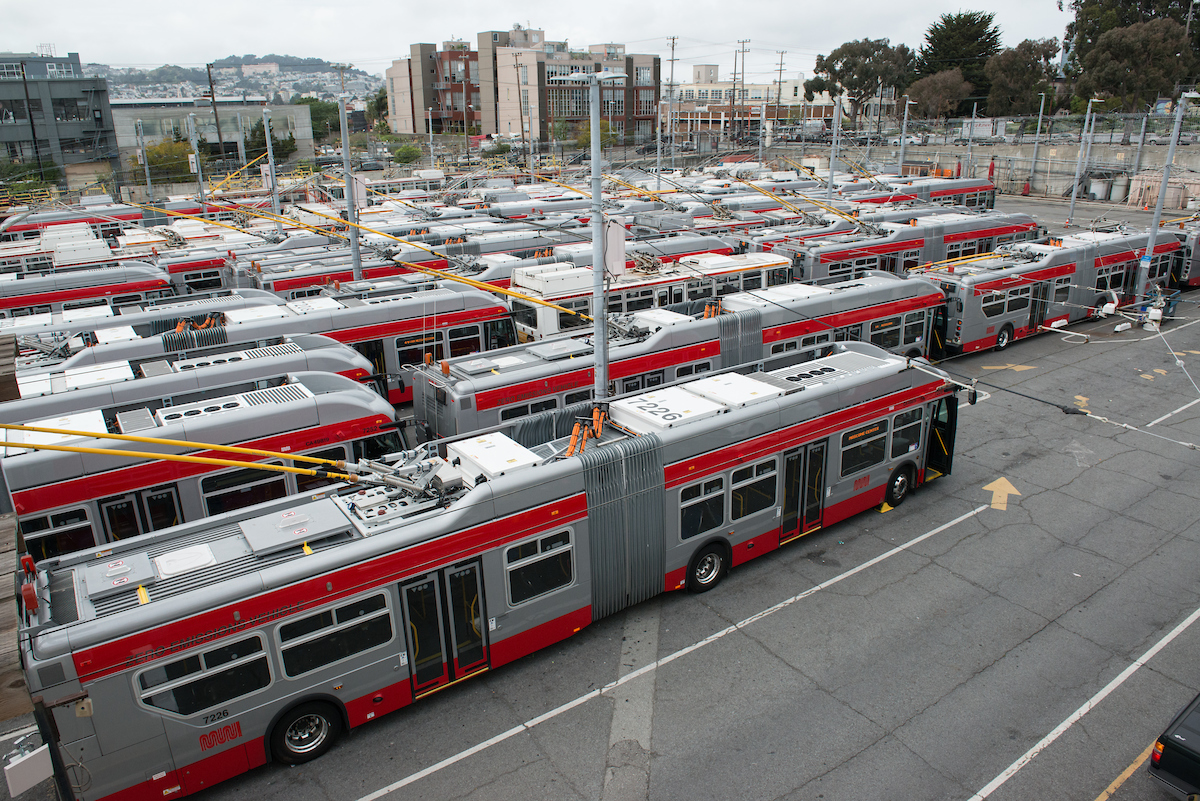
Potrero Yard operates 24 hours a day, 7 days a week, to support six Muni routes (5 Fulton, 5R Fulton Rapid, 6 Haight/Parnassus, 14 Mission, 22 Fillmore, and 30 Stockton) that carry 14% of Muni’s total ridership per day.
Due to the building’s age and changes in bus fleet technology, major improvements are needed to ensure we continue operating this facility for the next 100+ years.
The Project Concept
Last October, we hosted an Open House to present the draft project concept and hear your feedback. Over an 18-month period of community engagement, a draft project concept was developed for a new Potrero Yard that serves the community, supports our workforce, and reflects the values of the neighborhood.
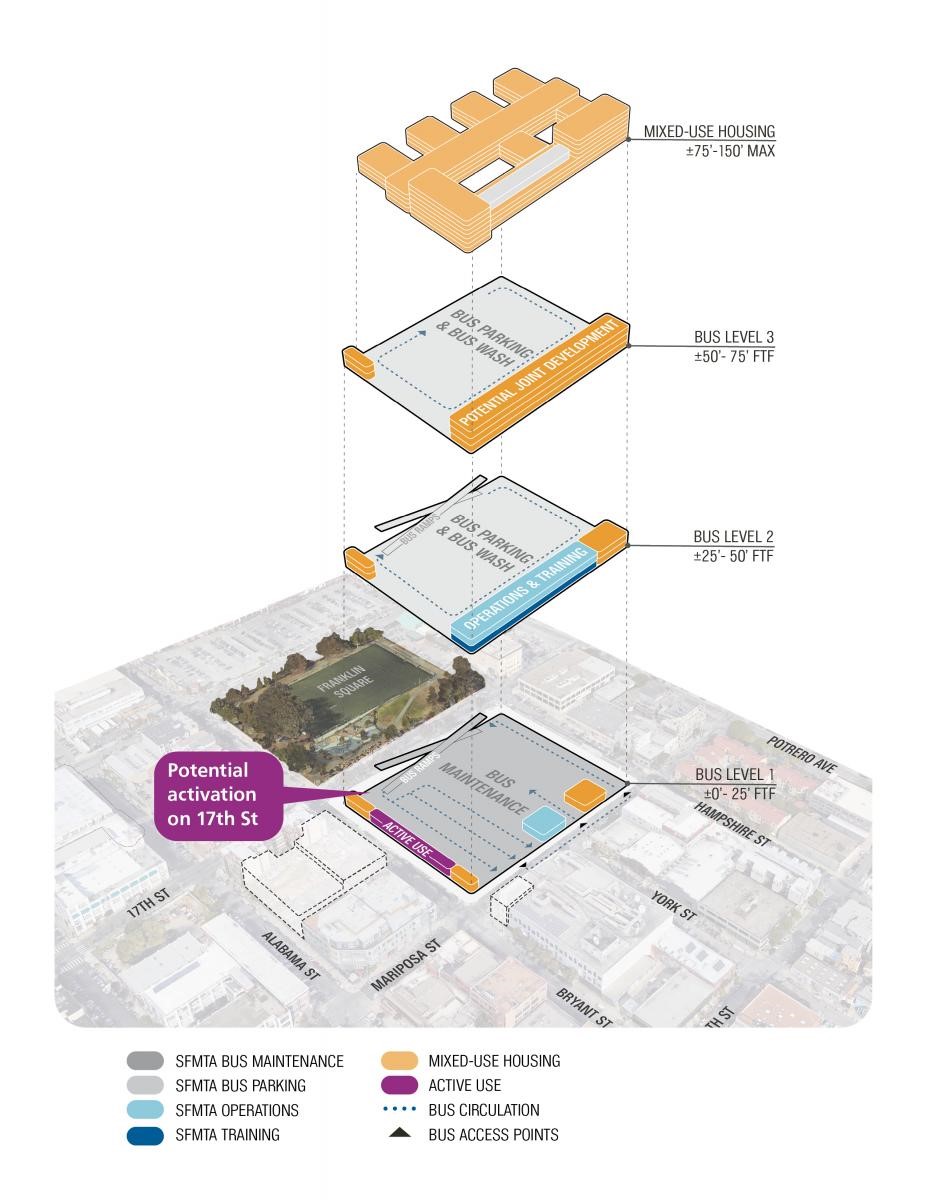
The modern yard will be able to store 213 buses, increasing capacity by approximately 50%.
In addition, the facility will include the following features:
- LEED Gold Certification
- Built to an elevated structural and seismic standard
- Infrastructure for battery-electric buses
- Centralized location for Street Operations - Muni’s “first responders”
- Centralized, modern space for Muni operator training
- Ground floor active uses on Bryant and possibly 17th streets
 Housing on Top of the Yard
We partnered with other City departments (SF Planning Department, Public Works, Mayor’s Office of Housing and Community Development, and Office of Economic and Workforce Development) to explore how the land can be used to accommodate housing above Potrero Yard. Guided by input from the community, the SFMTA has concluded that housing is a feasible, compatible use on the site.
The SFMTA is proposing a range of 525 to 575 housing units with a goal that 50% of the total units are affordable. Many factors informed the proposed project’s size and unit count, such as building height, massing, financial feasibility, and shadow considerations.
Where we Are Now
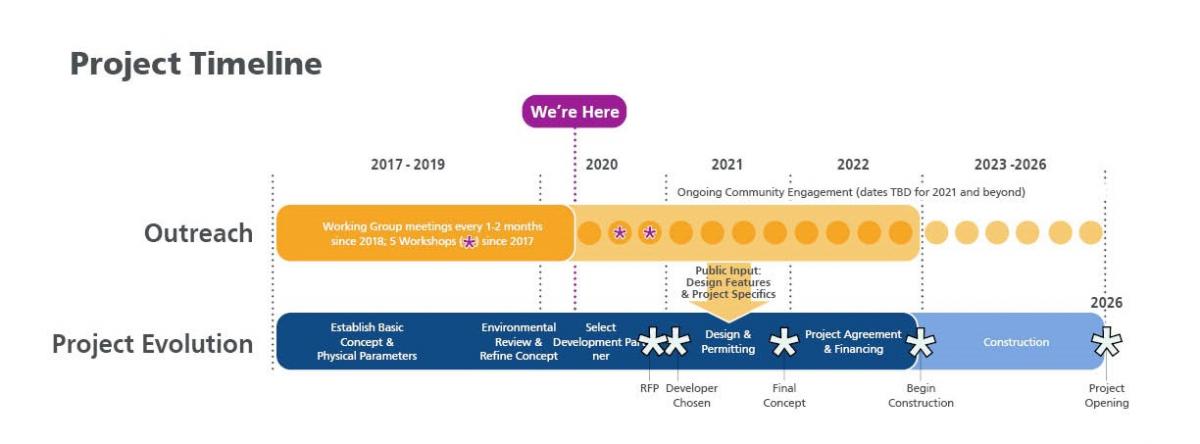
The environmental review process is underway, and we are developing a Request for Qualifications (RFQ) for a joint development partner to design and build the project. We are also introducing legislation to the Board of Supervisors that will enable the SFMTA to deliver the project following a continued public process and environmental review and approval process.
Since November 2019, we have been working with the Planning Department on the environmental review process (CEQA) that will analyze potential environmental impacts and identify strategies for mitigating those impacts.
At the same time, we are working on the RFQ and RFP to procure a joint development partner to finance and build the project. The RFQ process will evaluate the qualifications of proposed project teams and determine the top three responders based on an evaluation of their relevant experience and qualifications. Those top three responders would then be invited to submit a full proposal through a subsequent RFP process. We hope to release the initial RFQ in early June to develop the shortlist of qualified firms. We will then issue an RFP to shortlisted firms in late summer.
Join the Conversation
We recently sent out a spring 2020 update brochure through the mail and email to residents who live near Potrero Yard, Muni employees, and community stakeholders who are generally interested in the project.
Participate in virtual conversations and telephone events:
Saturday, June 6, 11 AM to noon (English), Call 877-229-8493 and enter 119593#
Saturday, June 6, 1 PM to 2 PM (Spanish), Call +1-669-900-6833 and enter 81568997301#
We hope you can join us!
You can also provide input by participating in a phone-based survey by texting “Potrero” to (415) 599-8662 in English or “Potrero” to (415) 707-5406 in Spanish
Learn more about the project and subscribe to project updates by visiting www.sfmta.com/PotreroYard.
Also visit Talking Headways Podcast: Housing on the Bus Yard to hear the project team discuss the project.
For more information, please email PotreroYard@sfmta.com or call us at 415.646.2223.
Published May 19, 2020 at 06:16PM
https://ift.tt/3bK9JTZ
Show HN: Fantasy Congress – a fantasy sports website for politics https://ift.tt/3g5sW60
Show HN: Better Raspberry Pi Performance with ZRAM and Kernel Parameters Tweaks https://ift.tt/2AKh3ST
Show HN: Freetransportationdata.com – Tips/Sources for Transportation Data https://ift.tt/2Tj3AHY
Show HN: Ilograph – Fractal Sequence Diagrams https://ift.tt/3g3MkQS
Show HN: I made an example landing page you can use to improve your copywriting https://ift.tt/2ThWXFJ
Show HN: Python Client for Blockchain Exchange API https://ift.tt/2ZpLTKy
Show HN: Useful Libraries for Go https://ift.tt/2TigFS4
Show HN: Hands-On Data Science Course https://ift.tt/36hDcUm
Show HN: Common ownership between S&P 500 companies https://ift.tt/2zbpHcB
Show HN: Freeciv-Web https://ift.tt/2LDAL4Z
Show HN: Planning poker online – vote your estimates without influencing others https://ift.tt/2LHTnkm
الاثنين، 18 مايو 2020
Show HN: Light up code in text editor as it executes https://ift.tt/2XfMLz4
Show HN: Walkthru Twilio Video P2P WebRTC, WebSockets and Go https://ift.tt/368Virw
Show HN: Turn an image into Unknown Pleasures style art https://ift.tt/3bH42Gw
Show HN: How Much Adobo? – An Adobo and Rice TDEE Meal Generator https://ift.tt/3cHJ2kg
Show HN: Get help on any Linux command by typing 'howdoi –' in your terminal https://ift.tt/3bIhjP3
Show HN: Hustling Sunlight – anagrams in black and white https://ift.tt/3g1Papv
Show HN: Web development – Self evaluation checklist https://ift.tt/36fburk
Show HN: Volunteer mentors/tutors for students affected by COVID-19 https://ift.tt/3g4o6FZ
Show HN: Codeblock.css – 263 bytes to make HTML code blocks pretty again https://ift.tt/3bMN757
Show HN: I scraped local court records to find dirty cops https://ift.tt/2LAp3rE
Show HN: Hiring DevOps and SREs – testing troubleshooting live https://ift.tt/3cJnkMI
Show HN: A Python tool for text-based AI training and generation using GPT-2 https://ift.tt/2LFIakg
Show HN: Explore the returns of senators' stock portfolios https://ift.tt/2zISJjH
Show HN: Contributify: Write Text on GitHub's Contributions Calendar https://ift.tt/2WH89xW
Show HN: A technical SEO cheat sheet (and flying astronaut) https://ift.tt/3fZyKOd
Show HN: Automatically generate fast validation functions for TypeScript types https://ift.tt/3dWXnJC
Show HN: Hot-swap API endpoints and Kafka streams with Clojure and Dataworks https://ift.tt/2LEBt1G
Show HN: Little Ball of Fur – A Python library for graph subsampling https://ift.tt/2TgEFFb
Show HN: Vrmac Graphics, a cross-platform graphics library for .NET https://ift.tt/2zJPf0v
Show HN: A password manager for your grandma https://ift.tt/2XdvNBo
الأحد، 17 مايو 2020
Show HN: Single-page web app for prototyping financial scenarios https://ift.tt/2Z8ZCWe
Show HN: A platform for longform online discussions between two or more people https://ift.tt/2TcLgAs
Show HN: WhatCanWePlay? Find games that you and your friends already own https://ift.tt/2TeGvGq
Show HN: Career Fair – Learn about Jobs by People Who Have Done Them https://ift.tt/2WZJnIk
Show HN: Today's HN stories along with similar past ones https://ift.tt/2X4gKKb
Show HN: Python convtools library – code generation for data transforms https://ift.tt/2z5WiR4
Show HN: Musical instrument practice with web audio https://ift.tt/2LA2tj5
Show HN: Unpacking HP Firmware https://ift.tt/2LCbRTe
Show HN: Tech Notes – A weekly longform newsletter on tech https://ift.tt/36igCLn
السبت، 16 مايو 2020
Show HN: Run VSCode on iPhone and iPad https://ift.tt/3dPWEKi
Show HN: Find personal blogs written by humans https://ift.tt/3fVk96p
Show HN: Trade stocks from the command line with no commission https://ift.tt/2yUxk7h
Show HN: Hacker Spring – Instant blog by email, no signup required https://ift.tt/2z4NZVt
Show HN: VPC Design Studio – Subnet CIDR planning with Terraform/Pulumi code gen https://ift.tt/2LAlGAZ
Show HN: Beautiful forms connected to your Notion dbs https://ift.tt/2TciQXj
Show HN: XP.css – Windows XP CSS file and framework for building GUIs https://ift.tt/36hg3kZ
Show HN: Use DynamoDB with the Redis API (Go) https://ift.tt/3fU8PHV
Show HN: Visual Brainfuck Interpreter https://ift.tt/2LBufLQ
Show HN: Sorcia – a Federated Git hosting engine https://ift.tt/2LxKl9c
Show HN: Hacker Feud https://ift.tt/2ZbTf4C
Show HN: A GitOps development environment in the comfort of your own localhost https://ift.tt/2ArHPiz
Show HN: Docup – single-page documentation for your open source projects https://ift.tt/3cEo8m2
Show HN: New UI pattern for file manager type apps https://ift.tt/2Z9Av5G
Show HN: ONNX-Based ML Deployments https://ift.tt/3bA8TZT
The Next Phase of Slow Streets
By
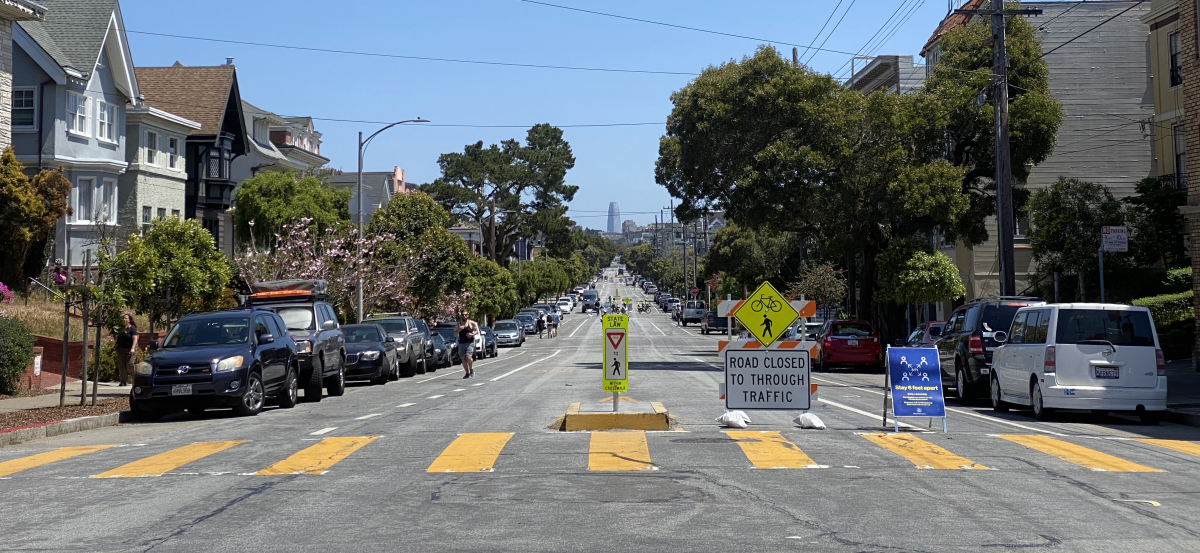
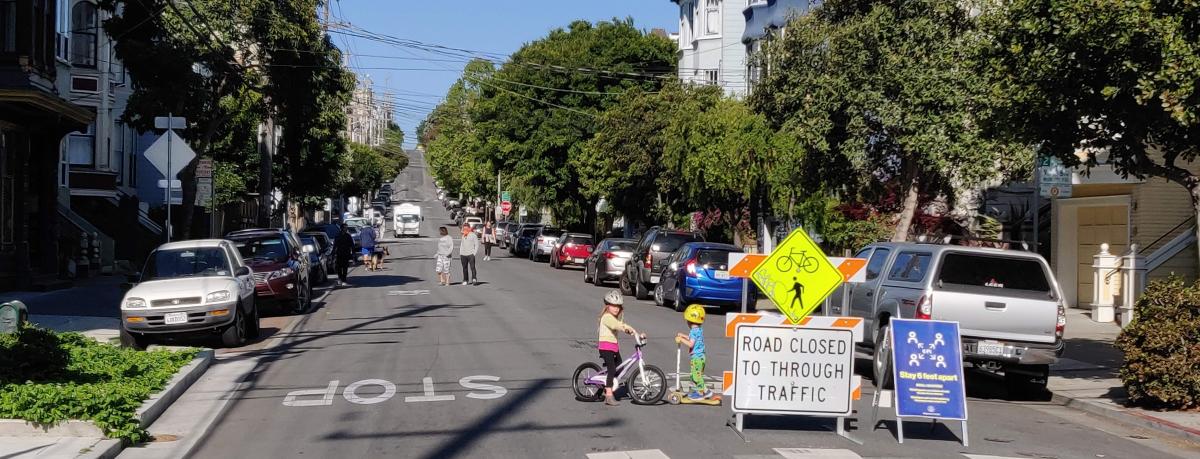
Due to the COVID-19 health crisis, the way we get around and where we are going are changing. Many San Francisco residents need to walk and take other modes of transportation for their essential trips. However, sometimes it is difficult to maintain the six feet of social distance on many sidewalks. Because of this, many pedestrians are choosing to walk in the street, exposing themselves to swiftly moving vehicle traffic. Our Slow Streets program aims to limit through traffic on certain residential streets and allows them to be used more as a shared space for foot and bicycle traffic.
At the start of the program, we released a survey and have happily received over 1,300 Slow Streets suggestions from San Franciscans. We heard broad support of the program from many residents and businesses, and we are pleased to announce the following future Slow Streets corridors, many generated by you:
- 20th Street, from Valencia to Potrero
- 23rd Avenue, from Lake to Cabrillo
- Chenery, from Elk to Brompton
- Excelsior, from London to Prague
- Golden Gate Avenue, from Masonic to Divisadero
- Jarboe, from Moultrie to Peralta
- Lane, from 3rd Street to Oakdale
- Lombard, from Jones to Stockton
- Mariposa, from Kansas to Texas
- Sanchez, from 23rd to 30th
- Shotwell, from 14th Street to Cesar Chavez
- Somerset, from Silver to Woolsey
- Stockton, from Bay to Lombard
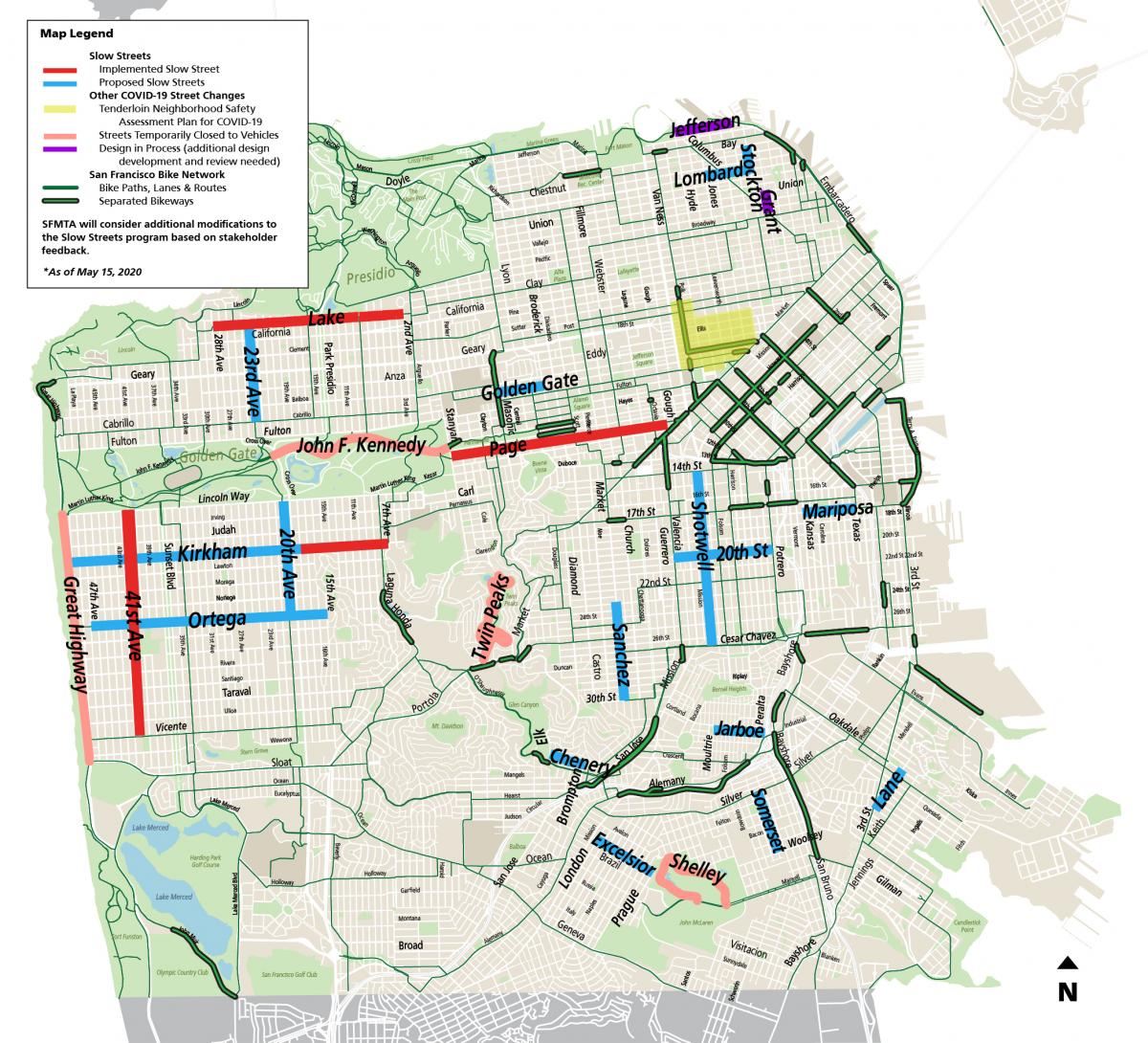 SFMTA’s implemented (red) and proposed (blue) Slow Streets corridors.
The first four Slow Streets corridors we implemented (41st Avenue, Kirkham, Lake, and Page) total 11 lane miles, and the remaining first phase of planned Slow Streets total 9 lane miles. These thirteen new corridors add another 14 lane miles of streets prioritized for walking and biking, for a complete Slow Streets network of 34 lane miles.
Slow Streets are one element of the city’s efforts to provide physical distancing as people make essential trips. They create more space for those traveling on foot or by bicycle while still making sure people who live on the streets, and emergency vehicles have full access. Signage restricts through vehicle traffic, and SFMTA has worked with navigation map providers to re-route through traffic through these corridors on their apps.
How were these streets selected?
SFMTA staff gathered the most frequently suggested corridors. Streets were initially screened for conflicts with Muni service, primary public safety routes, and commercial loading zones. Additional screening criteria included intersection geometry and sight distances, topography, surrounding land use, connections to the bicycle network and open space network, and reductions in Muni service.
The most requested Slow Streets corridors include Sanchez Street and Shotwell Street in the Mission, Chenery Street in Glen Park, and Golden Gate Avenue in Western Addition. We also solicited corridor suggestions from community-based organizations and District Supervisors’ offices and included recommendations from previous community planning efforts.
Due to the multiple uses of our roadways, not all streets are good candidates for Slow Streets. For example, Jefferson and Grant streets are locations with high commercial delivery needs and complex emergency vehicle access needs. We are working with adjacent stakeholders and other City departments to create a detailed plan that allows for increased pedestrian access, business recovery, and complex access needs during the current public health crisis.
What is the Tenderloin Neighborhood Safety Assessment and Plan?
We heard a lot of interest in adding more Slow Streets to the Tenderloin area. At the same time, last week Mayor Breed announced the release of the Tenderloin Neighborhood Safety Assessment and Plan for COVID-19 -- a comprehensive report of the current conditions in the Tenderloin and a block-by-block plan for addressing those challenges.
The Tenderloin Plan is part of the City’s broader efforts to address the public health crisis in San Francisco and among people who are experiencing homelessness. We noted the area on the map above and will support other departments in our capacity, including adding things like Slow Streets where appropriate.
What is next?
We are currently working to schedule the implementation of the additional Slow Streets corridors with the input from neighborhoods, community groups, and elected officials. SFMTA is balancing the need for Slow Streets in each district and will share regular updates on our progress and plans.
Please remember to use Slow Streets for essential trips. They are not neighborhood gathering points. We also encourage everyone to bring a face covering and maintain proper physical distance from people outside their households. We are continuously monitoring this program for its effectiveness and want to make sure it is being used properly.
For updates and additional information on the SFMTA’s Slow Street Program, visit the program webpage at SFMTA.com/SlowStreets. Please also visit SFMTA.com/COVID19 for the latest agency updates about our COVID-19 response.
Published May 16, 2020 at 05:56PM
https://ift.tt/2LA60hm