الخميس، 30 أبريل 2020
Show HN: A device simulator that cycles through many mobile device simulations https://ift.tt/35pBEab
Show HN: Kmdr – Explains the syntax of CLI commands you select in the browser https://ift.tt/2Yt1CIi
Show HN: Full Text Search on Podcasts https://ift.tt/35hLWt2
Show HN: Pantry – Free JSON Storage for Personal Projects https://ift.tt/2KRIiwk
Show HN: Game of Life in 32 bytes of assembler https://ift.tt/2YjAzzi
Show HN: ArcadeJack: Daily Math Practice for grades 1 to 4 https://ift.tt/35ooni7
Show HN: Connect.Club app – Real networking in a virtual world https://ift.tt/3f7Izta
Show HN: Layer – Get a dozen staging servers per developer https://ift.tt/3f6nnE0
Show HN: Census – The missing “export” for data warehouses https://ift.tt/2VPqFDO
Show HN: Tara – A smart and free alternative to Jira https://ift.tt/2Wenq7V
Show HN: XpanXn – chat designed for how conversations work https://ift.tt/2VRH7DO
Show HN: Pitsby – Have a nice time documenting components https://ift.tt/3aOzouo
Show HN: Instantly Find anything across your email, cloud drives, and more https://ift.tt/2YjAw6w
Show HN: A compiler for a small language into x86-64 assembly https://ift.tt/3cZPByc
Show HN: Quantum JavaScript https://ift.tt/2Yl0Mxx
Show HN: I built an addon as I was getting distracted in this lockdown period https://ift.tt/3bLyzDP
Show HN: Browser extension for playing emoji sounds https://ift.tt/35hSnfC
Show HN: An interactive CLI ArXiv explorer https://ift.tt/3aSnQWV
Show HN: Hex Edit Pcaps in Vim https://ift.tt/2xmDdt5
Show HN: GIF Tracking Protection – Prevent privacy-invasive 1x1 GIFs https://ift.tt/2Skm22A
Show HN: Sci-Hub Now! – Free access to academic paper with just a single click! https://ift.tt/3aRdpTB
الأربعاء، 29 أبريل 2020
Show HN: Konsen – Distributed key-value store based on Raft protocol https://ift.tt/3aJ44Ny
Show HN: Summarize your time availability in seconds https://ift.tt/3eY2F9f
Show HN: OpenMorphi – Build SVG animations between 2 emojis (web, desktop only) https://ift.tt/35hZ4hG
Show HN: My New Web Page Looks Like Windows 95 https://ift.tt/3aMg40z
Show HN: Komak, a geolocation-enabled volunteering platform for Covid-19 https://ift.tt/2W4F51S
Show HN: A puzzle game for learning stack operations https://ift.tt/3eXwRkR
Show HN: Pragli, a virtual office for remote teams https://ift.tt/2Sg5ubS
Show HN: Moanalytics.com – Analytics management for your team https://ift.tt/3f4R1cw
Show HN: Lynk – Securely expose local TCP and HTTP services to the web https://ift.tt/2W7J7Xq
Show HN: Insomnia Designer, an API Designer Powered by Insomnia https://ift.tt/2KGlShM
Show HN: Leantime 2.1 – open-source Project Management System https://ift.tt/35irfNm
Show HN: Building a real time dashboard using by server rendered partials https://ift.tt/2WaXRoo
Show HN: React Futures – manipulate asynchronous data synchronously https://ift.tt/3cXJA53
Show HN: Learning Node Representations That Capture Multiple Contexts (PyTorch) https://ift.tt/2KLHZ6i
Show HN: Midas, a Streaming Anomaly Detector. Now Implemented in Go https://ift.tt/3f5bD4n
Show HN: A 108-point Ecommerce Conversion Checklist to increase conversion rate https://ift.tt/2zyqLqH
Show HN: Git-cloc – Embeddable lines of code stats for your Git repo https://ift.tt/2zHBq2v
Show HN: NoCode Covid response apps to accelerate remote work https://ift.tt/3cYBfy0
Show HN: MonkeyMind – A shortcut-driven to-do list for your Mac's menu bar https://ift.tt/3f1oCEl
Show HN: A sound-effect chatroom for meeting engagement https://ift.tt/3bP1czX
الثلاثاء، 28 أبريل 2020
Show HN: A Shell for Working Effectively with Multiple Kubernetes Clusters https://ift.tt/35eb97D
Show HN: A simple app to cryptographically time-lock files https://ift.tt/2zIHfgh
Show HN: Parallel.so – looking for early stage users https://ift.tt/3f6RefB
Show HN: Implement a Simple VM in JavaScript https://ift.tt/2W7P7zh
Show HN: Treenga – simple task management for remote teams https://ift.tt/2KNbCEd
Show HN: S3kit – AWS S3 command-line tool for tags/versions/lock management etc. https://ift.tt/2yQ0Hag
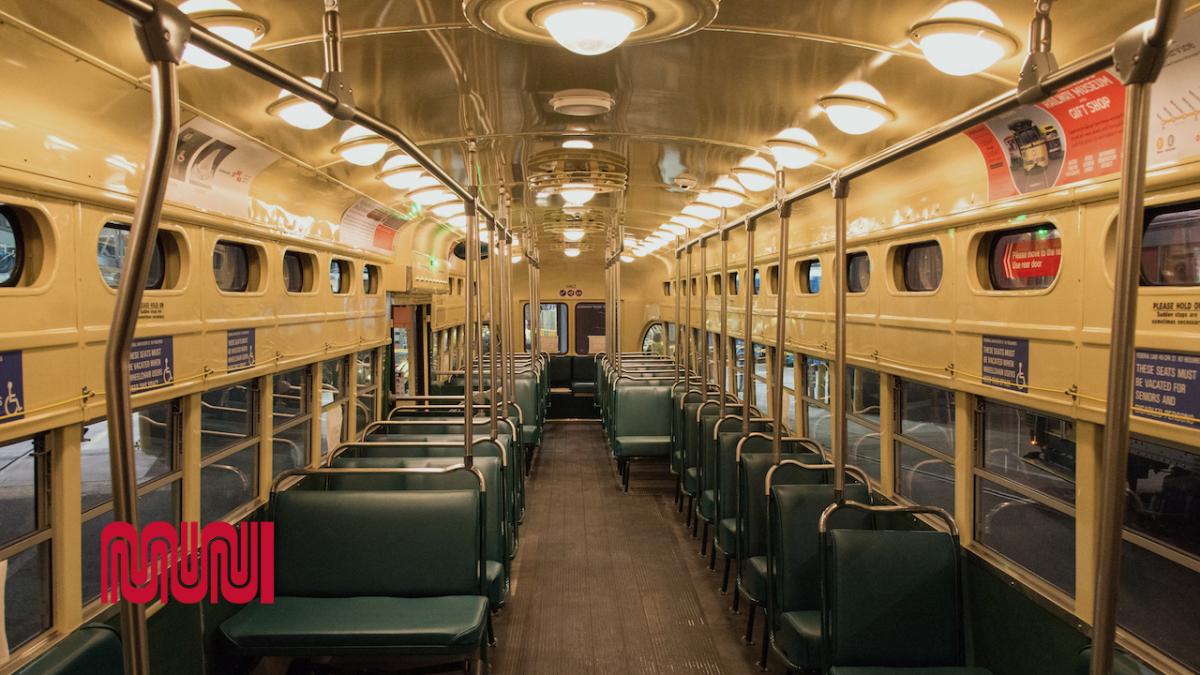
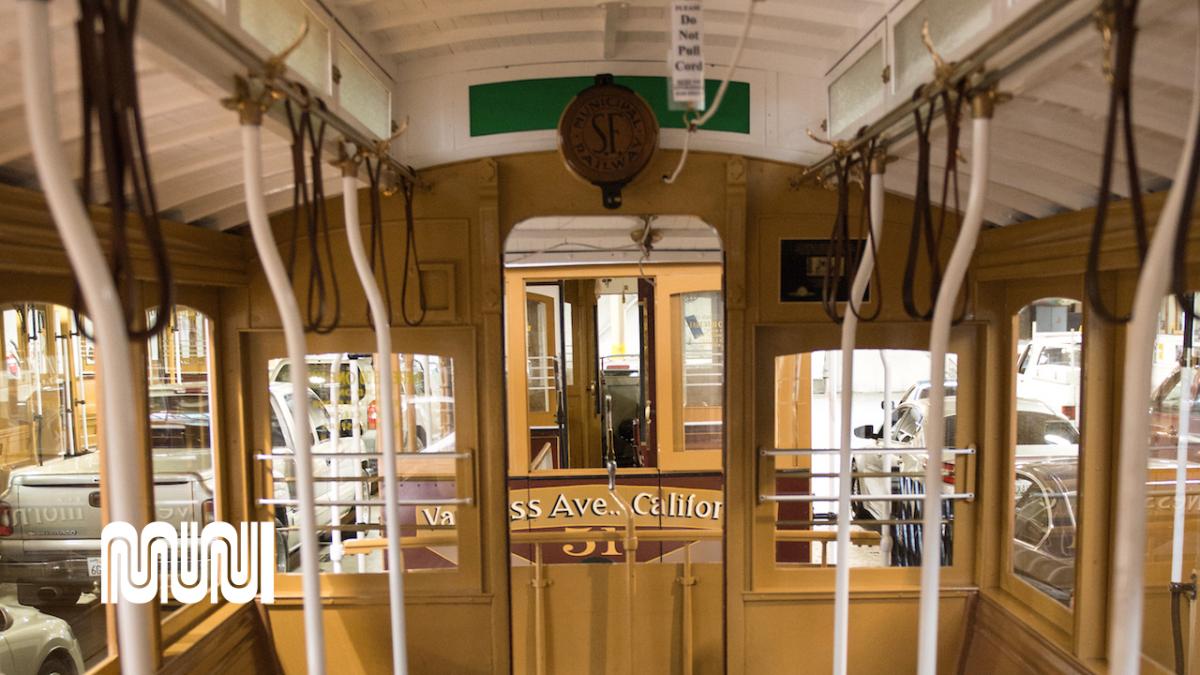
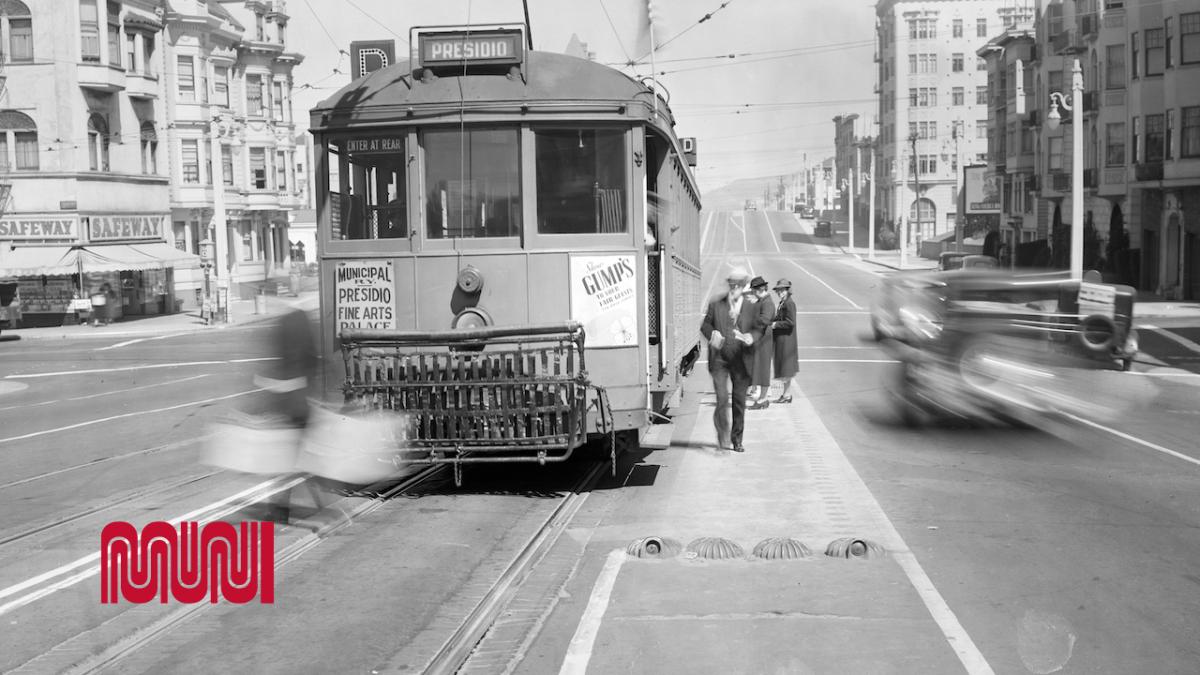
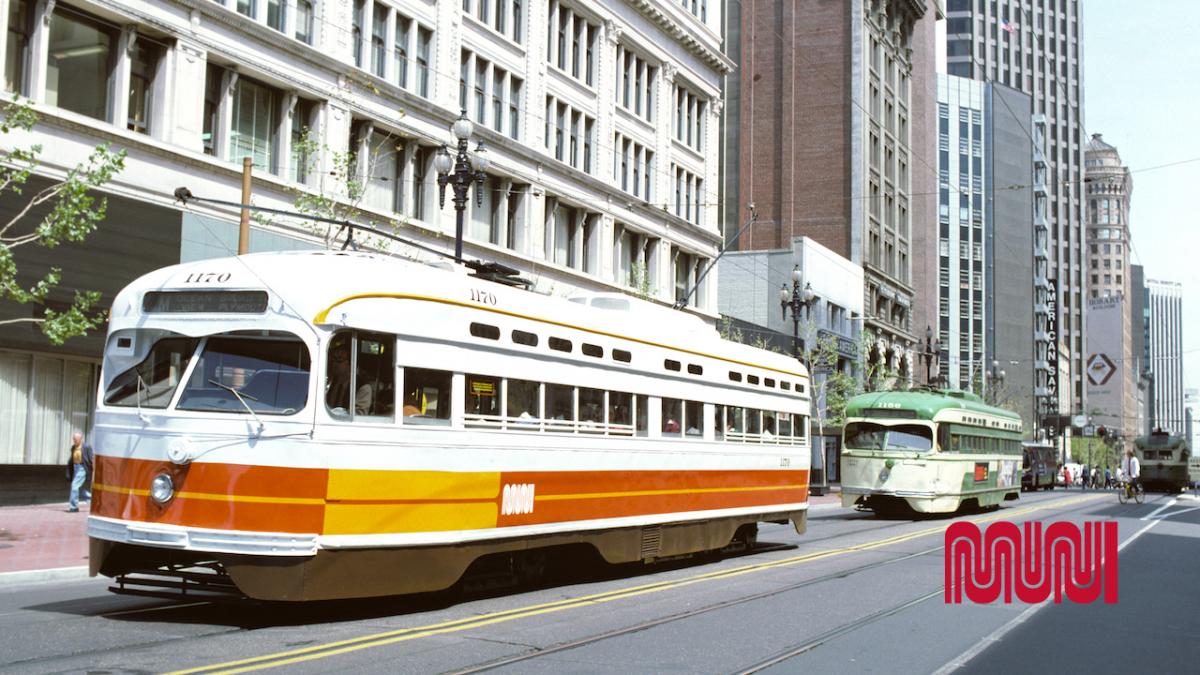
Muni inspired virtual backgrounds
By Sophia Scherr
Whether you’re telecommuting, teaching or learning online, or staying home and riding Muni for essential trips only - do it in style with these Muni virtual backgrounds. Download, save and use them for any of your preferred video chatting platforms. For the latest COVID-19 related transit updates please visit SFMTA.com/COVID-19.


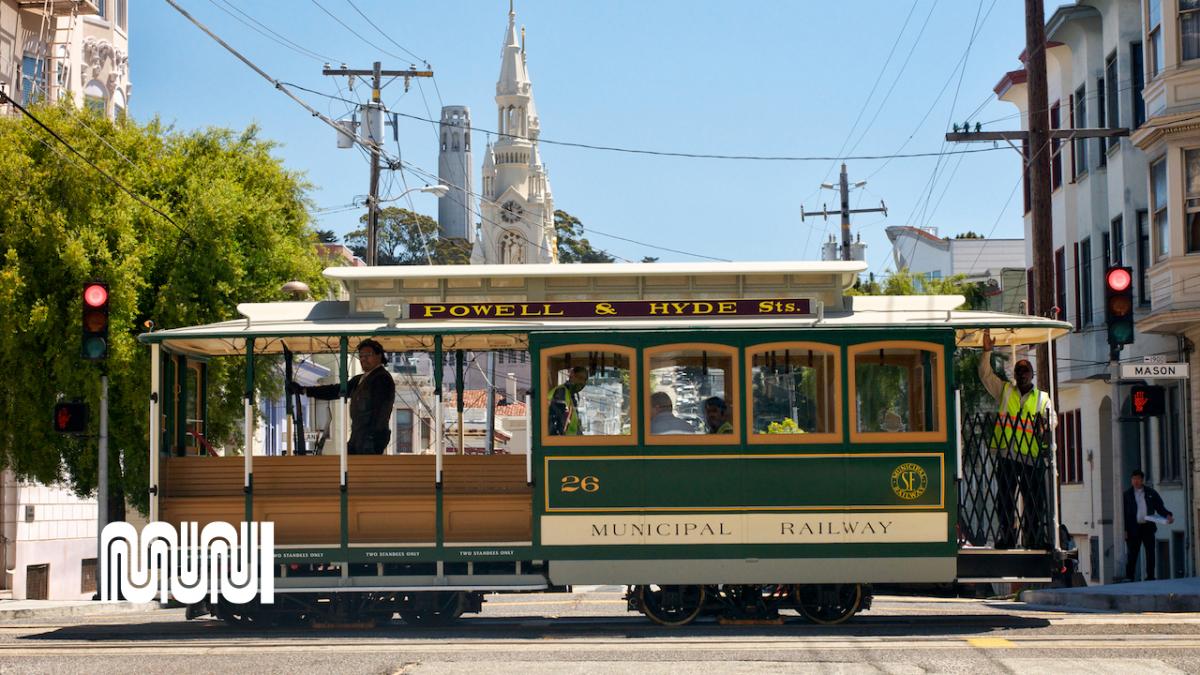
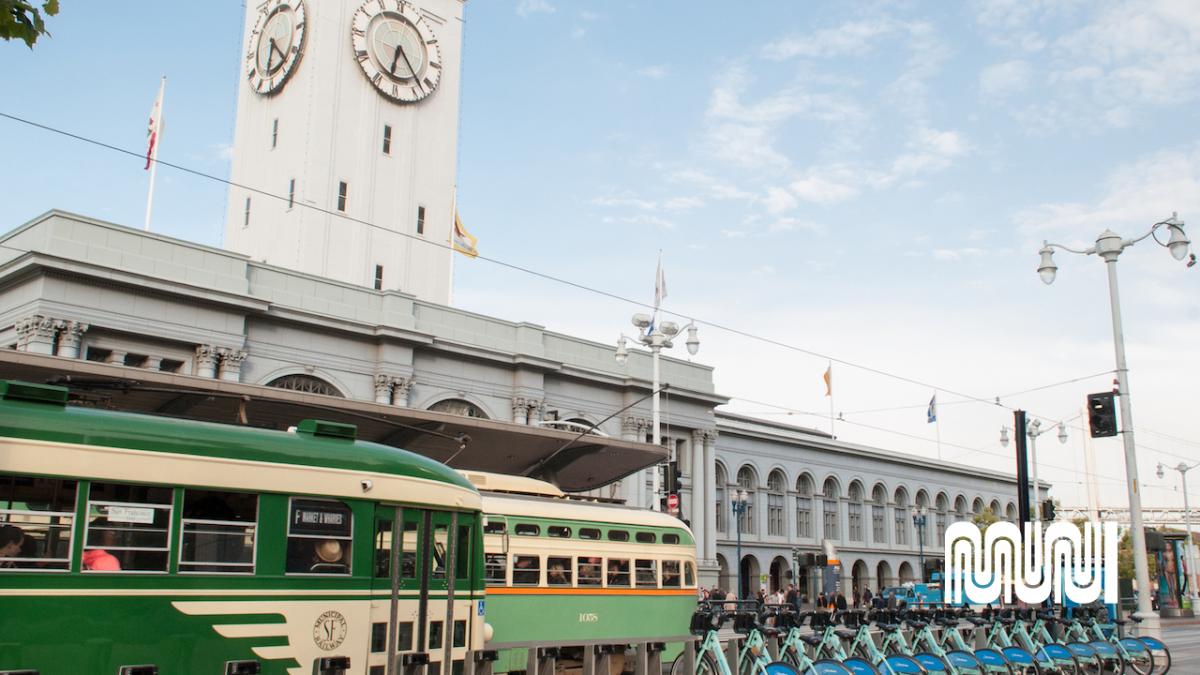
Published April 28, 2020 at 11:42PM
https://ift.tt/3cQpcTo
Show HN: List of Serverless Functions for JAMstack Apps https://ift.tt/3eYR5dZ
Show HN: Code Time 2.0 – free automatic time tracking and metrics for devs https://ift.tt/3cUwYLX
Show HN: Android App – But Did I Do It: Build Habits That Matter” https://ift.tt/2YfxCQo
Show HN: Liftbridge – Lightweight, fault-tolerant message streams https://ift.tt/2YeOaaU
Show HN: AI Cough Diagnostic for COVID-19 https://ift.tt/2KGHlar
Show HN: Add license key verification to your apps https://ift.tt/2KJLUk1
Show HN: A volunteer driven list of your city's indie bookstores https://ift.tt/2xYauev
Show HN: Deploy Jitsi on AWS in 5 Minutes https://ift.tt/3bM6Mmx
Show HN: Search all 700 plus of HireRemotely’s tracked jobs https://ift.tt/2yODvsY
Show HN: A Step-by-Step Guide to Making 3D Maps with Satellite Imagery in R https://ift.tt/2SfJH48
Show HN: Editly – Slick, declarative command line video editing https://ift.tt/2KIWLL4
Show HN: Versatile Coronavirus Covid-19 Tracker Using Grafana https://ift.tt/2VIB18s
Show HN: Wotop – Web on top of any protocol https://ift.tt/2W8I750
Show HN: Gallery of 200 database schema diagrams of open-source packages https://ift.tt/3d1tvLX
Show HN: New highly configurable raw SSL terminal https://ift.tt/2W7IwVs
Show HN: I built a no-code abstraction layer on top of Stripe https://ift.tt/2SgocQK
Show HN: Tell us what you wanna learn and we’ll find high quality content for it https://ift.tt/3cXX1SL
الاثنين، 27 أبريل 2020
Show HN: A web app to search upcoming IPOs https://ift.tt/2W7Y9MA
Show HN: An open-source, online implementation of the card game Literature https://ift.tt/35bl4e5
Show HN: Place where you can follow and share collections of links for learning https://ift.tt/2W9jLZg
Show HN: I made an E-book compiling the best of r/personalfinance https://ift.tt/3cQAZRz
Show HN: AI Generated SEO Articles https://ift.tt/2Yb7G8v
Show HN: Automated Redaction sensitive information from PDF thru Pdffiddler https://ift.tt/2zC1yMf
Show HN Trends on Hacker News https://ift.tt/2KJpRtH
Show HN: Goodnight Zoom – Remote storytime with isolated seniors https://ift.tt/3bGg8Aw
Show HN: GoldenHour App for Mac https://ift.tt/2VJs5zU
Show HN: A syntax highlighter for Git and diff output, written in Rust https://ift.tt/2zsLMTE
Show HN: Resuming Elixir by self-hosting plausible analytics https://ift.tt/2S8Y0Ht
Show HN: Wrk – we built a simple and affordable way to hire https://ift.tt/2SaVd0I
Show HN: A decentralized and anonymous contact-tracing app https://ift.tt/2zzWeJg
Show HN: Indie Game – Make your friend guess movies using only 3 emojis https://ift.tt/359McKt
Show HN: AriFramework – Template based without virtual DOM and Webpack https://ift.tt/2xb8P4D
Show HN: Lua Pubsub client driver for the ngx_lua based on the cosocket API https://ift.tt/3cVz1PR
Show HN: I built a tool to send you daily digest of your saved bookmarks https://ift.tt/357Ij8M
Show HN: Shared Inbox for Gmail and Slack https://ift.tt/3eUfuBo
Show HN: An iPhone app that lets you pick colors and identify PANTONE colors https://ift.tt/2W0coDg
Show HN: Web app to compare various PDF-to-text libraries easily https://ift.tt/2S7NMXR
Show HN: Play snake by moving your head https://ift.tt/3eUoPJr
الأحد، 26 أبريل 2020
Show HN: Pure CSS Threadlines for Hacker News https://ift.tt/2VEKPAd
Show HN: Talkie, an app for system-wide push-to-talk https://ift.tt/2VZsugl
Show HN: Gez.la – Explore all kind of places around the world with virtual tours https://ift.tt/2xRl5YD
Show HN: Gmail CLI Utils (bulk delete mail by query, get/create filters) https://ift.tt/3d0Txir
Show HN: First time I got interested in game probability, the Monty Hall problem https://ift.tt/2KxUzGp
Show HN: I hit inbox zero every day with this Gmail filter https://ift.tt/359yJ5e
Show HN: Games, Learning Apps and Coding https://ift.tt/2S90iqe
Show HN: 4x4x4 Rubik's Cube solving machine https://ift.tt/3aDst75
Show HN: Leader Election Using Apache Kafka https://ift.tt/3cN62xO
Show HN: Xlskubectl – control your Kubernetes cluster with Google sheets https://ift.tt/2xe97rE
Show HN: Role2Vec: Learning Role-Based Graph Embeddings https://ift.tt/3bGHaHI
Show HN: Kanmail – An email client that functions like a kanban board https://ift.tt/3cLI3Px
Show HN: Linux Webcam Automation https://ift.tt/2xZfG1z
Show HN: Convert a number to an approximated text expression https://ift.tt/3aKrGl2
السبت، 25 أبريل 2020
Show HN: Docker.hostip.dev – Access localhost from Docker on Mac, Linux, windows https://ift.tt/2Y2bitn
Show HN: I made a dev first signup form for your landing page https://ift.tt/2S8FIX1
Show HN: Brew Diary – An Apple Watch application to track your brews https://ift.tt/2VXahjF
Show HN: A Github Action for deploying files to the any cloud storage https://ift.tt/3eQOwdN
Show HN: Get a daily email of Wikipedia's “Current Events” https://ift.tt/2VZ6RNi
Show HN: Academic research group website template (React/Bootstrap) https://ift.tt/2KBqDJf
Show HN: An interactive choropleth map of countries by tap water quality https://ift.tt/2S6CaEu
Show HN: Free foreign exchange rates API https://ift.tt/2Y65FKM
Show HN: Control vlc with commands specified in a file e.g. skip, change volume https://ift.tt/3eS1CaE
Show HN: Catch'Em All – frameworkless app from JSON to PWA https://ift.tt/2Y2uDuf
Show HN: Magic Photo Eraser – Remove Unwanted Content from Your Pictures https://ift.tt/2VzAhCs
الجمعة، 24 أبريل 2020
Help Me Decide Please https://ift.tt/3eOvyob
Show HN: AriFramework – Svelte Without Compiling https://ift.tt/2KxI6lY
Show HN: I created a CS:GO game server hosting platform and launched an MVP https://ift.tt/2VTz2x7
Show HN: Python tool to calculate and visualize trading indicator https://ift.tt/2VZRZhu
Show HN: A simple storage pricing calculator for AWS https://ift.tt/2Kz5tM1
Show HN: Like Headspace, but free, forever. https://ift.tt/2S6L6Kb
Show HN: The Poet of Logic Programming (Interview with Robert Kowalski) https://ift.tt/2Y2QnGk
Show HN: Dictionary Functions – Functions to look up dictionary on Google Sheets https://ift.tt/2Y1uOpL
Show HN: Shepherd – Get inside intros to dev teams with great culture https://ift.tt/2VTf8lU
Show HN: Mailform Checkout API – post a PDF, we'll handle print, mail, & payment https://ift.tt/352HfTD
Show HN: A free online ordering system for restaurants https://ift.tt/2zsyR4i
Show HN: Extract text from any pdf in the browser https://ift.tt/2VX4uu6
Show HN: We mapped Epidemiology Twitter to combat Covid-19 misinformation https://ift.tt/2S343xf
الخميس، 23 أبريل 2020
Show HN: Buzzwork Haikus https://ift.tt/3asuNOg
Show HN: I trained a recurrent neural network to draw dick doodles https://ift.tt/3eMxLR3
Show HN: Booste – Run apps in EC2, synced to your own text editor https://ift.tt/2VxjUGt
Show HN: Web development – Self-evaluation checklist https://ift.tt/2VUnz07
Show HN: Compare Covid death probabilities to skydiving and other activities https://ift.tt/3eLVS26
COVID-19 Ambassadors Help You Ride Muni Correctly
By Mariana Maguire
If you’re taking Muni for essential trips along Market Street you might see SFMTA’s yellow-vested Ambassadors wearing face masks or coverings and directing customers to maintain safe physical distance at curbside bus stops and boarding islands. What you can’t see are their smiles behind their masks as they work throughout the day to help San Francisco “flatten the curve.”
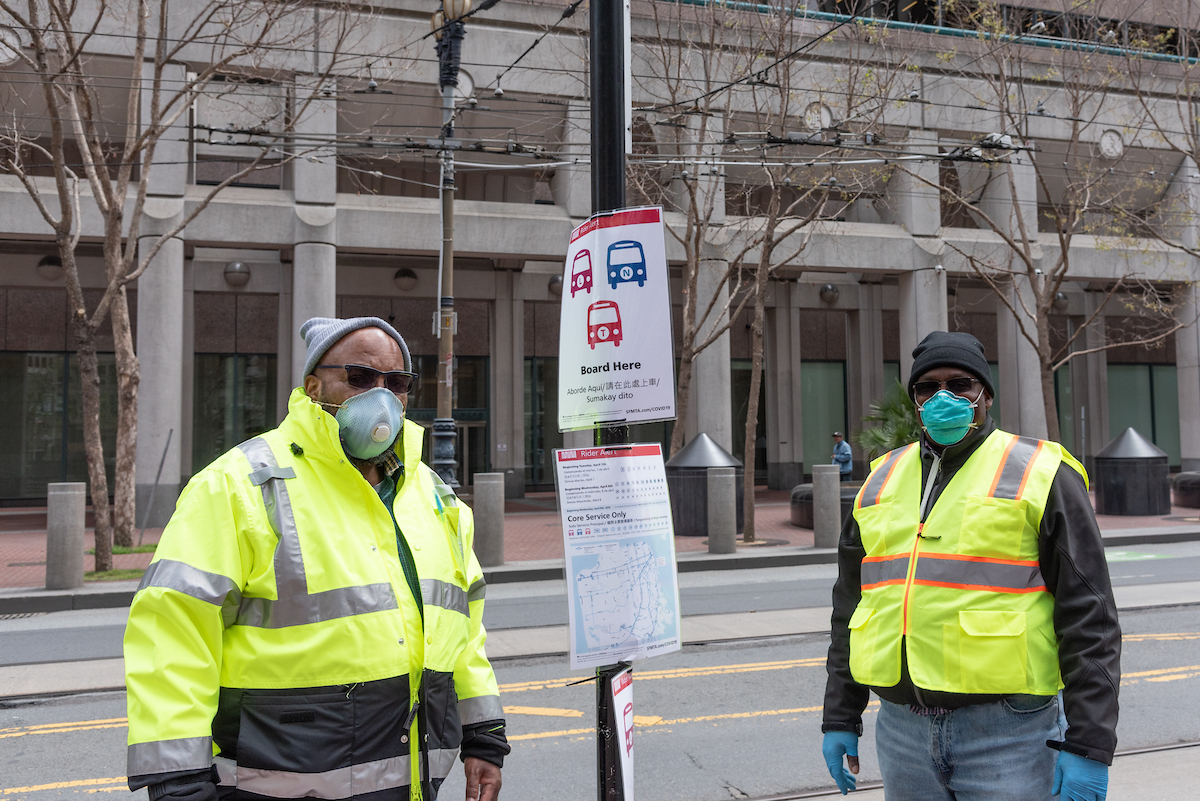 COVID-19 Ambassadors at a bus stop on Market Street.
Last week, the SFMTA launched our COVID-19 Ambassador Program. Although overall ridership is down, during peak times in certain areas we sometimes still see crowding at bus stops and on buses. If a bus is too crowded, our operators will stop picking up new passengers until there is enough room for more. We know that this and other changes are tough on everyone.
That’s where our Ambassadors come in. Their aim is to encourage customers to practice good public health behavior throughout the entire Muni experience – waiting, boarding, riding – as well as informing customers about alternatives to Muni like our new ETC discount taxi program for older adults and people with disabilities. They also have information on the temporarily modified routes or can explain why a bus may have just passed up riders.
In some places, we added markings on the ground at bus stops to signal where the customers can wait at an appropriate physical distance from one another, just like those at many area supermarkets and other essential businesses.
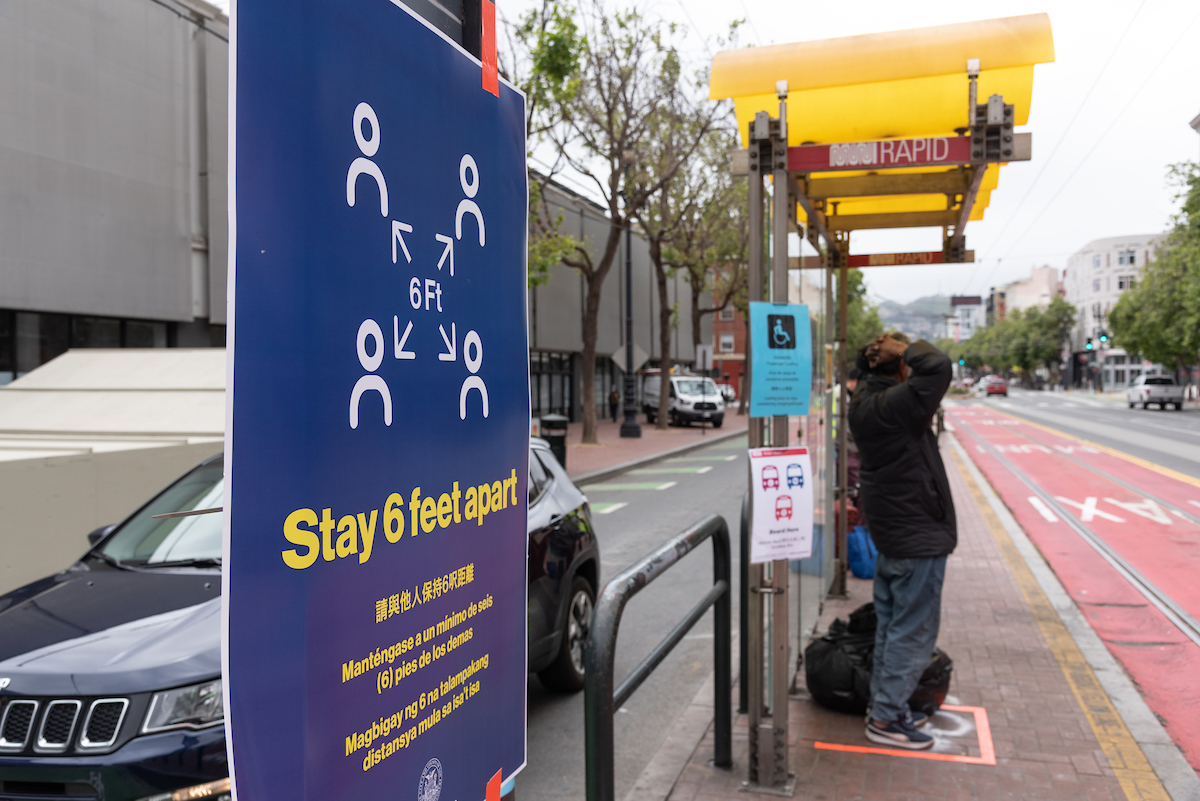 Signage and ground markings at Muni stops encourage physical distancing.
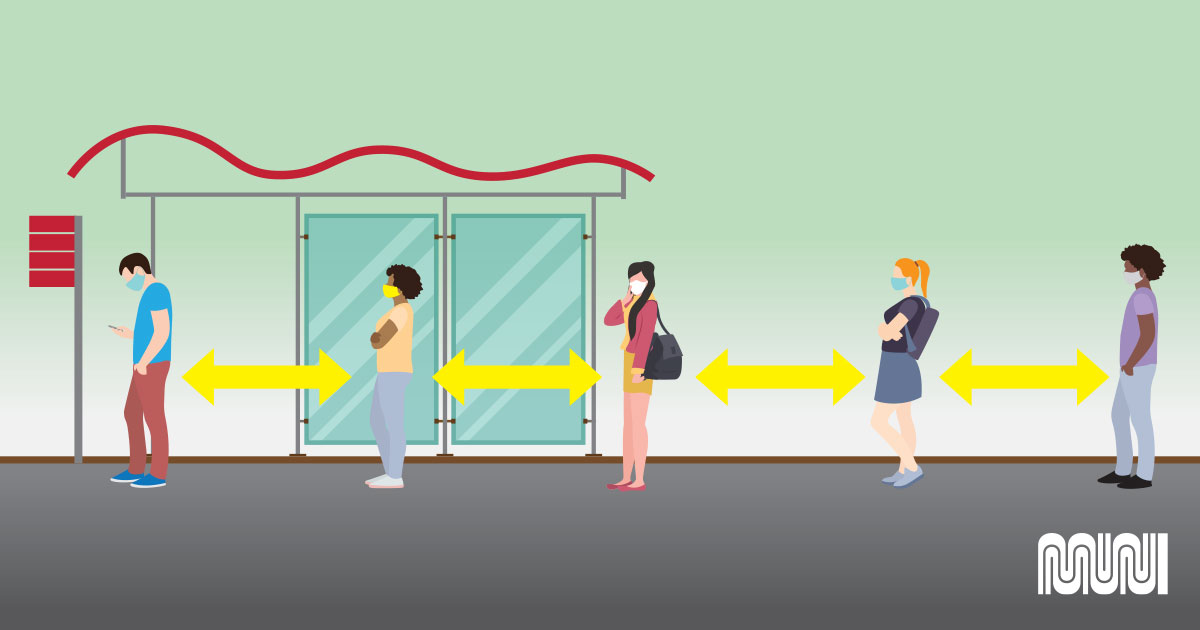 Graphic showing physical distancing at Muni stops
To encourage customers to give each other space on and off Muni, when buses arrive about half full or more, Ambassadors may ask customers to wait for the next bus. And, once a bus arrives the Ambassadors remind waiting customers to give space to those offloading, explain that customers are required to wear a cloth face covering or mask, and ask customers to maintain physical distance inside the bus throughout their ride.
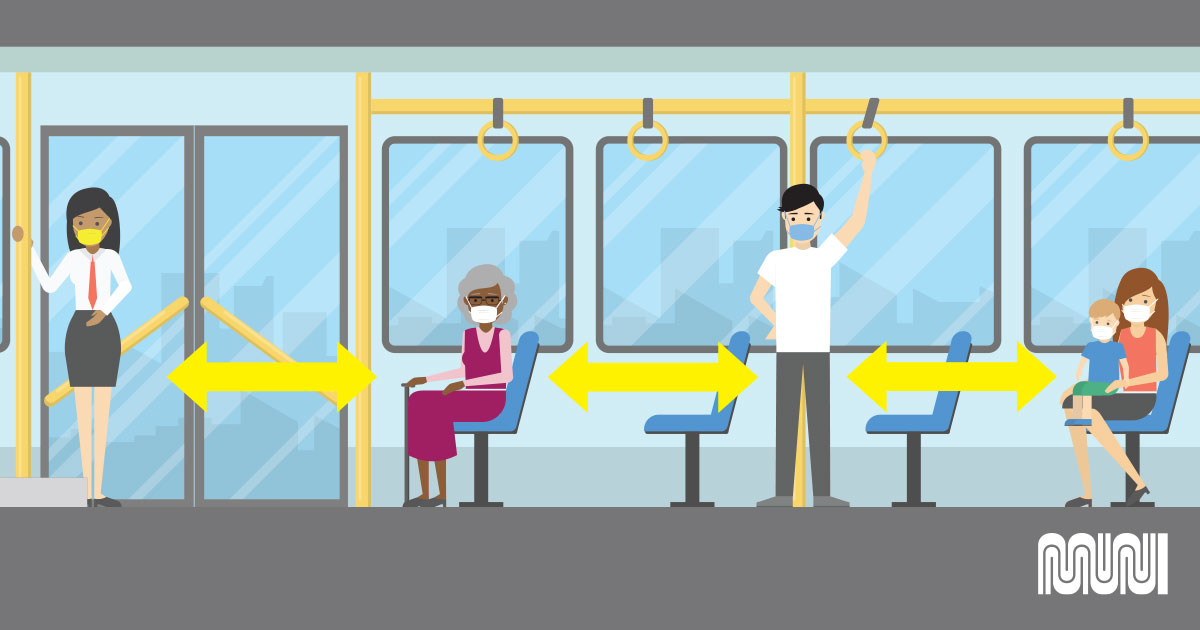 Example of physical distancing on Muni buses: Wear a mask or face covering and give space for fellow riders.
We have also launched new onboard announcements and two social media campaigns encouraging customers to #stayhome and use Muni for #essentialtripsonly. New signs inside Muni buses and ads on the outside of buses are coming soon to remind customers to give space and wear face coverings or masks.
Now that wearing face coverings is a citywide order, customers are required to wear these when riding Muni. Operators may skip stops if those waiting don’t have face coverings. Operators have been instructed that they may also skip stops if the bus is already more than half full to maintain appropriate physical distancing on board.
Though ridership has decreased dramatically thanks to people staying home in observance of the shelter-in-place, Muni continues to serve approximately 100,000 customers daily. These customers are largely hospital workers, social service providers, grocery store workers and other essential workers. Any time you take another mode of transportation, you save a seat for those who rely on Muni. If you need to ride, be sure to wave hello to our Ambassadors.
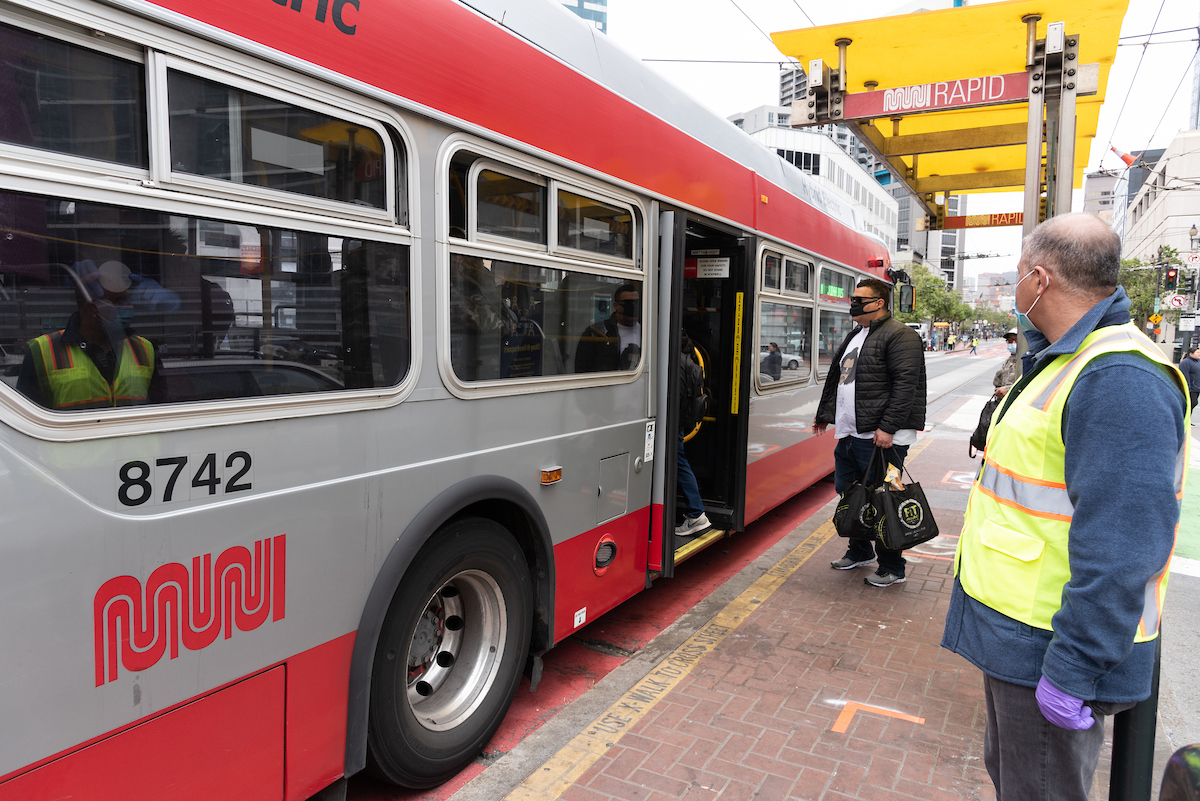 Muni Ambassador looks on as customer wearing a mask waits to board through the back after taking an essential trip for groceries.
Published April 23, 2020 at 11:28PM
https://ift.tt/2Vxhx6N
Show HN: NativeConnect 1.0 is available on the Mac App Store https://ift.tt/2Y6YBO1
Show HN: Revert GitHub Notifications UX and Remove the Cruft https://ift.tt/3cIFjlQ
Show HN: Ego-Splitting: From Non-Overlapping to Overlapping Clusters https://ift.tt/2zhOP0T
Show HN: Offer Bitcoin as incentives to contributors of your project, business https://ift.tt/2RZBXTR
Show HN: An online collaborative UML editor using PlantUML https://ift.tt/2S30uar
Show HN: Minimalist Stack Overflow https://ift.tt/2KweRQg
Show HN: Enviro.Work – Find and fill jobs that benefit the environment https://ift.tt/2VP41ug
Show HN: Lingohackers – new online community for language learners https://ift.tt/2S0vNCR
Show HN: Sam Altman on Hard Startups – Summary https://ift.tt/2xJhcVD
Show HN: LibreLingo adds major new features https://ift.tt/3cxV6UG
Show HN: Host your own minimal file sharing site (now with expiring files) https://ift.tt/2VtY2f9
Show HN: Open-source lowcode platform now with a tutorial https://ift.tt/2RZgESk
الأربعاء، 22 أبريل 2020
Show HN: Slashpackaging.org https://ift.tt/2Kt40ql
Show HN: OpenFaaS (0.18.17) – multiple/parallel asynchronous queues https://ift.tt/2W3ISg3
Show HN: Make money from virtual events hosted on Zoom https://ift.tt/2VvNXhX
Show HN: Automate Software Documentation https://ift.tt/3ao6Ur6
Show HN: A social network that lets you own your data https://ift.tt/3bxT86K
Show HN: I created my own nano PHP blogging platform https://ift.tt/3cFSUuo
Show HN: Deep Autoencoder-Like Nonnegative Matrix Factorization https://ift.tt/2xGj5Cr
Show HN: Unicode Text Segmentation for Go https://ift.tt/2RYi0N7
Show HN: We made a site to help track unemployment https://ift.tt/2VuVA8l
Show HN: Tail Recursion Optimization for the JVM https://ift.tt/3cByDWL
Show HN: I made a site to create learning road maps https://ift.tt/2VtFkof
Show HN: Chrome extension to blur personal data before screen capture https://ift.tt/3eGRxx7
Show HN: Intrusion Detection in Real-time https://ift.tt/2VQ1Eah
Show HN: Slack app to control your team's Amazon purchases https://ift.tt/2yzowTA
Show HN: Dash a terminal dashboard solution inspired by Grafana https://ift.tt/2VqfSjc
Show HN: Hum – sync your hue lights to your electric drumkit (Rust) https://ift.tt/3bt3o01
Show HN: I made a medical test simulator, to explore statistical errors https://ift.tt/2VMLU8e
Show HN: I made a site where students can create and share flashcards and notes https://ift.tt/3bwsJpC
الثلاثاء، 21 أبريل 2020
Show HN: Lockdown project- Job board to find out who is hiring during COVID19 https://ift.tt/3cBRWz9
Show HN: Flipper Zero – Tamagotchi for Hackers https://ift.tt/2xRDOD4
Show HN: Tiny game made overnight for the 2020 Blender 24hr art competition https://ift.tt/2XYXnnJ
Show HN: Distributed Caching on Kubernetes with Olric https://ift.tt/3aoLDO5
Show HN: if.fail – Share and discover ideas that failed https://ift.tt/34ST4vy
Show HN: Dogger – an indie-hacker friendly Docker host and CLI https://ift.tt/3cAOrJb
Show HN: I made a macOS app to let me draw on the screen while on video calls https://ift.tt/2VMwMYf
Show HN: Desed – Debugger for Sed https://ift.tt/3ezFrWN
Show HN: Add license key verification to your apps https://ift.tt/2VMcGNT
Show HN: Quarantine Life Tracker https://ift.tt/3ap6IHV
Show HN: Estima – A planning poker app made with Flutter https://ift.tt/2RXtcto
Budget Outreach and Engagement
By
This is the fourth in a series of blogs exploring the San Francisco Municipal Transportation Agency’s (SFMTA’s) budget process and proposal for Fiscal Years 2021-2022. The first blog provided a high-level overview of the budget process, the second discussed our projected revenue and expenditures and how they inform budget development, and the third presented a deep-dive into our policy objectives and funding priorities. This post will discuss on overview of the outreach process for the Fiscal Years 2021-2022 Consolidated Budget. Please stay tuned for future posts in this series.
Introduction
The SFMTA’s work impacts the lives of everyone that sets foot in San Francisco, connecting individuals to work, school, healthcare, and other essential services by foot, wheelchair, bike, paratransit, and public transit. Our policies, services, and projects affect the lives of workers, residents, and visitors throughout the city. The Consolidated Budget reflects our values and lays out the path the SFMTA will take towards fulfilling its mission to connect San Francisco through a safe, equitable, and sustainable transportation system. Engaging the public and incorporating their perspectives in the Budget, and all of our work, is necessary to fulfill this mission.
The development of the proposed FY 2021-22 Consolidated Budget included a public outreach and engagement process. We designed the outreach and engagement process to ensure that SFMTA’s stakeholders are fully informed and their feedback is carefully considered as the agency develops the Budget. The public outreach and engagement plan included meetings with elected officials, neighborhood groups, community organizations, citizens’ advisory councils, and partner agencies. A list of organizations that we met with is presented at the end of this blog.
The Consolidated Budget outreach planning and implementation began in January and ends April 21st when the SFMTA Board is presented with the final budget. It’s important to note that SFMTA staff learns about community needs in the years between budget cycles through surveys, SFMTA committees, advocacy and community groups, and project-specific outreach. These learnings informed budget proposals and decisions. Below are the highlights of the outreach schedule:
Public Outreach & Engagement Schedule
|
Activities/Tasks |
|
|
1/28/2020 |
|
|
Feb/Mar 2020 |
Reached out to and met with District stakeholders and Supervisors. |
|
2/12/2020 |
Posting of notices in SFMTA vehicles |
|
2/14/2020 |
Posting of Facebook events and related advertisements |
|
2/18/2020 |
|
|
Feb/Mar 2020 |
Publication of advertisements in citywide and neighborhood newspapers |
|
3/3/2020 |
|
|
3/17/2020 |
SFMTA Board of Directors Presentation – Updated Consolidated Budget |
|
4/2/2020 |
Online Conversation with Jeff Tumlin, SFMTA Director of Transportation |
|
4/7/2020 |
|
|
4/21/2020 |
SFMTA Board of Directors Presentation and Vote on the Consolidated Budget |
In January 2020, SFMTA staff hosted an all-day budget workshop for the SFMTA Board of Directors which outlined the budget landscape and proposed a roadmap to achieving a balanced and sustainable budget. At the budget workshop staff presented possible funding priorities (i.e. additional Transit Operators, ect.), and policy objectives (i.e. fare policy, ect.). This workshop was also the first opportunity for public comment on budget proposals.
Following the workshop, the Agency launched a series of public workshops and online discussions to share proposed budget decisions and gather valuable feedback to further refine the budget. We emailed 1,024 community stakeholders in each district to offer the opportunity to meet with SFMTA staff and ask questions or offer feedback on the balanced budget proposals presented at the Board of Directors workshop. We met with every group that responded, and a complete list of participating community partners can be found at the end of this blog.
As the community engagement process continued to shape the budget, COVID-19 emerged as a serious threat to public health and major disruption to the way of life in San Francisco. The financial impacts of the first weeks of the public health emergency drastically reshaped the Agency’s understanding of and projections for the budget.
Despite the challenges created by COVID-19, we were committed to continuing our dialogue with the public. The SFMTA moved the series of planned public meetings and workshops to a virtual space. Members of the public could participate in live conversations via social media accounts (twitter, Facebook, YouTube), via email, and via telephone. Recordings of both the Virtual Budget Open House (3/19) and the Online Conversation with SFMTA Director of Transportation (4/2) are available on the SFMTA YouTube page.
Outreach responses
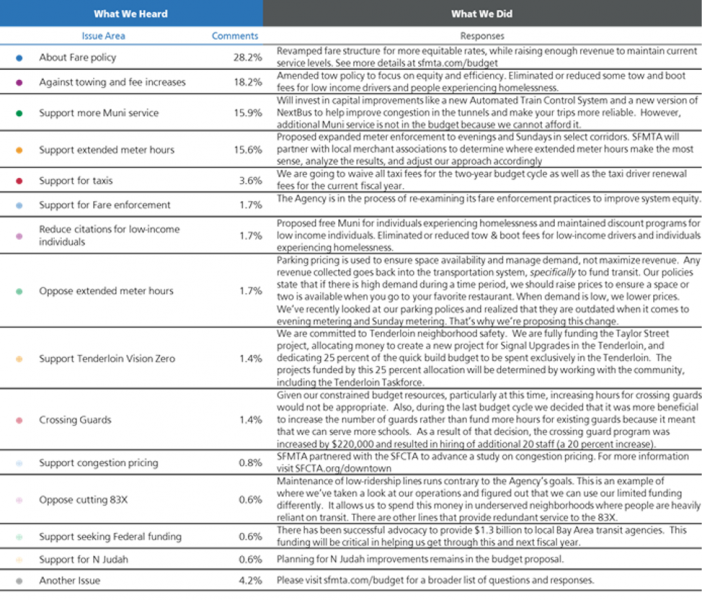
During our outreach and engagement process, we received hundreds of postcards, voicemail messages, emails, and mentions on our social media accounts with valuable feedback on our consolidated budget proposal. The issues that we heard the most about included fare policy (28.2%), advocating against increasing towing and fees (18.2%), support for more Muni service (15.9%), support for extended meters (15.6%), and support for taxis (3.6%); see pie chart below. The Agency put together a FAQ to answer many of the questions that we heard most throughout the outreach process.
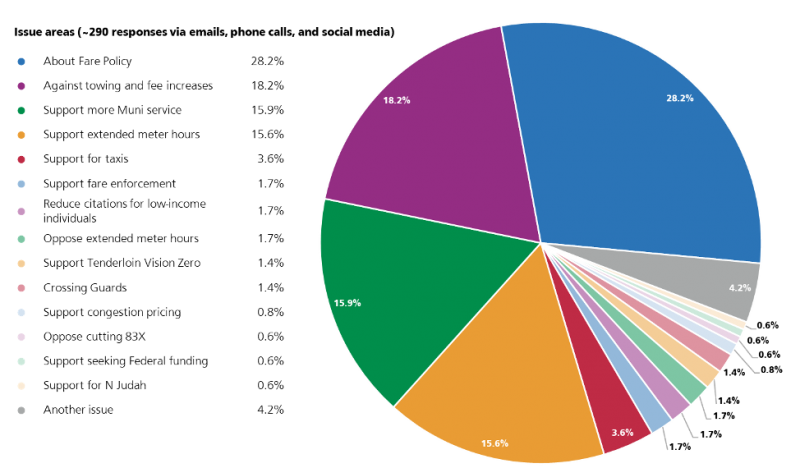
Accessible text version of graphic #1
This feedback informed several key decisions in the proposed budget including addressing equity concerns related to the fare proposal and the tow fees, providing support for the taxi industry, proposing extending parking meter hours, allocating funds to Vision Zero projects in the Tenderloin, increasing fines on safety violations such as parking in a bike lane, etc.. Stakeholder input and discussion informed many of the final Consolidated Budget decisions.
The table below provides a short summary of how the Agency addressed community feedback. More detailed feedback and also be found in the FAQ.
Accessible text for graphic #2
Acknowledgements
We at the SFMTA want to thank you all for your invaluable input. You truly helped to shape the budget we will bring to our Board of Directors on April 21st. The Agency recognizes that we must work to continuously improve our outreach process. We will assess the success of the budget outreach process and welcome your feedback, which you can submit to sfmtabudget@sfmta.com.
Participating Community Partners
|
SFMTA Citizens Advisory Council |
|
Small Business Commission |
|
San Francisco Youth Commission |
|
San Francisco Transit Riders |
|
Budget Digital Town Hall |
|
Paratransit Coordinating Committee |
|
South of Market Community Action Network (SOMCAN) |
|
Market and Octavia Citizens Advisory Council |
|
Chinatown Community Development Corp TRIP |
|
SF Building Owners and Managers Association (BOMA) |
|
SF Chamber of Commerce |
|
SF Council of District Merchants |
|
SF Travel |
|
Young Women’s Freedom Center |
|
Community Housing Partnership |
|
SF Rising |
Published April 21, 2020 at 08:51PM
https://ift.tt/3bvlgqQ
Show HN: Enform – Enjoyable Forms with React https://ift.tt/3bq0UiY
Show HN: I made a Chrome extension to stop mindless browsing https://ift.tt/2KnQx3c
Show HN: Goxygen: A CLI Tool to Generate Web Projects with Go+Angular/React/Vue https://ift.tt/2VQBxAl
Show HN: Transparent Replication and Persistence for POJO Graphs https://ift.tt/2KpuWaK
Slow Streets Program to Help With Social Distancing
By
With Muni service temporarily reduced during the COVID-19 health crisis, many San Francisco residents need to walk and take other modes of transportation to make essential trips. However, sometimes it is difficult to maintain 6’ of social distance on many sidewalks, park paths, and bikeways. This can be especially true when passing lines outside grocery stores and other essential services. Because of this, many pedestrians are choosing to walk in the street, exposing themselves to swiftly moving vehicle traffic. The SFMTA is implementing a new program, Slow Streets, to close some streets to through traffic and allow roadways to be used more as a shared space for foot and bicycle traffic.
Throughout the city, corridors have been identified for Phase 1 Slow Streets. Beginning this week, some of these streets will be closed to through vehicle traffic to prioritize walking/biking and to provide more space for social distancing during essential travel by those modes.
What Will Slow Streets look like?
Vehicle traffic will be allowed, and streets will not be closed completely, local access to vehicles is allowed, (e.g. driveway access for residents.) Slow Streets will not create any legal change in the right of way. People walking/running in the street will not have the right-of-way over motor vehicles but will be allowed to be in the street (as the Calif. Vehicle Code currently permits). The goal is to take advantage of low vehicle numbers on certain travel corridors and allow people to maximize our resources while maintaining social distancing. Slow Streets will be in effect 24/7, given the limited staff resources to deploy/re-deploy equipment daily.
“The purpose of Slow Streets is to manage traffic speeds and create a safe network for essential walk and bike travel while transit service levels are reduced,” said Jeffrey Tumlin, SFMTA Director of Transportation. “Our agency is committed to giving San Franciscans the necessary space to practice social distancing as they leave their homes for critical needs.”
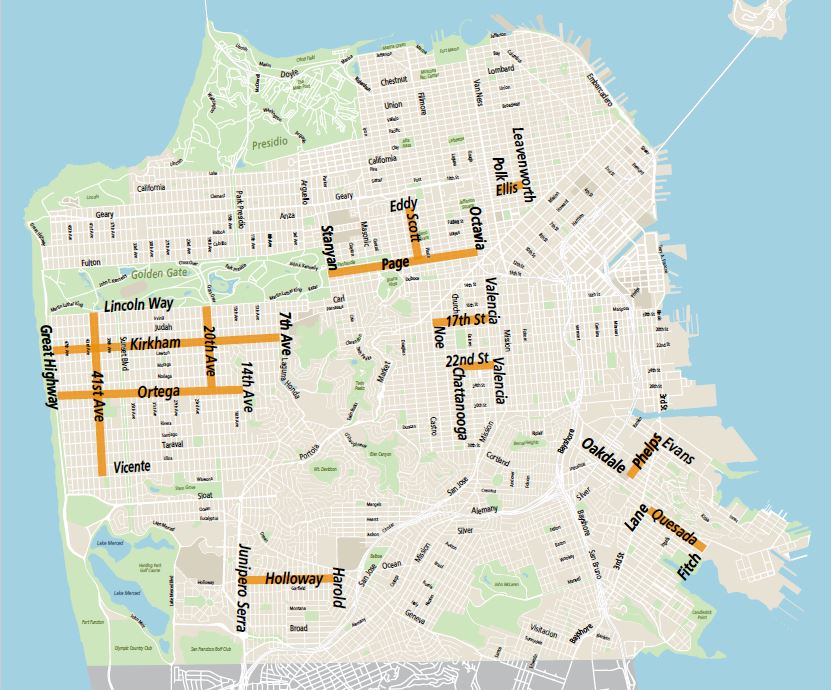
Slow Streets candidates
- Good candidates for a first phase of Slow Streets are shown on the map and in Table 1. These are lower-traffic residential streets that connect neighbors to essential services in the absence of Muni service. They have been vetted for feasibility and exclude Muni routes and major emergency traffic corridors.
- For most Slow Streets, rollout will be incremental and iterative - approximately 8 blocks at a time - and may not initially cover the entire length shown on the map. Careful monitoring will be provided to ensure the transportation benefits of Slow Streets are not undermined by crowding and congregation.
| Street | From | To | Muni Routes |
| 17th Street | Noe | Valencia | 22 Fillmore, 33 Stanyan |
| 20th Avenue | Lincoln | Ortega | 28 - 19th Ave |
| 22nd Street | Valencia | Chattanooga | 48 Quintara |
| 41st Avenue | Lincoln | Vicente | 18 - 46th Ave |
| Ellis | Polk | Leavenworth | 27 Bryant, 38 Geary |
| Holloway | J Serra | Harold | K Ingleside, 29 Sunset |
| Kirkham | Great Highway | 7th Avenue | N Judah |
| Phelps | Oakdale | Evans | 23 Monterey, 44 O'Shaughnessy |
| Ortega | Great Highway | 14th Avenue | 7 Haight |
| Page | Stanyan | Octavia | 7 Haight |
| Quesada | Lane | Fitch | 23 Monterey, 44 O'Shaughnessy |
| Scott | Eddy | Page | 24 Divisadero |
When will these streets be closed?
Beginning this week, we hope to install 2-3 Slow Streets corridors per week. Signage and traffic cones for the first round of streets. We will continue to monitor the use of Slow Streets to minimize impacts on surrounding streets.
How were the Slow Streets corridors chosen?
The streets were chosen to supplement reduced or suspended Muni routes, while providing bicycle and pedestrian access to essential services. Many of these streets run parallel to other major streets and transit routes. The Slow Streets are intended to provide a network of streets that prioritize walking and biking for essential trips.
Slow Streets are one part of the city’s efforts to reduce sidewalk crowding. Other efforts include removing vehicle parking outside grocery stores and restaurants to create extra pedestrian queueing space and widening sidewalks by removing vehicle parking on select high-pedestrian-traffic. Please visit sfmta.com/COVID19 for the latest agency updates.
Published April 21, 2020 at 04:59PM
https://ift.tt/3bt1lce
Show HN: Outro – Retrospectives, Re-Imagined https://ift.tt/3bsnmrG
Show HN: Easy to Understand Software Security Training https://ift.tt/3cN0yDp
Show HN: A super-fast user agent string parser (for Python) https://ift.tt/3cEJNKv
Show HN: My Quarantine Project, The Bell https://ift.tt/2VrzZxF
Show HN: Voiceplace – want multiple convos at the same time in video calls? https://ift.tt/2XSU4OV
Show HN: Pattern.css https://ift.tt/2VIIL9i
Show HN: Vayu – Interactive, no-code data science notebook https://ift.tt/2RRzcUf
الاثنين، 20 أبريل 2020
Show HN: A spoken language inspired by Tom Bombadil https://ift.tt/2XS8yys
Show HN: My lockdown coding project, Legend of the Pink Dragon (IRC game) https://ift.tt/2RU0SIj
Muni Updates: Restoring Some of Our Service
By Erin McMillan
Since April 8, Muni has been operating a COVID-19 Core Service Plan to support essential trips that cannot be made any other way. With fewer operators, car cleaners and maintenance staff available during the shelter-in-place, Muni service has been significantly reduced. Our initial network of 17 key lines was informed by our data on where ridership is highest, our Muni Equity Strategy to provide transportation for those with the fewest options, locations of essential services like hospitals and groceries, and to provide coverage across the city.
Over the past week and a half, SFMTA has seen a small increase in the number of available key personnel, allowing us to expand our service based on ridership trends and public feedback during the pandemic. On April 25, we will be modifying Muni’s Core Service by adding back some modified routes and increasing the frequency of buses on others. This additional bus service was informed by the same criteria as our initial Core network, along with on-the-ground information from operators, riders, and policy makers.
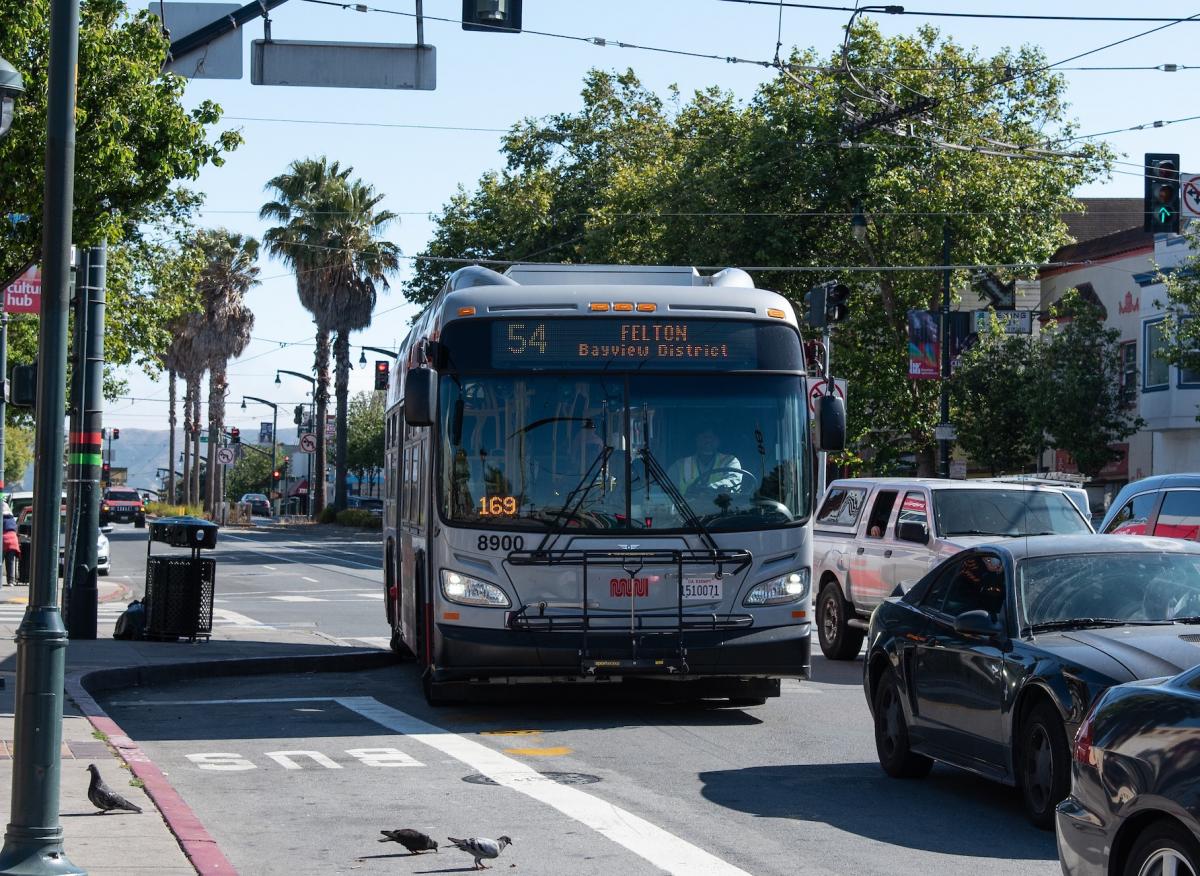
The service additions will increase coverage across the city and connect to additional essential services. To ensure we’re connecting customers who are making essential trips to health care facilities like hospitals, we’re restoring modified service on the 5 Fulton and 28 19th Avenue lines. Segments of the 12 Folsom/Pacific and 54 Felton are also being restored to ensure customers in Chinatown and southeastern neighborhoods have greater access to essential trip locations.
By adding service on heavily used lines of the Core network, it will also help minimize risks to customers and operators by reducing crowding on buses and increasing riders’ ability to physically distance from others.
Muni still serves approximately 100,000 passengers a day – getting nurses, cooks, custodians, and other essential workers to their jobs. We continue to ask San Franciscans’ help by a) complying with the shelter-in-place directive, b) only making essential trips, and c) using alternatives to Muni for essential trips when possible.
In addition to running Core service, the following Muni routes will start service or be adjusted on Saturday, April 25. Please note differences between weekday and weekend service.
5 Fulton
- Local stops between Salesforce Transit Center and Fulton/6th Avenue
- Frequency: approximately every 10-20 minutes (weekdays and weekends)
- Being added to provide connection to St. Mary’s Hospital
9 San Bruno
- Frequency: approximately 6 minutes (weekdays) and 10 minutes (weekends)
- Being added to reduce crowding on buses, increasing riders’ ability to physically distance
12 Folsom
- Shortened route on Pacific between Van Ness Avenue and Battery
- Frequency: approximately every 20 minutes (weekdays and weekends)
- Being added to provide key connections to grocery stores
28 19th Avenue
- Local stops between Geary Boulevard and Daly City
- Frequency: approximately every 20 minutes (weekdays only, no weekend service)
- Being added to provide healthcare worker access between Daly City BART and UCSF Medical Center, Parnassus; creates additional north-south connectivity on west side
38R Geary Rapid
- Weekend service returning (will supplement existing weekday service)
- Frequency: approximately every 10-20 minutes (weekends)
54 Felton
- Adding shortened route between Newhall/Hudson (Bayview/Hunter’s Point) and Balboa Park
- Frequency: approximately every 20 minutes (weekdays only, no weekend service)
- Being added to provide additional east-west connectivity for southeastern neighborhoods
714 BART Early Bird Shuttle
- Shuttle between Salesforce Transit Center and Daly City
- Frequency: one trip departs Daly City at 4:05 a.m. and second trip departs Salesforce Transit Center at 4:45 a.m. (weekdays only)
- Maintaining a connectivity lifeline for early morning service workers
L Bus
- Increasing frequency to 10 minutes or less (weekdays and weekends)
- Being added to reduce crowding on buses, increasing riders’ ability to physically distance
N Bus
- Increasing frequency to 10 minutes or less (weekends)
- Being added to reduce crowding on buses, increasing riders’ ability to physically distance
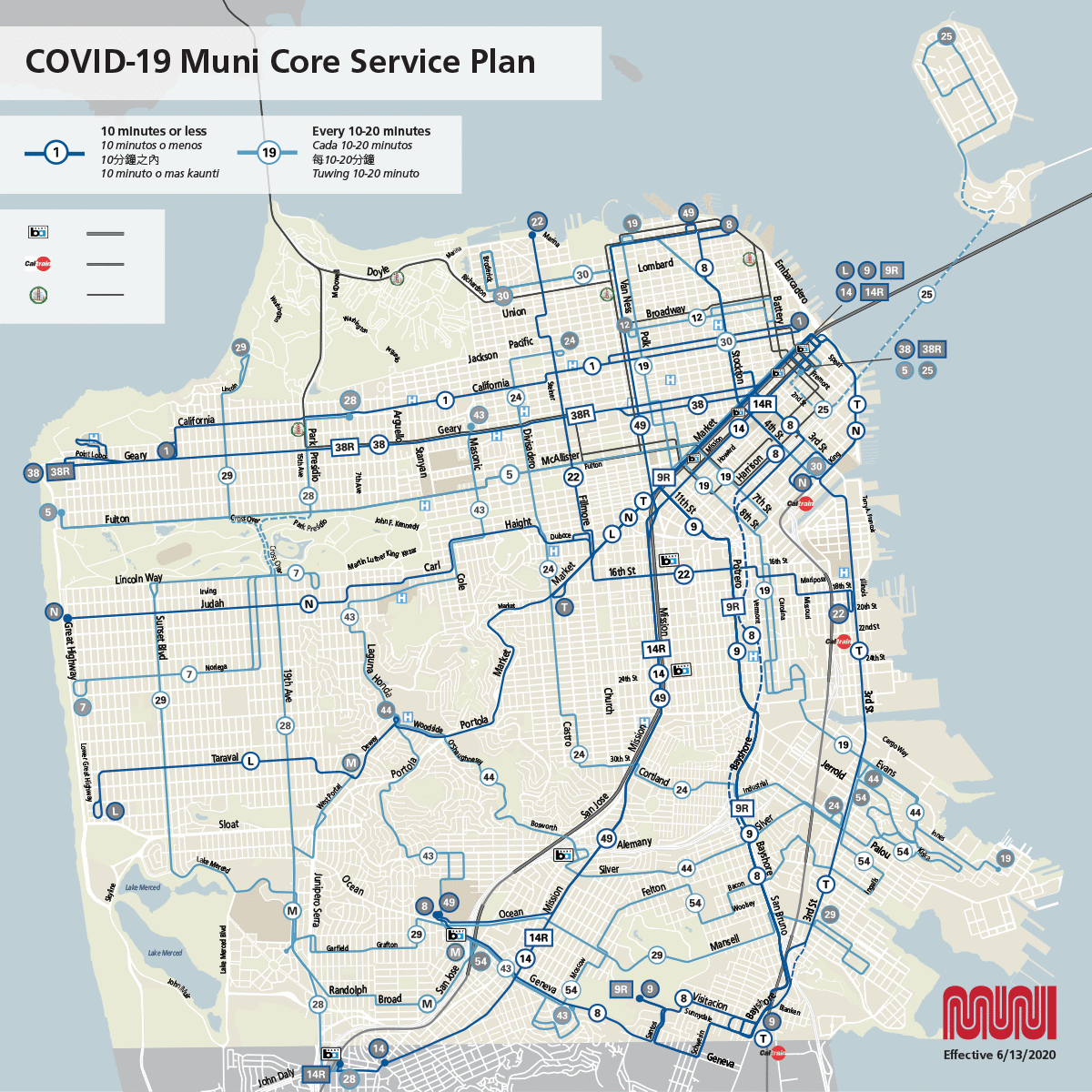
This modified Core Service Plan is in support of essential trips that cannot be made in other ways. We are asking all San Franciscans to help us maintain adequate space on buses for social distancing by staying at home except for essential trips. Staying home or walking, biking or driving instead saves a seat on Muni for those that don’t have other options. You may see some of our staff at select bus stops helping reinforce this message to our customers.
Still need to travel on Muni? Be sure to plan extra time for your trip which now may include transfers and a longer walk. Remember your fare is good for two hours across multiple buses. We have also updated our predictions software to better account for the changes in service - read this blog post to find out more.
Essential Trip Card - A New Way to Get Around
We also know that the recent temporary transit changes are hard for many people with disabilities and older adults for whom walking farther to an alternate bus or paying for other transportation isn’t possible. To address this need, the SFMTA launched the Essential Trip Card Program to help older adults and people with disabilities take and pay for essential trips in taxis during this crisis.
The Essential Trip Card Program provides two to three round trips per month at 20% of the cost of a regular cab ride fare. If you are a 65+ years old or person with a disability, you can apply for the Essential Trip Card by calling 311 and mentioning the program or visiting the program page to learn more.
Stay tuned for additional details about these service changes. Visit SFMTA.com/COVID-19 for the latest information or to explore other ways to get around.
Published April 20, 2020 at 10:11PM
https://ift.tt/2RWzmdk
Show HN: Simple Raycasting Engine https://ift.tt/34PcQZ7
Show HN: Sursis, a Network Notebook https://ift.tt/2VoSUJu
A New Way Of Generating Prediction Times
By
The last month has brought about dramatic changes in virtually all aspects of our lives, including how we use our Muni transit system. When we implemented our Core Service Plan that focused our limited resources on 17 lines that were serving the majority of our customers, we also transitioned our service operation from a schedule-based system to a headway or frequency-based system. This means vehicles depart their terminals at regularly timed intervals instead of at specific times. In so doing, we also had to make adjustments on how this information was processed by NextMuni to generate reliable arrival time predictions.
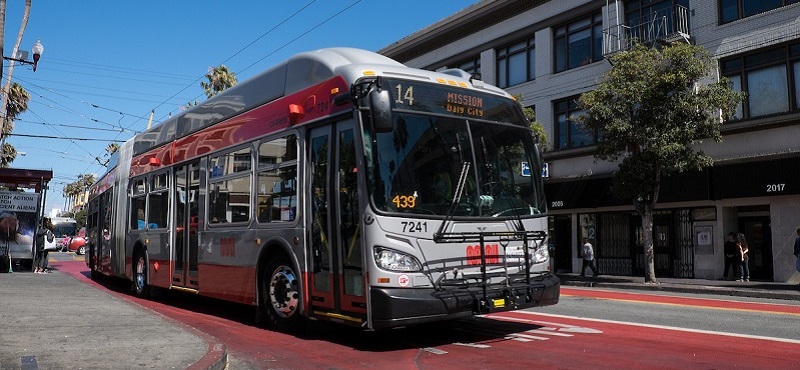
Up until now, if a Muni vehicle departed the terminal before its scheduled departure time, it would register on NextMuni as being on break and would not generate predictions, even though it was on its regular route. When we transitioned to a headway-based system, and as the buses experienced fewer delays on their routes, we started to see a lot of these vehicles depart before their scheduled times. The stopgap solution has been for a small but dedicated team in our Transit division to manually reassign these early departure vehicles within NextMuni, thereby allowing this system to generate predictions. Recently this team has been making about 300 such reassignments per day. This was neither efficient nor sustainable.
Working with our NextMuni vendor, we were able to modify the prediction software to better handle this situation. When generating predictions, the software will now basically disregard any scheduled times and instead rely only on the vehicle’s location.
With this change, arrival time predictions will now only become available once a vehicle has left the terminal. What this means is that if you are waiting at a stop, especially stops near the beginning of the route, you may see “No Prediction Available” when you check either the bus shelter display (should one be available) or NextMuni’s online predictions. This will mean that a vehicle has not yet departed the terminal. In this case, please check either our website or that bus shelter’s display to see the frequency for that particular route. Our website also has a live map which will show the location of each bus on the route, including those at the terminals that are not yet generating predictions. Simply use www.sfmta.com/the letter or number of the Muni route you want to check (For example, www.sfmta.com/22 takes you the live map for the 22 Fillmore.
While this is not ideal, our other option was to make no change and have vehicles operating in service without generating predictions at all. The current changes will make sure most vehicles have predictions most of the time. Another benefit of this change will be that prediction times will now only reflect an actual vehicle that is in service, thus eliminating the dreaded “ghost bus,” which has been the bane of many transit riders.
Please note that our Core Service Plan operates daily from 5 a.m. to 10 p.m. Between 10 p.m. and 5 a.m. our Owl Service Plan is in operation. Frequency times on each of the 10 Owl routes in service will be about 30 minutes. Please visit our Owl Service Plan webpage for further details.
Our team continually reviews the performance of our prediction system and suggests changes when they believe it will result in more accurate information to our riders. In addition to that continuing effort, we are in the process of rolling out a Next Generation Customer Information System as the replacement to NextMuni. When deployed, this new system will allow us to provide more reliable information to our riders, including being able to generate more reliable predictions near the terminals.
For more updates on all SFMTA services during this public health crisis, please visit SFMTA.com/COVID19.
Published April 20, 2020 at 08:20PM
https://ift.tt/2z9IGUq
Show HN: Slack Video Chat Roulette https://ift.tt/3bkA8s6
Show HN: Free tool to draw database diagrams using code (Database as Code) https://ift.tt/2Ki7bkz
Show HN: Silk, a simple systems programming language https://ift.tt/2XNgMbf
Show HN: SpacedTime – Remember the important things in your life https://ift.tt/2VmbAcE
Show HN: News Extract API – Pull structured data from online news articles https://ift.tt/2RN7EQ7
Show HN: Pathtracing Neon Landscapes in R https://ift.tt/2VOMmTw
Show HN: ETL and EDA on the Covid-19 global datasets using pandas and matplotlib https://ift.tt/3as65NL
Show HN: Lidia – Short and handy Wikipedia audio summaries https://ift.tt/3czuC5e
Show HN: The Gives – Watch videos with friends https://ift.tt/2VohTfQ
Show HN: Netpeek – Application Layer Sniffer https://ift.tt/2VOzRY6
Show HN: N-gram API based on Google Ngram dataset https://ift.tt/3eAOmHl
الأحد، 19 أبريل 2020
Show HN: Extract a .app from the macOS Zoom Installer to Drag to /Applications https://ift.tt/34PFfxU
Show HN: Create and Render 3D models in Go https://ift.tt/34ZsIZb
Show HN: Pxy – A Go server that proxies websocket livestreams to RTMP servers https://ift.tt/2Voar4y
Show HN: A programmable tooltip on Mac OS https://ift.tt/2VmvhRz
Show HN: Stream your pen/paper, explain remote students super effectively https://ift.tt/2RQPGfI
Show HN: Toe Codes – QR codes with the domain in the code pattern https://ift.tt/2ynxGT7
Show HN: Box Line Text – A simple whiteboarding tool for screencasts https://ift.tt/2VjkMi4
Show HN: Brök – Find broken links in text documents https://ift.tt/2VEk65P
Show HN: Manticore – Static site generator in Python https://ift.tt/3evaJ0S
Show HN: Teddy Bear Tracker iOS App https://ift.tt/34MIiHn
Show HN: Strainer, Rust CLI for finding duplicate code in a project https://ift.tt/2Vj8BBG
Show HN: A tiny, static AMD API implementation https://ift.tt/2VDyvz6
Show HN: Stream your pen/paper, explain remote students super effectively https://ift.tt/2zdFYgQ
Show HN: Chatparty – host videochat parties with no audio https://ift.tt/2XPdS5B
Show HN: Atbswp, a Minimalist Macro Recorder https://ift.tt/2VFqQAf
Show HN: Monte Carlo ray tracer in Rust https://ift.tt/3arpIG5
Show HN: Dialogflow for Web – the Dialogflow Web Integration you were missing https://ift.tt/2XPvqP8
Show HN: I made a Chrome Extension that replaces new tab into a done tasks list https://ift.tt/2KfRaf7
Show HN: Errorship, use datadog as an error tracker https://ift.tt/3aozZTc
Show HN: Minimal Recipe – Recipes without the bloat https://ift.tt/2ROJVyK
Show HN: I made a Flipper plugin for redux and React Native https://ift.tt/3exWk46
السبت، 18 أبريل 2020
Show HN: Codelift – A “No Code” GUI for Your React App https://ift.tt/2xFwF8X
Show HN: Universal Tone Generator – A Generative Music Experience https://ift.tt/3eBRyTk
Show HN: Real Networking at Virtual Place https://ift.tt/2RPkY6n
Show HN: I made a multiplayer web game with Elm https://ift.tt/2XLDekZ
Show HN: Sheets Add-On for Monte-Carlo Simulations https://ift.tt/3eAz7y0
Show HN: Explore Wikipedia edits made by institutions, companies and governments https://ift.tt/3bkQDV9
Show HN: Shishua – Fast pseudo-random generator https://ift.tt/2VmHyFT
Show HN: Vault on AWS – A Terraform Project for Secrets Management Anywhere https://ift.tt/2Vioc4p
Show HN: Open-Source GitOps Framework for K8s Based on Terraform and Kustomize https://ift.tt/3bkQxg1
Show HN: An Emulator in JavaScript (That Interfaces with Multiple UIs) https://ift.tt/2xxy2Xo
Show HN: A tool for visualizing your YouTube watch history https://ift.tt/2Vh792W
Show HN: Gentle is a social app where you give and get kindness (TestFlight) https://ift.tt/3blUfpP
Show HN: VimTricks, a Vim Email Newsletter https://ift.tt/3bkWKbV
Show HN: A place that lists free games https://ift.tt/2wTiblA
Show HN: Changelog Generation Tool https://ift.tt/2z6GM6Z
Show HN: I've been writing TILs for 5 years https://ift.tt/3alscFL
Show HN: TypeScript language plugin gives superpowers to SQL tagged strings https://ift.tt/2KeluGZ
Show HN: Running Your Own Read Later Service with Raspberry Pi and Pinboard https://ift.tt/2KhfRIc
Show HN: Gact Store https://ift.tt/3ai54Ib
Show HN: Interactive 3D Tour of a San Francisco Skatepark Created on a Phone https://ift.tt/2RPhTTQ
Show HN: Find out if you are getting paid fairly and help to reduce pay inequity https://ift.tt/34Lucpv
الجمعة، 17 أبريل 2020
Show HN: Plain Old Recipe: convert online recipes to plain-text https://ift.tt/2KejYEP
Show HN: Infstream – We’re trying to fix video monetization for creators https://ift.tt/34Rcd11
Show HN: Random Poetry from Reddit Posts https://ift.tt/3cm3wye
Show HN: Play Fishbowl at your next virtual hangout (free, open source) https://ift.tt/3eschJb
Show HN: JWT terminal tool https://ift.tt/2KcmE5E
Show HN: Free Movies https://ift.tt/2VHf9ci
Show HN: Covid ICU Bed Tracking – In Production on 130 ICUs https://ift.tt/2Kb2YiI
Show HN: Chrome extension that notifies you when new technology products launch https://ift.tt/34JoV1O
Show HN: I made an API to generate social media images https://ift.tt/2RKh0w3
Show HN: Encrypted, synced, offline first todo list https://ift.tt/2VgZmSJ
Show HN: A basketball hoop to maximize shots that go in [video] https://ift.tt/2Kg4HTQ
Show HN: Mobile 3D group video chat with spatial audio for friends and events https://ift.tt/3exXEUo
Show HN: I built an actual Chaos Monkey for Kubernetes https://ift.tt/3bdfpXb
Show HN: Python package to create HQ images programmatically with templates https://ift.tt/2wRQyJG
Show HN: Zoomerbackgrounds.com – community sourced virtual video backgrounds https://ift.tt/3ajbw1s
Show HN: A Parallel Implementation of Graph2Vec https://ift.tt/2RMxjbE
Show HN: Sound visualisation, better than FFT (iOS) https://ift.tt/3ewKrLx
Show HN: Graphite – Create apps from GraphQL APIs without writing code https://ift.tt/34GXwO4
Show HN: Ulist – a mailing list service (like mailman) that keeps it simple https://ift.tt/2Vij3tj
Show HN: I made a website to check Growth rate and Doubling days of Covid-19 https://ift.tt/2VE1Qcy
Show HN: Site built with Vue.js to write a story of your project or startup https://ift.tt/2RHovDO
الخميس، 16 أبريل 2020
Show HN: AWS Transcribe and OBS = real-time subtitles https://ift.tt/3bfUyCJ
Show HN: Play Hearts – Open-source, made with Vue and web sockets https://ift.tt/3bidFf9
SFMTA Budget: Policy Objectives and Funding Priorities
By
This is the third in a series of blogs exploring the San Francisco Municipal Transportation Agency’s (SFMTA’s) budget process and proposal for Fiscal Years 2021-2022. The first blog provided a high-level overview of the budget process, while the second discussed the state of our projected revenue and expenditures and how they inform budget development. This post will discuss our policy objectives and funding priorities for Fiscal Years 2021-2022 based on the latest proposals that SFMTA staff have put forward. Future blog posts will include content on:
- Overview of our outreach
- The adopted Consolidated budget and what it includes
Introduction
The previous blog post described the foundation of the Operating and Capital Budgets; the funding necessary for daily operations, equipment, and infrastructure maintenance. This post will discuss the policy proposals & funding priorities above and beyond current service levels. Funding the current service levels comprise most (98%) of the budget. These generally include: employee salaries and benefits, professional service contracts for services, like the maintenance of our bus shelters, that aren’t directly provided by SFMTA staff, and materials and supplies like bus tires or fuel. It is imperative that we continue providing these services to meet the Agency’s Strategic Plan Goals:
- Create a safer transportation experience for everyone
- Make transit and other sustainable modes of transportation the most attractive and preferred means of travel.
- Improve the quality of life and environment in San Francisco and the region.
- Create a workplace that delivers outstanding service
As noted in the previous blog post, the Agency faces a structural deficit, meaning that our projected revenue will not keep up with the projected expenditures necessary to provide daily service. So, while the suite of policy proposals discussed in this blog will help us improve and expand services, they will also help us address this deficit. These proposals are rooted in our values of creating a safe transportation system, advancing equity, decarbonizing, and creating a workplace culture that delivers excellent customer service.
Fare Policy
Our budget process began in January and, over the past three months, we have worked hard to ensure an open discussion with the public about San Francisco’s needs, priorities, and the trade-offs that would be required; and to gather feedback through multiple channels so they could be involved in and inform the outcome.
We launched a comprehensive, multilingual public outreach campaign at the beginning of the budget process to gather and consider public input on the budget and the proposed fare changes. As part of that outreach campaign, we received over 300 questions, comments, and concerns, many of which were focused on fares.
We began with our Automatic Indexing Policy, increasing all of our fares as a result of increases in both Consumer Price Index (CPI) and Labor Costs. The implementation of a fare indexing policy allows Muni to raise fares incrementally, rather than holding constant in good times, and increasing above cost of living to help cover budget deficits in economic downturns. Allowing fare revenue to rise in relationship to increased operating costs also allows the SFMTA to invest in the system and increase service.
Some people have questioned whether the SFMTA should raise fares at all, especially given the fact that fares have doubled in the last 10 years.
While this is true, it is important to note that for the previous 10 years, Muni fares were held constant while the economy was strong. Moreover, fares represent a significant percentage of our budget (almost 20 percent). Although the current public health emergency creates uncertainty about our future revenues, we project that not raising fares would mean a loss of $15 million dollars annually. While this seems like a relatively small amount in the context of our overall budget, it does mean that the agency would need to cut programs and services by that amount. For example, because our transit operating expenses are about 60% of the total budget, a revenue loss of $25 million, proportionally reducing all programs and services at the SFMTA, would mean a 3 to 5% transit service reduction and would remove up to 140 operators from service.
Cutting transit service and/or other programs is a bad idea at a time when: we’re seeing significant population growth in the region and one of the Mayor’s top priorities is to build more housing; the need to support sustainable modes of transportation is undeniable given the climate change we’re experiencing; and the need to maintain our infrastructure in a state of good repair is the long-term fiscally responsible thing to do.
So, not increasing fares is NOT a strategic option that considers the trade-offs between short-term gains and long-term consequences.
In order to create a more equitable system, we must prioritize better service and more accessible service through our low- or no-fare programs. Our goal is to create a budget that recognizes the trade-offs that we face and best advances our values. This is why we are proposing free Muni for all youth and for individuals experiencing homelessness.
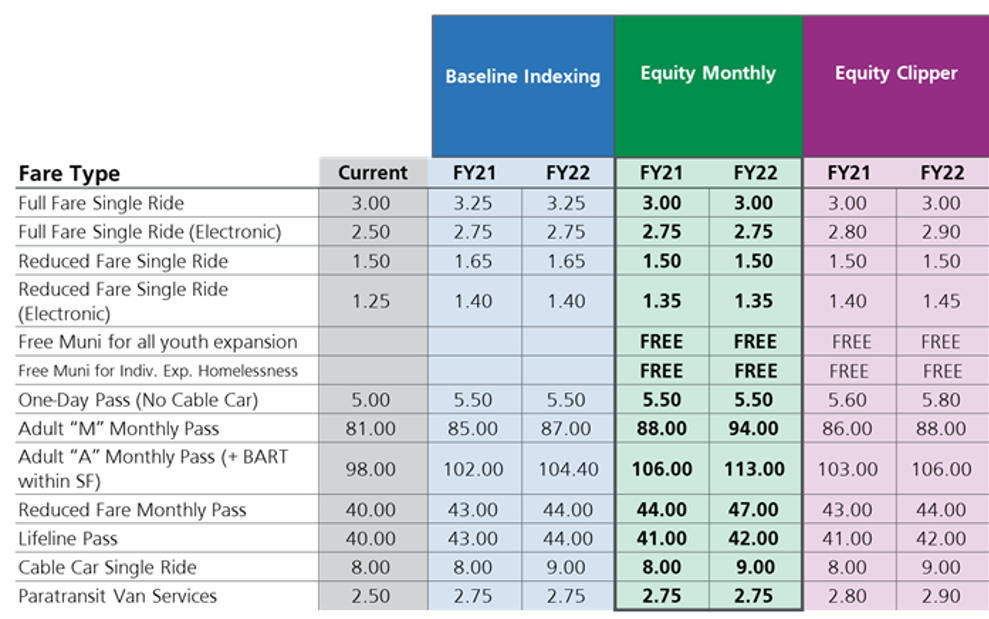
In response to calls to pause fare increases or to eliminate fares altogether, and with an eye on our funding gap and keeping proposals revenue neutral, we developed two equity-driven proposals that asks San Franciscans who are able to pay, to pay a little more to help our more vulnerable populations who are reliant on transit for employment and other essential needs like healthcare and getting kids to school.
Both fare proposals provide free Muni for all youth under the age of 19 and for individuals experiencing homelessness, and do not raise fares for Cash Fare Single Rides or Reduced Fare Single Rides.
The Equity Monthly Option places the cost burden largely on monthly pass holders to avoid increases in the cash fare and adjusts our Lifeline Pass to be increased by Social Security Income (SSI), rather than inflation (CPI).
The Equity Clipper Option places the cost burden on the monthly pass holders and on riders paying the full single ride fare electronically by reducing—but not eliminating—the discount between the electronic fare and the cash fare.
We are recommending the Equity Clipper Option to our Board, as it distributes the cost burden between a number of fare mediums and supports a more overall equitable fare policy. If this option is approved by our Board:
- About 72% of all riders would be impacted by fare increases, based on the 2017 on-board survey, but not all fares would be increased equally.
- All proposed fare increases would impact 55% of minority riders and 34% of low-income riders.
- All proposed fare decreases would benefit 63% of minority riders and 57% of low-income riders.
- Low-income riders use cash fares at higher rates than they use electronic fares. Cash fares for Adults, Seniors, and Disabled single rides will remain the same.
- Low-income riders make up only 28% of our Monthly Adult Passes, compared to 53% of our overall ridership.
- Free Muni will also continue to be available for Seniors and People with Disabilities, for which we have set a much higher threshold to align with MOHCD at 100% of Bay Area Median Income ($123,150 for a family of four).
- Lifeline monthly passes are available for those riders who are at 200% of the federal poverty level. Fares are discounted at half off regular fares and will be increased at the lower SSI rate: $1 for monthly passes and $0.10 for single rides per fiscal year, a smaller increase.
- In addition, beginning this year, the SFMTA will be offering a 50% discount on single ride fares to meet the needs of those who can’t afford, or may not need, a monthly Lifeline pass as part of the SMART regional pilot program.
- We will also be studying the option of moving from monthly passes to fare capping to enable those who cannot afford the up-front cost of a monthly pass to pay as they go.
Fare Proposals: April 2020 Selected
Transit Service
Based on the recommendations of the Muni Reliability Working Group, the Agency is proposing to hire 88 full time employees for system management, maintenance, and planning. Primarily, this includes 30 Transit Operators to support the opening of Central Subway. Other critical staff will:
- Support transit operations,
- Increase training functions that increase reliability and support trainers and supervisors,
- Provide strategic vehicle maintenance,
- Support subway reliability, continue regular extended maintenance shutdowns, and
- Support Central Subway testing and opening
These proposals represent only an initial investment in the Muni Working Group’s entire set of recommendations. Due to the previously discussed structural deficit, we have scaled back proposals for transit supervision and near-term maintenance improvements and are not recommending a 6% service expansion by FY 2022.
Curb and Congestion Management
In addition to fares, SFMTA is also recommending policy changes to parking pricing. These proposals arose from community feedback, supported by data on parking space availability, that the Agency needs to increase efforts to manage the curb and congestion. Our parking policy proposals have several main components:
1. Modernize Parking Meter Hours: Evening Option and Sunday Option.
Parking pricing is used to manage demand and ensure space availability, not maximize revenue. Any revenue collected goes back into the transportation system, specifically to fund transit.
Since 2011, the SFMTA has operated a demand-responsive parking pricing system: if demand is high, we raise prices to ensure a space or two is available when you go to your favorite restaurant (which hopefully will be soon when the Shelter in Place Order is lifted). When demand is low, we lower prices.
We recognize that increased parking prices could mean less demand from more price-sensitive drivers, many of whom are low income. As part of any proposal we will need to address equity concerns, including maintaining access by continuing to provide quality alternatives, like transit.
We’ve recently looked at our parking polices and realized that they are outdated when it comes to evening metering and Sunday metering. We know that the demand for parking in commercial corridors during the evenings is high. That’s why we are proposing extending the time that meters are enforced beyond the standard 6 pm end time.
We won’t be doing this city-wide immediately; we’ll partner with local merchant associations to determine where extended meter hours make the most sense and see how it works, particularly given the current economic challenges related to the pandemic.
We’re also considering enforcing meters on Sundays, where we’d follow a similar community- and data-driven process to make sure it works for our residents, businesses, and visitors. In 2014, San Francisco's meters charged on Sundays--as a result, parking availability increased significantly, which allowed folks visiting our commercial neighborhood to find parking.
2. Raise the maximum variable parking meter rate by $1 per year to a maximum of $9 per hour in FY 2021 and a maximum of $10 per hour in FY 2022.
The current maximum rate for demand responsive pricing is $8 per hour[1]. This policy is a response to the demand for parking and ensures that parking spaces are regularly accessible to commercial corridor patrons and disabled placard users during business hours. A relatively small percentage of meters in the City operate at the maximum hourly cap.
In addition to updating parking pricing policies, the Agency also recommends the hiring of 66 more Parking Control Officers (PCOs) to manage congestion. This will be a 20% increase of our current staff of 300 PCOs who are responsible for enforcing several safety and quality of life violations like double parking, school zones, bike lanes, and blocked driveways. They are also responsible for traffic control, known technically as a ‘fixed post’. Fixed post is when a PCO stands at an intersection and directs traffic. This is a critical job for reducing congestion and increasing safety by, for example, making sure cars don’t block the box. Just as importantly, many fixed-post PCOs facilitate movement of transit. So, adding more PCOs will increase our ability to:
- Support multi-modal safety and neighborhood/commercial corridor needs;
- Keep the city moving by managing traffic congestion and supporting transit operations; and
- Respond to increased demand for services.
Transit Safety
Driven by overwhelmingly positive public feedback, the Agency is proposing to hire 20 more employees for the Muni Transit Assistance Program (MTAP). MTAP staff are community members who are trained in conflict resolution, and ride on specific transit lines with high incidences of graffiti and youth conflict. They focus on supporting our schools and young people, by working to diffuse and deter any conflicts or acts of vandalism and assist transit operators as needed. MTAP staff do not enforce fare payments, their purpose is to further the safety of youth and other Muni riders.
Vision Zero
The City and County of San Francisco adopted Vision Zero in 2014, committing city agencies to build better and safer streets, educate the public on traffic safety, enforce traffic laws, and adopt policy changes that save lives. The goal of this collaborative, citywide effort is to create safer, more livable streets as we work to eliminate traffic fatalities.
Supporting the Capital Budget, voters approved the use of Prop D Ride-Share Business Tax as a revenue source, with $15 million estimated annually for street safety projects. Staff are proposing expanding existing programs by using the funds evenly for:
- the new Quick-Build Program, especially protected bicycle facilities or projects on the High Injury Network; and
- signal hardware upgrades, especially signal modifications (new mast arms, poles, visibility) in Communities of Concern[2] and/or on the High Injury Network[3]
Additionally, staff are recommending that the Agency ensures ongoing funding and support of the Vision Zero Education and Outreach Program and Safe Routes to School in the Operating Budget. These programs focus on encouraging behavior change through education, complementing engineering programs and enforcement efforts. They also support the City’s children and families by building a coordinated framework to provide safe and effective options for school transportation. Creating a consistent funding source will increase outreach and education campaigns on safe driving behaviors and maintain the importance of realizing our Vision Zero goal of eliminating traffic fatalities.
Internal Capacity
While SFMTA has grown and added staff in recent years, we have not hired enough Human Resources (HR) employees to keep up with hiring needs. Not including Operators (who have a different recruitment pipeline), the Agency currently has 824 vacant positions out of 4,270, with one analyst for every 118 vacant positions. This has contributed to a number of issues, including that it takes 165 days on average to fill a typical position. To begin addressing this and other HR concerns, the Agency is proposing to add 13 positions to our Human Resources Division to support increased administrative needs, talent acquisition, examinations, leave management, and merit and comparability analyses.
In addition to meeting HR needs, SFMTA staff are also focused on strengthening morale and wellness through enhanced employee engagement and support, and a more diverse, inclusive, and equitable workforce.
To achieve these goals, the Agency is proposing to create an Office of Race, Equity and Inclusion to address inequities in our workplace and services, prioritize those who have the most need in every decision, and ensure just outcomes for all people.
Over the past month, COVID-19 has significantly impacted our community and dramatically altered the SFMTA’s financial outlook. Although this sudden change had an impact on our budget proposal, we maintained as many of the policies and proposals developed with help from public input as we could. However, we will be monitoring both our revenue and our expenditures closely, and we are committed to staying within our means. We can expect that the financial outlook will change over time and we will be making adjustments to the budget accordingly. We will report regularly to the public and the SFMTA Board during the course of the budget period on measures that we are taking to manage our finances.
We at the SFMTA want to thank you all for your invaluable input. You truly helped to shape the budget we will bring to our Board of Directors on April 21st. We encourage you all to tune in to SFGovTV to watch the meeting. You can also call in during the public comment portion of the meeting to share your opinions directly with the Board.
Coming up next in our series: Overview of our outreach
[1] Only 0.02% of metered streets are currently at the maximum $8, so this change only applies to a very narrow set of meters.
[2] San Francisco’s Communities of Concern include a diverse cross-section of populations and communities that could be considered disadvantaged or vulnerable now and in the future. Communities of Concern can have high levels of households with minority or low-income status, seniors, people who have limited English proficiency, people who have disabilities, and more.
[3] The 13% of all SF streets where 70% of severe and fatal collisions with pedestrians and cyclists occur
Published April 17, 2020 at 12:59AM
https://ift.tt/2VykEKl